DDDMUC/dsh-free-search
36 search engines, zero API keys, one DeepSeek Harness plugin
dsh-free-search decouples DeepSeek Harness's web search from the official DeepSeek API key — and quietly accumulates a whole search toolkit along the way.
Collecting fresh signals — velocity needs a few days of history.
collecting data…
star history
What it does
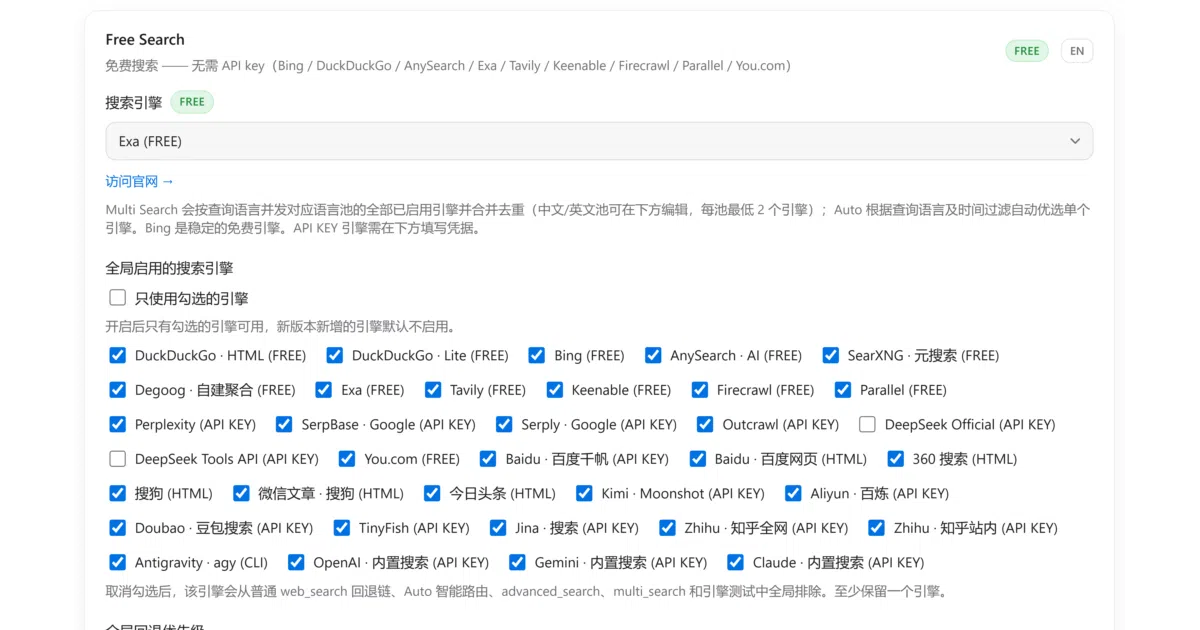
It’s a plugin for DeepSeek Harness (dsh) that registers itself as the web_search provider via the official WebSearchProvider seam. The motivation is specific: dsh’s built-in search requires DEEPSEEK_API_KEY, so third-party model users either get no search at all, or get silently billed through their DeepSeek account. This plugin offers 36 engines — DuckDuckGo, Bing, SearXNG, Baidu, Zhihu, arXiv, and many more — with a default fallback chain covering 28 of them, so a search never just fails.
The interesting bit
The failure handling is unusually thoughtful for glue code: quota/auth errors cool down that engine for the session, bot-walls cool down the whole HTML-SCRAPER family for 10 minutes, timeouts retry once, and parse failures don’t cool down anything. Multi-key rotation is per-key, cooldowns persist to disk, and a diagnostics panel tells you exactly why each engine is currently unavailable. Someone got rate-limited one too many times and turned it into engineering.
Key highlights
- Zero-cost engines work with no key or registration; paid ones (Exa, Tavily, etc.) still get tried since several offer keyless free tiers
Multi Searchmode fans out all engines in the query’s language pool concurrently, dedupes by eTLD+1, with a shared 30-second budget- Beyond search:
web_fetchwith SSRF protection, platform search (GitHub, Reddit, HN, Bilibili…), 41 keyless vertical sources, and aresearchtool that produces cited Markdown evidence packs - Prompt-injection defense: untrusted web text wrapped in
<untrusted-web-content>boundaries, snippets cleaned and truncated to 300 chars - 5-minute LRU result cache (50 entries) to spare free engines from rate limits
Caveats
- The 5 HTML-SCRAPER engines (Baidu, 360, Sogou, WeChat, Toutiao) are off by default — they scrape pages, trigger captchas, and cool down your entire egress IP for 10 minutes when they do
- Multi mode multiplies quota consumption; the README says so itself
cache_searchneeds Node ≥ 22.13 (or an experimental flag) fornode:sqlite, otherwise it silently no-ops
Verdict
If you run DeepSeek Harness without an official key — or you’re tired of invisible billing when using third-party models — this is a genuinely useful fix. If you don’t use dsh at all, it’s a well-documented curiosity about how to build a resilient search abstraction.
Frequently asked
- What is DDDMUC/dsh-free-search?
- dsh-free-search decouples DeepSeek Harness's web search from the official DeepSeek API key — and quietly accumulates a whole search toolkit along the way.
- Is dsh-free-search open source?
- Yes — DDDMUC/dsh-free-search is open source, released under the MIT license.
- What language is dsh-free-search written in?
- DDDMUC/dsh-free-search is primarily written in JavaScript.
- How popular is dsh-free-search?
- DDDMUC/dsh-free-search has 1k stars on GitHub.
- Where can I find dsh-free-search?
- DDDMUC/dsh-free-search is on GitHub at https://github.com/DDDMUC/dsh-free-search.