Coobiw/MPP-LLaVA
Pipeline parallelism for the GPU-poor: multimodal Qwen on RTX 4090s
It squeezes 8B and 14B multimodal model training onto RTX 3090/4090 cards using DeepSpeed pipeline parallelism.
Not currently ranked — collecting fresh signals.
star history
What it does
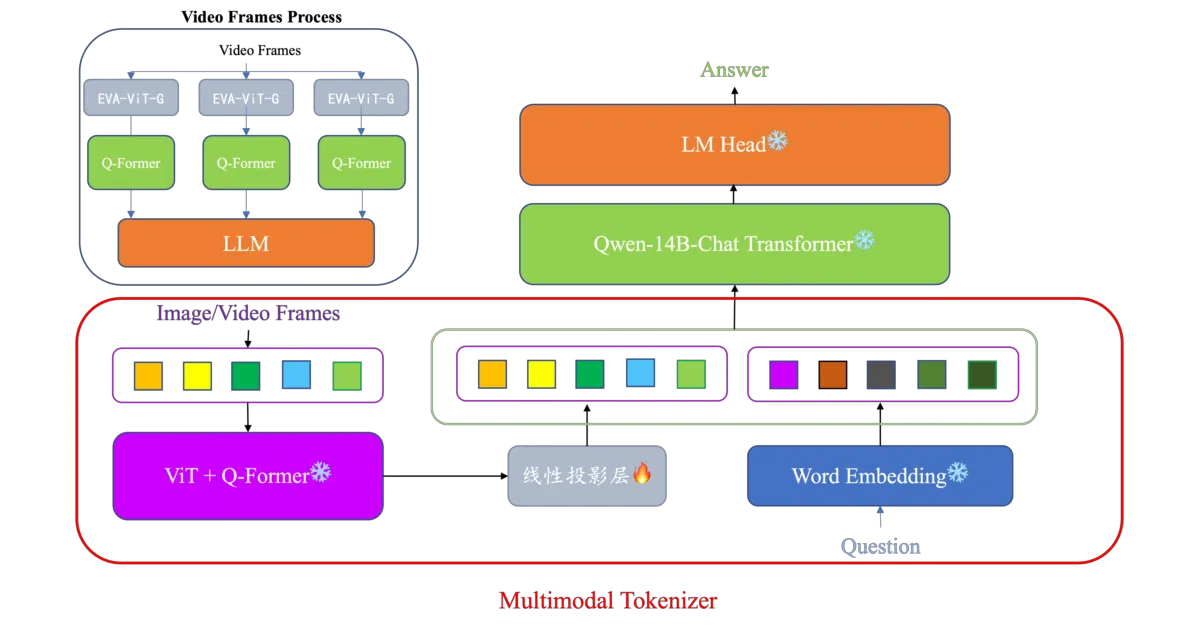
MPP-LLaVA is a personal training and inference stack for Qwen-based multimodal large language models that handle images, video, and multi-turn dialogue. It follows the LLaVA two-stage recipe—pretrain a projection layer, then supervised fine-tune the full language model—but wraps the process in DeepSpeed pipeline parallelism to fit on consumer hardware. Under the hood it is largely glue code: Salesforce LAVIS provides the BLIP-2 vision backbone, QwenLM handles the text, and LLaVA/VideoChatGPT data provides the supervision.
The interesting bit
The real trick is sharding the model across 24GB VRAM cards with pipeline parallelism, turning an enterprise-grade training job into something you can run on a handful of RTX 3090 or 4090 cards. The author also notes an emergent capability: after video fine-tuning, the model gains multi-image comparison skills despite never seeing dedicated multi-image training data.
Key highlights
- Trains 8B/14B multimodal models on RTX 3090/4090 GPUs via DeepSpeed pipeline parallelism (PP+DP)
- Supports image Q&A, multi-turn dialogue, and video conversations; multi-image understanding emerged after video SFT without specific multi-image training
- Built atop LAVIS and QwenLM, using BLIP-2 vision components and LLaVA’s pretrain-then-SFT paradigm
- Released SFT weights (~15 GB) and preprocessed datasets, currently hosted on ModelScope and Baidu Netdisk
- Offers both CLI and Gradio demos, with multi-GPU inference via
device_map="auto"
Caveats
- Hugging Face
transformersintegration is still on the TODO list, so don’t expect a standard HF workflow yet - Weights and datasets are distributed through ModelScope and Baidu Netdisk, which may be less convenient depending on your region
- The README warns that absolute paths are sometimes required to avoid file-path errors, suggesting the tooling can be finicky
Verdict
Grab this if you want to experiment with training large multimodal models on local consumer hardware and don’t mind wrestling with a patchwork of upstream tools. Pass if you need a polished, standalone framework with Hugging Face ecosystem integration.
Frequently asked
- What is Coobiw/MPP-LLaVA?
- It squeezes 8B and 14B multimodal model training onto RTX 3090/4090 cards using DeepSpeed pipeline parallelism.
- Is MPP-LLaVA open source?
- Yes — Coobiw/MPP-LLaVA is an open-source project tracked on heatdrop.
- What language is MPP-LLaVA written in?
- Coobiw/MPP-LLaVA is primarily written in Jupyter Notebook.
- How popular is MPP-LLaVA?
- Coobiw/MPP-LLaVA has 691 stars on GitHub.
- Where can I find MPP-LLaVA?
- Coobiw/MPP-LLaVA is on GitHub at https://github.com/Coobiw/MPP-LLaVA.