Canner/wren-engine
Archived: the semantic engine that taught AI agents business context
A Java/Rust context layer that let LLMs reason over metrics and relationships instead of guessing SQL joins—now merged into WrenAI.
Not currently ranked — collecting fresh signals.
star history
What it does
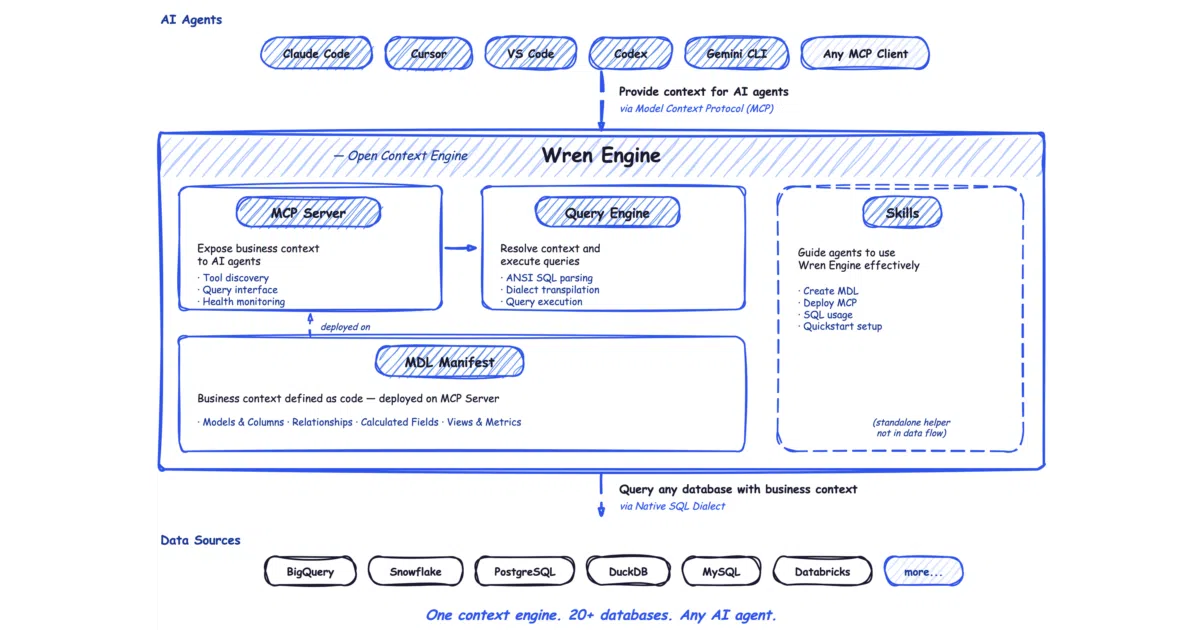
Wren Engine sat between your data warehouse and AI agents, translating raw tables into business concepts. You modeled your domain in its Modeling Definition Language (MDL); the engine then handled query planning, governance rules, and MCP-based agent access across 17+ connectors including Snowflake, BigQuery, DuckDB, and Spark.
The interesting bit
The core was a Rust context engine built on Apache DataFusion, wrapped with PyO3 bindings and served through a FastAPI-based ibis-server. That architecture—Rust for planning, Python for execution, MCP for agent plumbing—reflected a real bet that agents need semantic understanding, not just schema access. The README’s comparison table is unusually honest about where catalogs, BI tools, and raw text-to-SQL agents fall short.
Key highlights
- Rust + DataFusion query planner with Python bindings (
wren-core,wren-core-py) - MCP server for Claude Code, Cursor, Cline, and other agent environments
- Read-only mode and governance-aware query planning for safer agent usage
- 17+ data source connectors via the
ibis-servermodule - Now archived and merged into Canner/WrenAI under
core/; new development happens there
Caveats
- Repository is archived (read-only) as of the README’s current state; issues and PRs redirect to WrenAI
- The “engine-architecture” diagram is dense and not obviously explained in prose
Verdict
Worth studying if you’re building semantic layers for LLMs—check the MDL concepts and the a16z thesis they cite. Not a standalone choice anymore; go to WrenAI for active development.
Frequently asked
- What is Canner/wren-engine?
- A Java/Rust context layer that let LLMs reason over metrics and relationships instead of guessing SQL joins—now merged into WrenAI.
- Is wren-engine open source?
- Yes — Canner/wren-engine is open source, released under the Apache-2.0 license.
- What language is wren-engine written in?
- Canner/wren-engine is primarily written in Java.
- How popular is wren-engine?
- Canner/wren-engine has 660 stars on GitHub.
- Where can I find wren-engine?
- Canner/wren-engine is on GitHub at https://github.com/Canner/wren-engine.