Canner/WrenAI
Your schema is lying to your AI agent
An open-source context layer that stops AI agents from guessing what your business data means.
Velocity · 7d
+11
★ / day
Trend
↗accelerating
star history
What it does
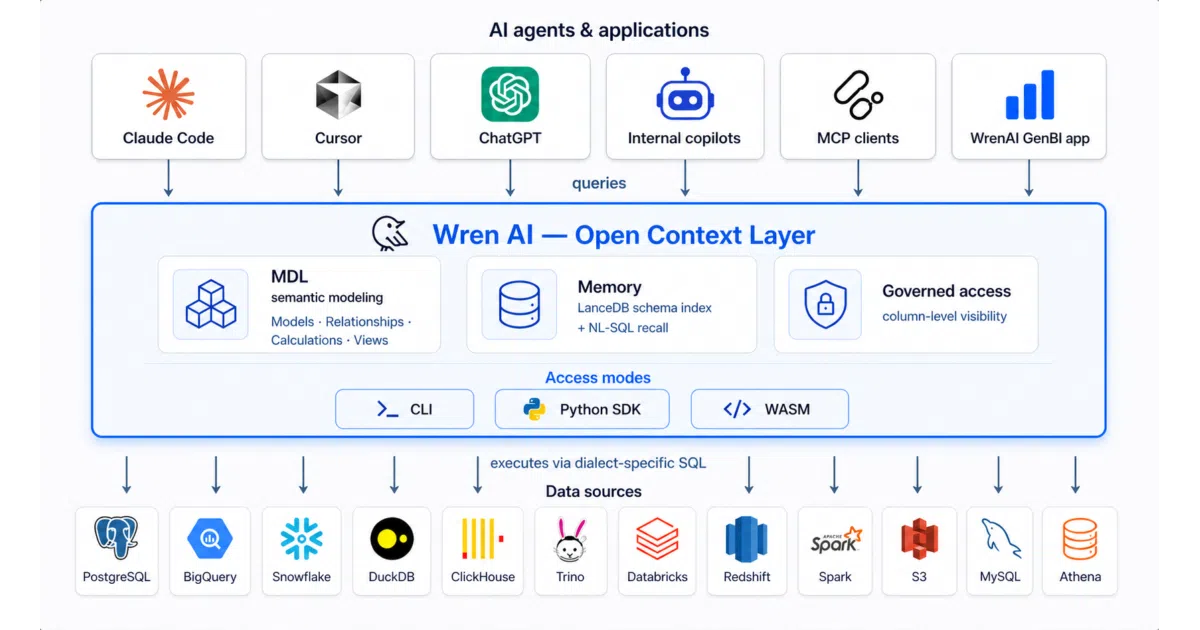
WrenAI sits between your data warehouse and AI agents, translating natural language into SQL using business semantics, relationships, and institutional memory rather than raw schema names. It supports over 20 data sources—including BigQuery, Snowflake, PostgreSQL, and DuckDB—and governs queries through a Modeling Definition Language (MDL) that captures metrics, access controls, and business meaning. The project ships as SDKs and agent skills for frameworks like LangChain and Pydantic AI.
The interesting bit
Rather than building another chatbot UI, WrenAI leans hard into the agent-driven workflow: you install skill bundles that teach Claude Code (or similar agents) how to scaffold projects, enrich context through grill or auto-pilot modes, and query through a shared semantic layer. All context—definitions, examples, memory—lives in versionable, Git-friendly files instead of a vendor black box.
Key highlights
- Apache DataFusion engine with a Rust core, Python bindings, and WASM builds
- LanceDB-backed memory with hybrid retrieval to surface similar past queries
MDLdefines models, relationships, cubes, metrics, and row/column-level access control- Dry-plan validation and structured error hints catch bad SQL before execution
- Skills-based onboarding lets existing AI coding agents drive the entire setup and query flow
Caveats
- The
/wren-enrich-contextskill is explicitly marked “under development” - A TODO comment in the README notes the vision paper still needs to be moved to a published path
- The previous GenBI application was archived to a
legacy/v1branch, so early adopters should confirm they are tracking the current architecture
Verdict
Teams already using AI coding agents and wanting a shareable, governed semantic layer should look here; if you just need a simple text-to-SQL demo without agent integration, this is likely overkill.
Frequently asked
- What is Canner/WrenAI?
- An open-source context layer that stops AI agents from guessing what your business data means.
- Is WrenAI open source?
- Yes — Canner/WrenAI is an open-source project tracked on heatdrop.
- What language is WrenAI written in?
- Canner/WrenAI is primarily written in Python.
- How popular is WrenAI?
- Canner/WrenAI has 18k stars on GitHub and is currently accelerating.
- Where can I find WrenAI?
- Canner/WrenAI is on GitHub at https://github.com/Canner/WrenAI.