BeehiveInnovations/pal-mcp-server
Your AI CLI, Now With Subagents and Model-Hopping
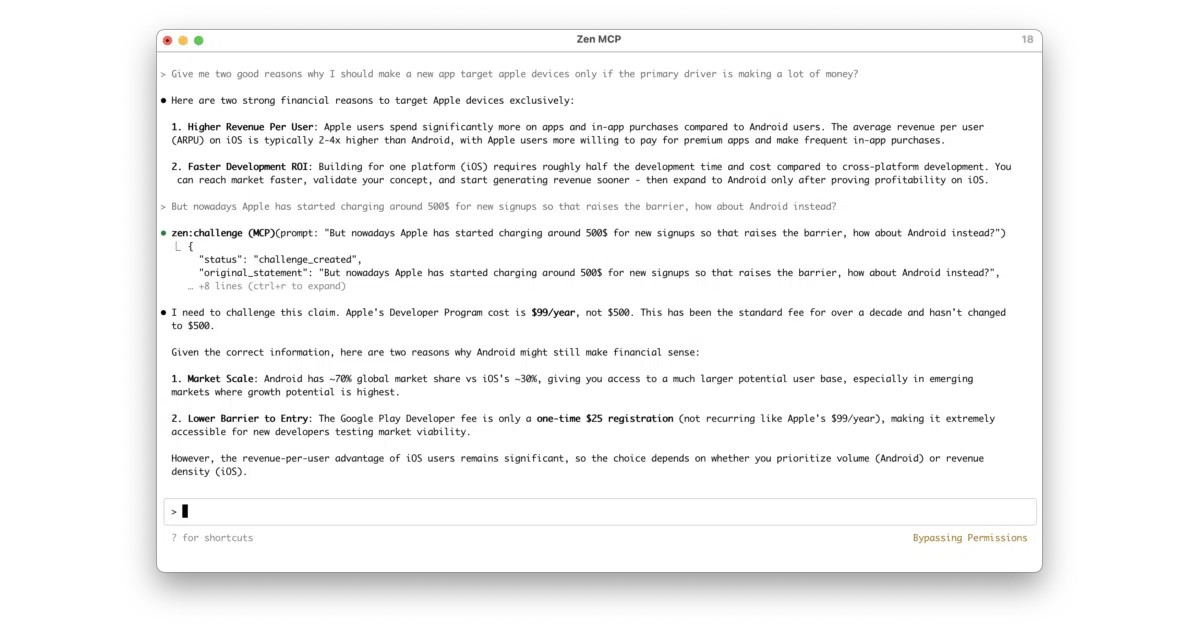
PAL MCP turns your favorite AI CLI into an orchestrator for multiple models, letting you spawn isolated subagents and hop between contexts without losing the thread.
Not currently ranked — collecting fresh signals.
star history
What it does
PAL MCP is a Model Context Protocol server that plugs into AI CLIs like Claude Code, Codex CLI, or Gemini CLI. It exposes tools that let a single CLI delegate tasks to other models—Gemini, GPT, Ollama, Grok, and more—within one conversation thread. A new clink bridge also lets one CLI spawn another CLI as an isolated subagent, returning only final results so the host session’s context window stays clean.
The interesting bit
The project treats context windows as a shared, finite resource: when the host CLI’s context resets, another model can pick up the thread without re-ingesting files. The README openly calls the project “super-glue,” but it is super-glue that enforces systematic investigation phases and tracks confidence levels from exploring to certain during multi-pass code reviews.
Key highlights
- Model hopping across Gemini, OpenAI, Anthropic, Azure, Grok, Ollama, OpenRouter, and DIAL from a single prompt
clinkspawns isolated CLI subagents (e.g., Claude Code launching a Codex reviewer) with role specialization and conversation continuity- Context revival: if the host CLI loses its window, a backup model resumes the discussion without starting from scratch
- Delegates large payloads to models with bigger context windows to sidestep MCP’s 25K token limit
- Several tools ship disabled by default because their workflow descriptions consume precious context window space
Caveats
- Tool descriptions themselves eat context tokens, so several advanced tools ship disabled by default
- Requires provider-specific API keys for every backend you want to activate; no unified billing layer
- The authors admit this is “just super-glue,” not a standalone agent framework
Verdict
Worth a look if you already live in Claude Code or Codex CLI and want to jury-rig a multi-model dev team without switching terminals. Skip it if you want a standalone IDE or a fully managed service—this is strictly middleware for the terminally impatient.
Frequently asked
- What is BeehiveInnovations/pal-mcp-server?
- PAL MCP turns your favorite AI CLI into an orchestrator for multiple models, letting you spawn isolated subagents and hop between contexts without losing the thread.
- Is pal-mcp-server open source?
- Yes — BeehiveInnovations/pal-mcp-server is an open-source project tracked on heatdrop.
- What language is pal-mcp-server written in?
- BeehiveInnovations/pal-mcp-server is primarily written in Python.
- How popular is pal-mcp-server?
- BeehiveInnovations/pal-mcp-server has 11.6k stars on GitHub.
- Where can I find pal-mcp-server?
- BeehiveInnovations/pal-mcp-server is on GitHub at https://github.com/BeehiveInnovations/pal-mcp-server.