Auromix/ROS-LLM
Giving ROS 2 robots an LLM they can actually use
ROS-LLM wires GPT-4 and ChatGPT into ROS 2 Humble so you can command robots with voice or text instead of writing yet another custom topic publisher.
Not currently ranked — collecting fresh signals.
star history
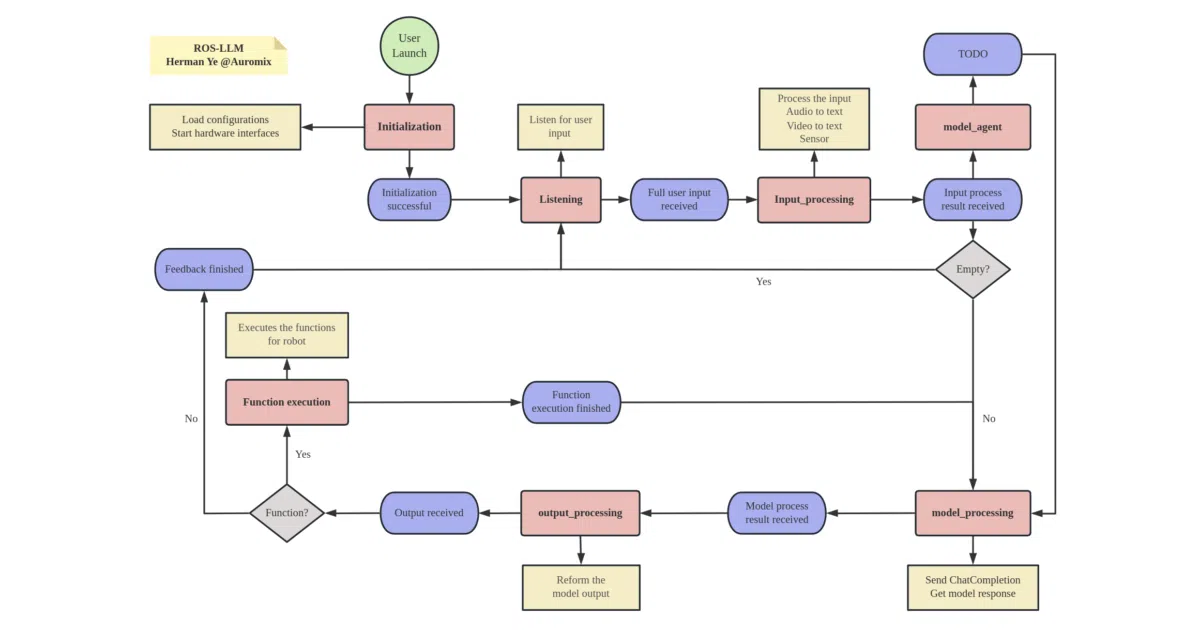
What it does ROS-LLM is a ROS 2 Humble framework that bridges Large Language Models and physical robots. It ingests natural language—via text or speech recognition—and lets GPT-4 or ChatGPT decide how to move or navigate the robot by calling functions you expose through a template interface. The goal is to drop this onto any existing ROS 2 robot without rebuilding the entire stack from scratch.
The interesting bit Rather than treating the LLM as a chatbot, the framework uses it as a headless decision layer that maps human requests to robot capabilities. It is, candidly, the kind of OpenAI-to-ROS glue code most labs are already duct-taping together, except here it is packaged with a config layer and a Turtlesim demo.
Key highlights
- Targets ROS 2 Humble on Ubuntu 22.04
- Supports both cloud (AWS) and local (OpenAI Whisper) speech recognition
- Retains local chat histories for debugging or review
- Exposes robot functions through a configurable
llm_robottemplate - Claims new robot integration in under ten minutes if your ROS interfaces are already clean
Caveats
- Hard dependency on OpenAI models; no local LLM support is mentioned
- Major capabilities—navigation interface, sensor input, agent logic, vision models—are explicitly listed as future work, so the current toolset is narrower than the roadmap promises
- The “ten minute” integration promise assumes your robot already has clean ROS 2 interfaces; the README notes you must modify
llm_robotandllm_configto match your hardware
Verdict Grab it if you want to prototype voice or text-driven robot commands without wiring up HTTP clients and topic pubs yourself. Pass if you need offline-only operation, local LLMs, or deep autonomous behaviors beyond simple function dispatch.
Frequently asked
- What is Auromix/ROS-LLM?
- ROS-LLM wires GPT-4 and ChatGPT into ROS 2 Humble so you can command robots with voice or text instead of writing yet another custom topic publisher.
- Is ROS-LLM open source?
- Yes — Auromix/ROS-LLM is open source, released under the Apache-2.0 license.
- What language is ROS-LLM written in?
- Auromix/ROS-LLM is primarily written in Python.
- How popular is ROS-LLM?
- Auromix/ROS-LLM has 833 stars on GitHub.
- Where can I find ROS-LLM?
- Auromix/ROS-LLM is on GitHub at https://github.com/Auromix/ROS-LLM.