Agent-Field/SWE-AF
One API call, one whole engineering team, allegedly
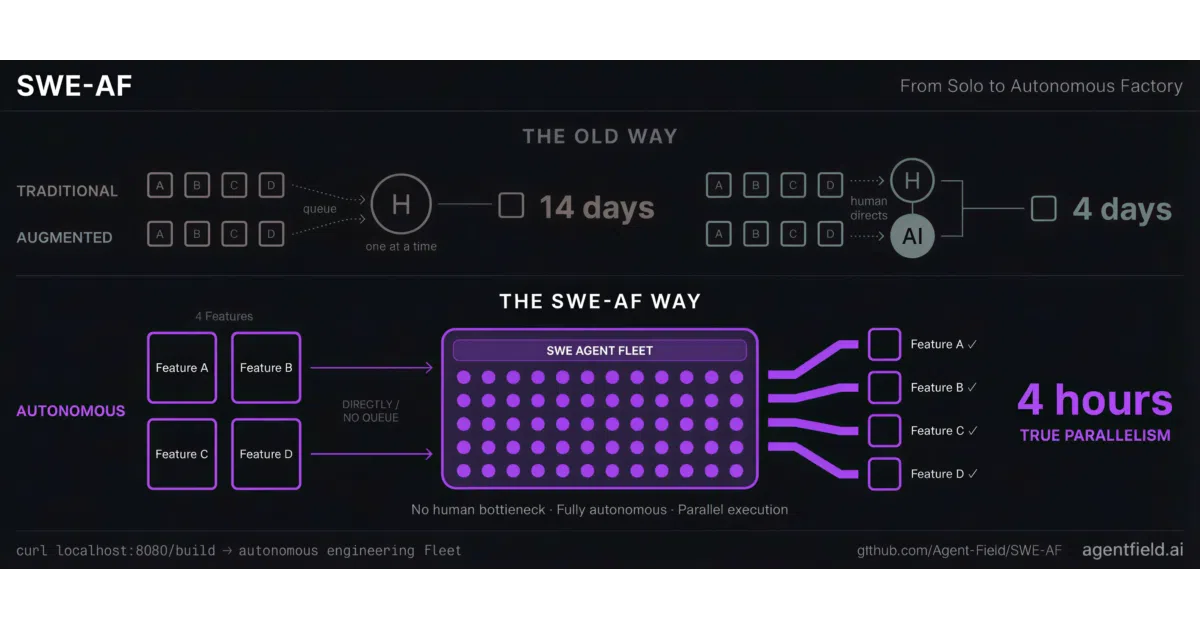
SWE-AF orchestrates a fleet of planning, coding, reviewing, and QA agents that take a goal and a repo URL and ship a PR.
Velocity · 7d
+23
★ / day
Trend
↗accelerating
star history
What it does
SWE-AF is an autonomous engineering team runtime built on the AgentField control plane. You hand it a natural-language goal plus a repo (or several repos with primary/dependency roles), and it spins up a pipeline of PM, architect, coder, reviewer, QA, merger, and verifier agents that decompose the work, code it in isolated git worktrees, and open a finished PR. It runs on Claude Code, OpenCode, or Codex backends, with a flat config map assigning different models per role.
The interesting bit
The architecture is three nested control loops: an inner loop where coders retry on QA failure, a middle loop where an advisor re-approaches, splits, or accepts with tracked debt, and an outer loop where a replanner restructures the remaining dependency DAG. Hard issues trigger replanning rather than blind retries — the strategy lives in the control stack, not the prompts.
Key highlights
- Multi-repo builds with
primaryanddependencyroles; dependency failures are captured but don’t block the build - Continual learning: conventions and failure patterns from early issues get injected into later ones (
enable_learning) - Checkpointed execution with
resume_buildafter crashes - Explicit compromise tracking — relaxed scope becomes typed, severity-rated debt
- Real-world example: PR #179 on AgentField, 10/10 issues, 217 passing tests, 79 agent invocations, $19.23 total on haiku-class models
Caveats
- The headline benchmark (“253.8x faster”) compares CPython subprocess spawning against a pre-warmed in-process RustPython pool — a real tradeoff, but the framing flatters the result
- Public beta; requires the AgentField control plane and a provider API key, so it’s a stack, not a single tool
- The 175-agent RustPython compiler example is impressive but hard to independently verify from the README alone
Verdict
Worth a look if you’re experimenting with multi-agent engineering pipelines and want DAG-level replanning instead of a single coder loop. If you just want a coding agent for one file, this is a factory where a screwdriver would do.
Frequently asked
- What is Agent-Field/SWE-AF?
- SWE-AF orchestrates a fleet of planning, coding, reviewing, and QA agents that take a goal and a repo URL and ship a PR.
- Is SWE-AF open source?
- Yes — Agent-Field/SWE-AF is open source, released under the Apache-2.0 license.
- What language is SWE-AF written in?
- Agent-Field/SWE-AF is primarily written in Go.
- How popular is SWE-AF?
- Agent-Field/SWE-AF has 1.1k stars on GitHub and is currently accelerating.
- Where can I find SWE-AF?
- Agent-Field/SWE-AF is on GitHub at https://github.com/Agent-Field/SWE-AF.