Accenture/AmpliGraph
TensorFlow knowledge graphs that predict missing links
A Python library for embedding entities and relations so you can fill in the blanks of incomplete knowledge graphs.
Not currently ranked — collecting fresh signals.
star history
What it does
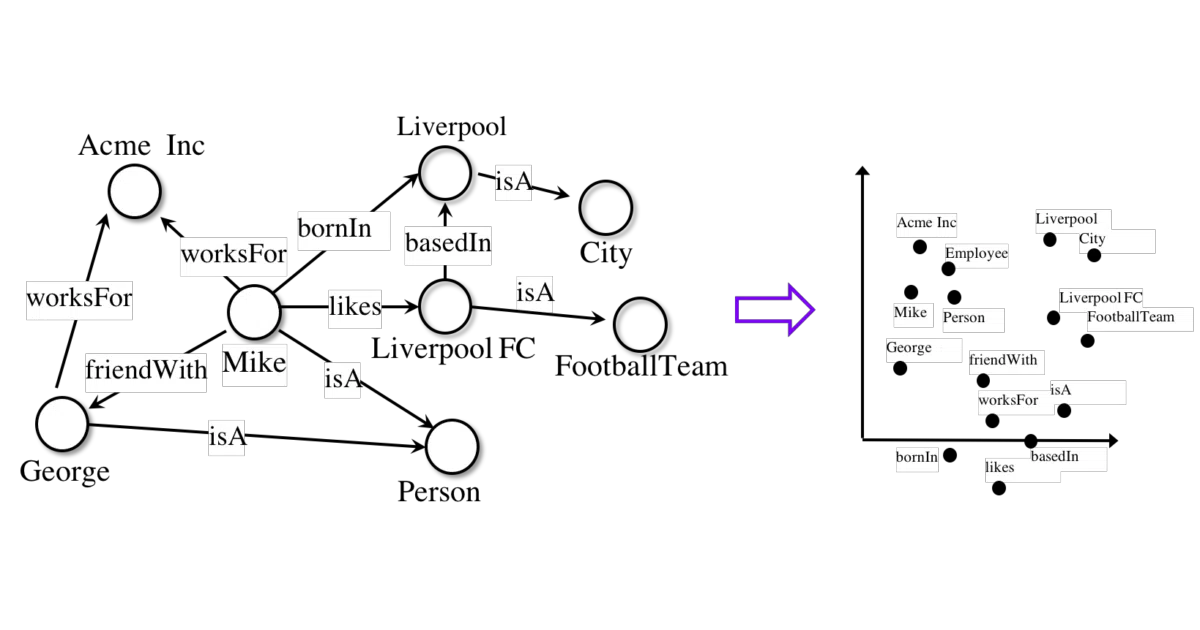
AmpliGraph turns knowledge graphs—think RDF triples of subject-predicate-object—into vector embeddings using neural models. You feed it incomplete graphs; it predicts missing links via model-specific scoring functions. It also bundles evaluation metrics, dataset loaders, and high-level “discovery” APIs for clustering and near-duplicate detection.
The interesting bit
The library is essentially a curated, Keras-styled assembly of established embedding models (TransE, ComplEx, RotatE, etc.) rather than a single new algorithm. Its value is in the plumbing: TensorFlow 2 backend, GPU readiness, and a compatibility shim for users still on the 1.x API. The README even publishes filtered MRR benchmarks against literature baselines—useful, though the fine print notes they use the most conservative tie-breaking protocol.
Key highlights
- Ships with TransE, DistMult, ComplEx, HolE, and RotatE; ConvE and ConvKB were dropped in v2.0
- Keras-style APIs and extensible base estimators for rolling custom embedding models
- “Discovery” submodule wraps clustering and fact discovery in convenience functions
- Includes evaluation metrics and standard datasets (FB15K-237, WN18RR, YAGO3-10)
- Apache 2.0 licensed; v2.1.0 current stable, v2.1-dev on develop branch
Caveats
- TensorFlow 2.9.0 is pinned; installation on Apple Silicon requires conda and tensorflow-metal gymnastics
- Some models from v1.x (ConvE, ConvKB) were discontinued, so migrating old code may need the compat shim
Verdict
Worth a look if you need to benchmark or prototype knowledge graph completion without wiring up TransE by hand. Skip if you want state-of-the-art from scratch—the published MRRs trail literature best on several benchmarks.
Frequently asked
- What is Accenture/AmpliGraph?
- A Python library for embedding entities and relations so you can fill in the blanks of incomplete knowledge graphs.
- Is AmpliGraph open source?
- Yes — Accenture/AmpliGraph is open source, released under the Apache-2.0 license.
- What language is AmpliGraph written in?
- Accenture/AmpliGraph is primarily written in Python.
- How popular is AmpliGraph?
- Accenture/AmpliGraph has 2.2k stars on GitHub.
- Where can I find AmpliGraph?
- Accenture/AmpliGraph is on GitHub at https://github.com/Accenture/AmpliGraph.