AIZOOTech/FaceMaskDetection
A 1.01M-Parameter Mask Detector for Seven Frameworks
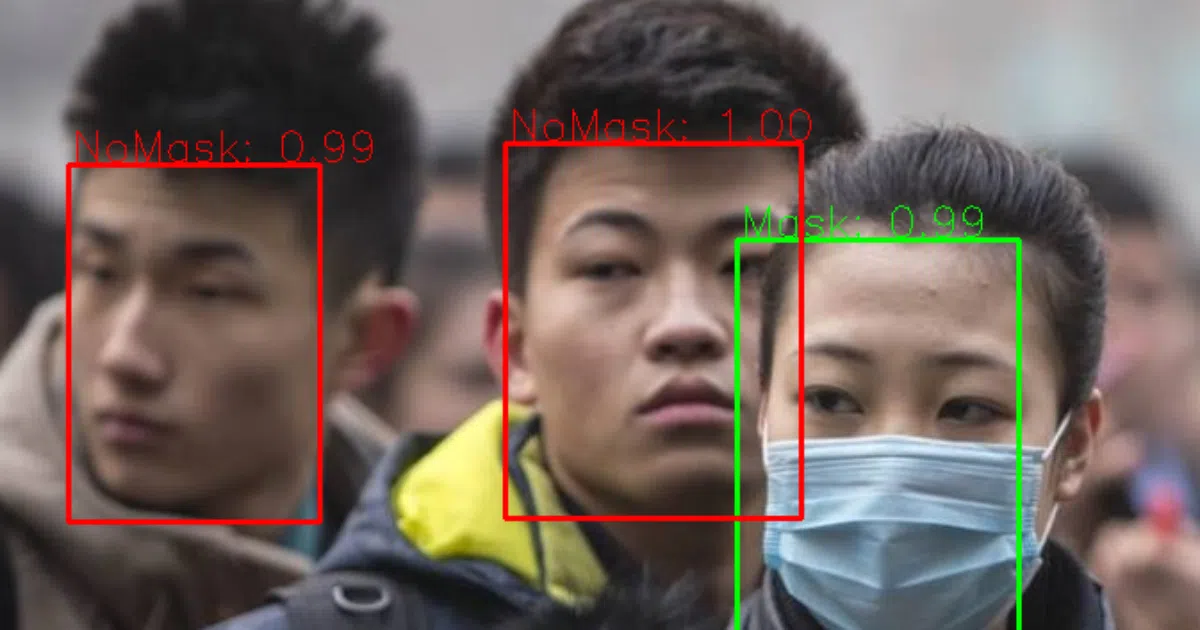
It open-sources face-mask detection models and inference code across seven deep-learning frameworks so you can drop the detector into whatever stack you already use.
Not currently ranked — collecting fresh signals.
star history
What it does The project trains a single-shot detector (SSD) to find faces and classify whether each is wearing a mask. It ships pre-trained weights and standalone inference scripts for PyTorch, TensorFlow (including TFLite), Keras, MXNet, Caffe, Paddle, and OpenCV DNN, so you are not forced to port weights yourself. The training data combines 7,971 images from the WIDER Face and MAFA datasets, with the authors noting they hand-corrected some annotation errors.
The interesting bit Instead of a heavy backbone, the network uses only eight convolutional layers and squeezes the entire model down to roughly 1.01 million parameters—small enough to run inside a browser via a TensorFlow.js demo. The authors also merge batch-normalization layers into their convolution counterparts to shave off inference overhead, which is the kind of boring optimization that actually matters at this scale.
Key highlights
- Multi-framework parity: native model files and inference code for seven stacks, from PyTorch to OpenCV DNN.
- Compact SSD architecture: 260×260 input, 24 layers total, five multi-box feature-map scales.
- Browser-ready: a live TensorFlow.js demo runs fully client-side.
- Curated training set: 7,971 images drawn from WIDER Face and MAFA, with some wrong labels manually verified.
- Batch-normalization layers fused into convolutions for faster inference.
Caveats
- Caffe inference requires the
caffe-ssdfork because of a permute layer; the README suggests falling back to OpenCV DNN if that dependency is a headache. - The README carries visible typos (“parametes”, “configurtion”, “writen”) and COVID-19-era framing, suggesting the project has not seen recent polish.
Verdict Grab this if you need a lightweight, off-the-shelf mask detector to prototype in a browser or embed on edge hardware. Skip it if you are looking for an actively maintained, general-purpose face-analysis pipeline—this is a narrow, COVID-era utility with vintage documentation.
Frequently asked
- What is AIZOOTech/FaceMaskDetection?
- It open-sources face-mask detection models and inference code across seven deep-learning frameworks so you can drop the detector into whatever stack you already use.
- Is FaceMaskDetection open source?
- Yes — AIZOOTech/FaceMaskDetection is open source, released under the MIT license.
- What language is FaceMaskDetection written in?
- AIZOOTech/FaceMaskDetection is primarily written in Jupyter Notebook.
- How popular is FaceMaskDetection?
- AIZOOTech/FaceMaskDetection has 2.1k stars on GitHub.
- Where can I find FaceMaskDetection?
- AIZOOTech/FaceMaskDetection is on GitHub at https://github.com/AIZOOTech/FaceMaskDetection.