863401402/she-love-me
Romance forensics for WeChat power users
It turns years of WeChat or QQ messages into a local, psychology-backed relationship audit that scores attachment styles, red flags, and who’s actually pursuing whom.
Velocity · 7d
+4.7
★ / day
Trend
→steady
star history
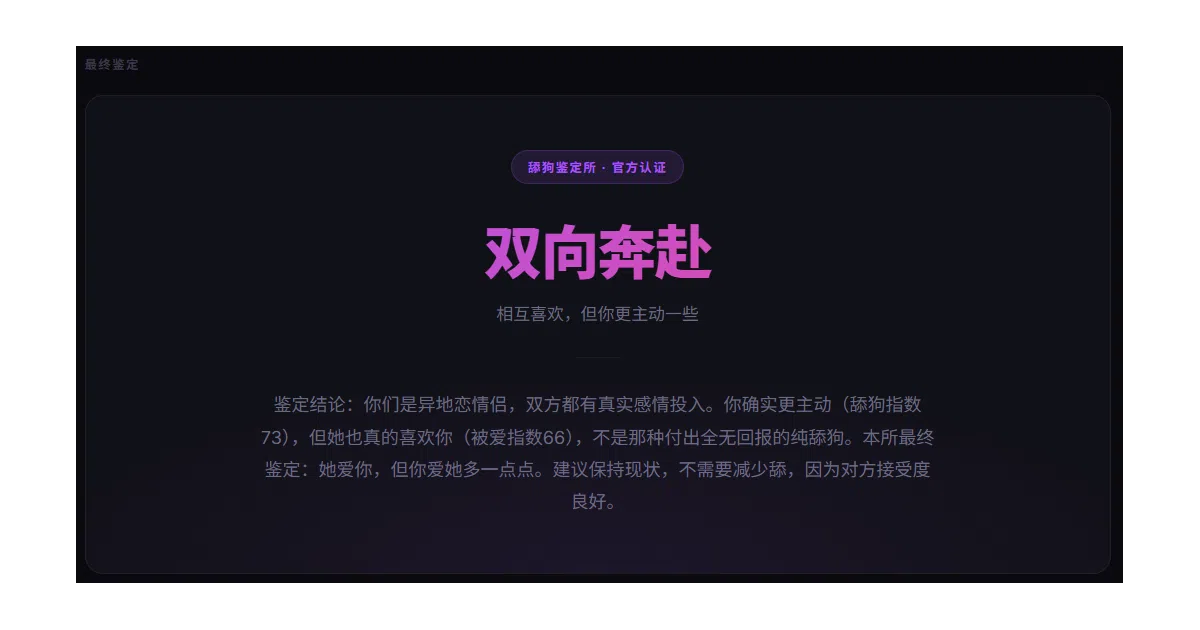
What it does she-love-me is a universal Agent Skill (and standalone script) that ingests exported WeChat or QQ chat histories and generates a comprehensive romantic-relationship analysis. It quantifies metrics like initiative ratio, reply latency, and message length, then layers on psychology frameworks—attachment style diagnosis, Gottman-style repair-attempt detection, and Sternberg’s triangular love scores—to produce both a terminal Markdown summary and a shareable HTML report. The whole pipeline runs locally; your chat data never leaves the machine.
The interesting bit The project treats romantic ambiguity as a data-quality problem. It builds a three-tier sampling architecture to avoid “full-context hallucination,” uses dual-threshold triggers to downgrade red-flag warnings when only one signal fires, and even includes a “祖师爷寄语” mode that channels streamer Tong Jincheng for street-level relationship advice alongside the clinical psychology readout. That combination of rigorous quantification and unapologetically informal commentary makes the output feel less like a horoscope and more like a roast-meets-report.
Key highlights
- Supports multiple export pipelines:
weflow-cli, CipherTalk, QQ Chat Exporter (NapCat), and legacy WeFlow JSON. - Scores conversations on initiative, “loved-ness,” coldness, discourse power, and Sternberg’s passion/intimacy/commitment dimensions.
- Detects seven danger-signal categories (gaslighting, love-bombing, intermittent reinforcement, etc.) with a dual-threshold system to reduce false alarms.
- Runs entirely offline after export; analysis is local and no data is uploaded.
- Also ships as a traditional Python script for non-programmers who do not use Claude Code, Codex, Cursor, or Copilot.
Caveats
- Windows WeChat support is tightly coupled to WeChat 4.x and third-party export tools the README admits are not independently audited; upstream changes or WeChat updates can break the pipeline.
- QQ analysis depends on an external NapCat + QCE stack, so it is not a single-tool experience.
- The Agent Skill automates a lot, but the README still warns that users may need to re-open sessions or re-scan keys when CLI exporters fail, suggesting the happy path is not always automatic.
Verdict Worth a look if you have years of chat history and a masochistic curiosity about attachment dynamics, power imbalances, and whether your 3 a.m. double-texting shows up in the data. Skip it if you do not use WeChat or QQ, or if you prefer your relationship uncertainty to remain unquantified.
Frequently asked
- What is 863401402/she-love-me?
- It turns years of WeChat or QQ messages into a local, psychology-backed relationship audit that scores attachment styles, red flags, and who’s actually pursuing whom.
- Is she-love-me open source?
- Yes — 863401402/she-love-me is open source, released under the MIT license.
- What language is she-love-me written in?
- 863401402/she-love-me is primarily written in Python.
- How popular is she-love-me?
- 863401402/she-love-me has 918 stars on GitHub and is currently holding steady.
- Where can I find she-love-me?
- 863401402/she-love-me is on GitHub at https://github.com/863401402/she-love-me.