zilliztech/VectorDBBench
The vector database shootout you didn't know you needed
A Python benchmark suite that pits Milvus, pgvector, Pinecone, and two dozen other vector databases against real-world datasets with cost metrics included.
Not currently ranked — collecting fresh signals.
star history
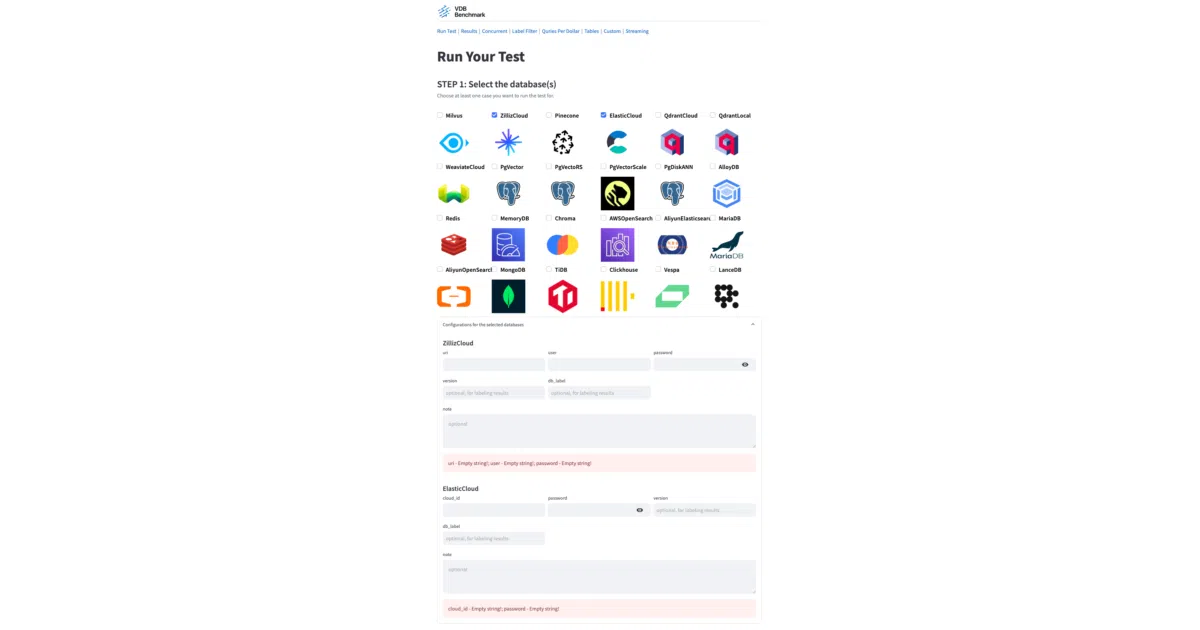
What it does VectorDBBench runs standardized insertion, search, and filtered-search tests across a sprawling roster of vector databases—open-source and cloud-hosted alike. It ships with public datasets (SIFT, GIST, Cohere, OpenAI-generated) and spits out both performance numbers and cost-effectiveness reports for cloud services. You can drive it through a web UI or a dense CLI with per-database tuning knobs.
The interesting bit The breadth is the point. The README lists 25+ optional database clients, from obvious suspects (Qdrant, Weaviate, Redis) to deep cuts like OceanBase, Hologres, and Lindorm. Each gets its own pip extra and CLI subcommand with database-specific flags—HNSW parameters for pgvector, IVF probes for VectorChord, AWS OpenSearch host strings. It’s less a benchmark than a small testing framework wearing benchmark clothes.
Key highlights
- Supports 25+ vector databases via optional pip extras (
[pinecone],[pgvector],[qdrant], etc.) - Includes both performance and cost-effectiveness reporting for cloud services
- Uses public, production-derived datasets with ground-truth validation
- CLI exposes granular per-engine tuning (HNSW
ef_construction, VectorChordepsilon, quantization modes) - Web UI for initiating tests and viewing comparative results
- Sponsored by Zilliz; publishes a public leaderboard at zilliz.com/benchmark
Caveats
- The README’s marketing prose is thick; “delve” appears unironically
- Python 3.11+ required, which may nudge some older environments
- Sponsorship by Milvus’s parent company raises the usual “who benefits?” eyebrow, though the tool itself is vendor-agnostic in client support
Verdict Worth a look if you’re evaluating vector databases for production and want apples-to-apples numbers on your own hardware. Skip it if you already know your stack and don’t need to justify the choice to a committee.
Frequently asked
- What is zilliztech/VectorDBBench?
- A Python benchmark suite that pits Milvus, pgvector, Pinecone, and two dozen other vector databases against real-world datasets with cost metrics included.
- Is VectorDBBench open source?
- Yes — zilliztech/VectorDBBench is open source, released under the MIT license.
- What language is VectorDBBench written in?
- zilliztech/VectorDBBench is primarily written in Python.
- How popular is VectorDBBench?
- zilliztech/VectorDBBench has 1.2k stars on GitHub.
- Where can I find VectorDBBench?
- zilliztech/VectorDBBench is on GitHub at https://github.com/zilliztech/VectorDBBench.