zhongqiangwu960812/AI-RecommenderSystem
The Full RecSys Funnel, Implemented Three Times Over
A self-study archive that pairs blog explanations with three code versions apiece to demystify the classic algorithms behind industrial recommendation pipelines.
Not currently ranked — collecting fresh signals.
star history
What it does
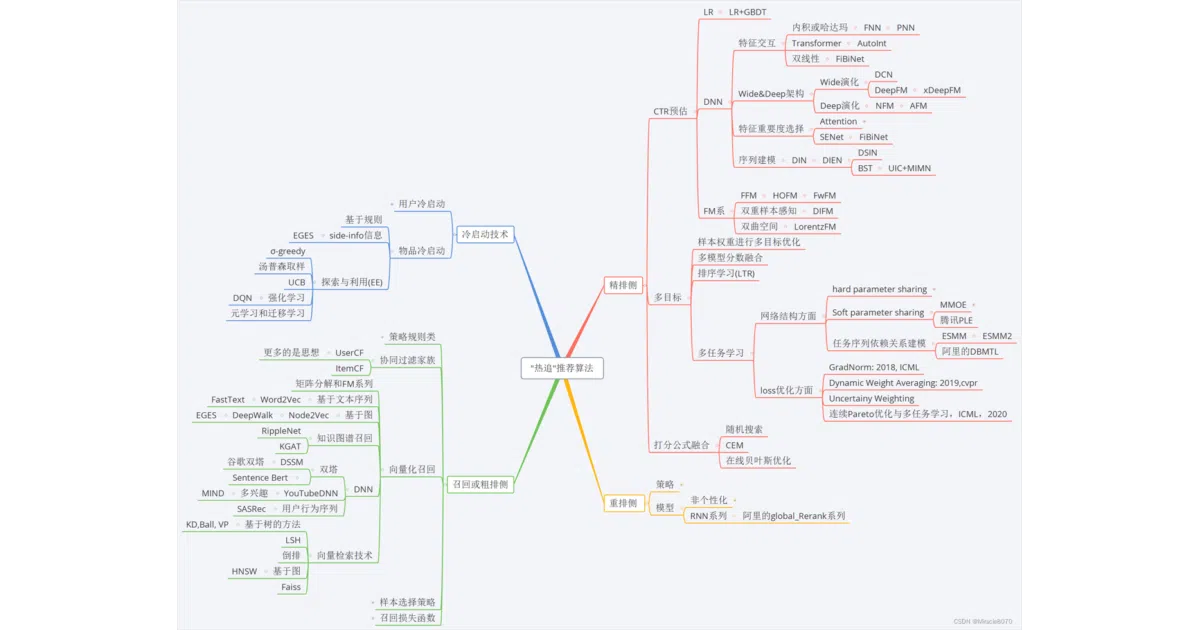
This repository collects classic recommender system algorithms—from content-based and collaborative filtering to FM/FFM and early deep models like NeuralCF and DeepCrossing—organized by their role in the industrial funnel (recall, coarse ranking, fine ranking, re-ranking). Each algorithm is backed by a CSDN blog post explaining the theory, while the code provides a from-scratch TensorFlow version, a from-scratch PyTorch version, and a library-based version using deepctr or deepmatch. The author frames it as a personal learning journal, prioritizing understanding over production polish.
The interesting bit
The three-version approach is a neat pedagogical hack: the bare-metal TensorFlow and PyTorch implementations let you trace the forward propagation by hand, while the deepctr/deepmatch wrapper lets you pivot to feature-engineering and loss-function experiments without rewriting the architecture. To keep everything on modest hardware, the author also sampled a real-world news dataset down to 20,000 users and about one million clicks.
Key highlights
- Covers the full industrial pipeline: recall, coarse ranking, fine ranking, re-ranking, and cold start
- Each model includes three implementations: hand-rolled TensorFlow, hand-rolled PyTorch, and a
deepctr/deepmatchlibrary version - Theory lives on CSDN; GitHub handles reproduction, creating a split-brain textbook format
- Uses a sampled real-world news dataset (carved from an 8 GB competition set) so experiments stay comparable and laptop-friendly
- Structured around the framework from Wang Zhe’s Deep Learning Recommender Systems
Caveats
- The author notes that earlier models were trained on inconsistent public datasets (Movielens, Amazon, Criteo), so historical results cannot be directly compared
- It is explicitly a self-study notebook collection, not a production framework or a research artifact
- The README admits the sampled dataset is a workaround because the full 8 GB original would not run on the author’s machine
Verdict A solid starting point if you want to understand how industrial recommender systems work under the hood and prefer theory paired with working code. Skip it if you need a maintained, production-grade library or the latest SOTA architectures.
Frequently asked
- What is zhongqiangwu960812/AI-RecommenderSystem?
- A self-study archive that pairs blog explanations with three code versions apiece to demystify the classic algorithms behind industrial recommendation pipelines.
- Is AI-RecommenderSystem open source?
- Yes — zhongqiangwu960812/AI-RecommenderSystem is an open-source project tracked on heatdrop.
- What language is AI-RecommenderSystem written in?
- zhongqiangwu960812/AI-RecommenderSystem is primarily written in Jupyter Notebook.
- How popular is AI-RecommenderSystem?
- zhongqiangwu960812/AI-RecommenderSystem has 2.2k stars on GitHub.
- Where can I find AI-RecommenderSystem?
- zhongqiangwu960812/AI-RecommenderSystem is on GitHub at https://github.com/zhongqiangwu960812/AI-RecommenderSystem.