zai-org/ChatGLM3
Bilingual chat models with tool use, no GPU farm required
Open-source bilingual dialogue models from Tsinghua and Zhipu AI that fit on modest hardware while claiming top marks among sub-10B competitors.
Not currently ranked — collecting fresh signals.
star history
What it does
ChatGLM3-6B is a family of open-weights bilingual (Chinese and English) dialogue models from Zhipu AI and Tsinghua’s KEG Lab. This repository hosts inference code, prompt utilities, and composite demos for four variants—standard 8 k context, a raw base model, and long-context 32 k and 128 k versions—intended for local or Hugging Face–based deployment.
The interesting bit
The base model claims the top spot among sub-10 B parameter models on the authors’ benchmark suite (GSM8K, MATH, BBH, and others), yet the chat variant still squeezes in native function calling, code interpretation, and agent-style tasks through a redesigned prompt format rather than relying on external orchestration.
Key highlights
- Four model flavors: standard
ChatGLM3-6B(8 k),ChatGLM3-6B-Base, and long-contextChatGLM3-6B-32K/128Kfor document-heavy workloads. - Reported benchmarks show the base model scoring 72.3 on GSM8K and 66.1 on BBH, up sharply from the prior generation’s 32.4 and 33.7.
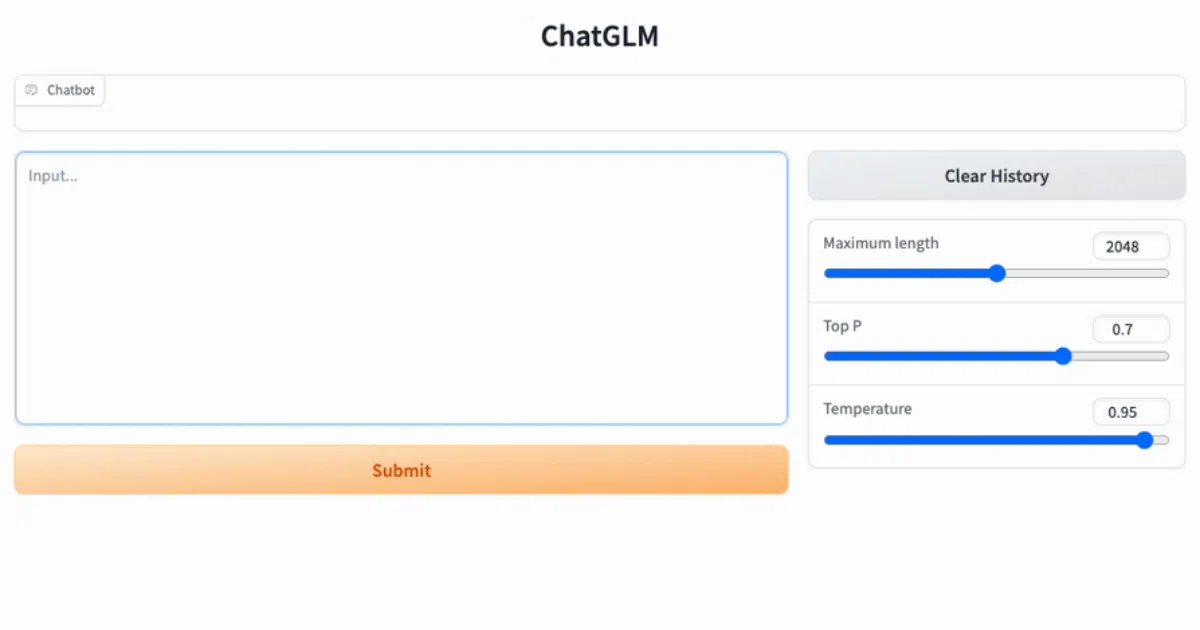
- A composite demo bundles chat, tool-use, and code-interpreter modes; the model executes code inside a Jupyter environment to answer complex questions.
- Weights are fully open for academic use and available for commercial use after a registration questionnaire.
- Broad ecosystem support: community ports cover
chatglm.cppquantization, TPU edge inference, TensorRT-LLM, OpenVINO, plus RAG and fine-tuning frameworks.
Caveats
- The README prominently steers users toward the newer GLM-4 and GLM-4-9B series, suggesting ChatGLM3 is no longer the flagship.
- Benchmark comparisons use a “Best Baseline” cutoff from October 2023, so the sub-10B landscape has likely shifted since then.
- The authors explicitly disclaim responsibility for model outputs and warn that the 6 B size limits output reliability.
Verdict
A solid candidate if you need a lightweight, Chinese-English conversational model with built-in tool support for local hardware. Skip it if you are already targeting the newer GLM-4 family or need independently verified, current leaderboard standings.
Frequently asked
- What is zai-org/ChatGLM3?
- Open-source bilingual dialogue models from Tsinghua and Zhipu AI that fit on modest hardware while claiming top marks among sub-10B competitors.
- Is ChatGLM3 open source?
- Yes — zai-org/ChatGLM3 is open source, released under the Apache-2.0 license.
- What language is ChatGLM3 written in?
- zai-org/ChatGLM3 is primarily written in Python.
- How popular is ChatGLM3?
- zai-org/ChatGLM3 has 13.7k stars on GitHub.
- Where can I find ChatGLM3?
- zai-org/ChatGLM3 is on GitHub at https://github.com/zai-org/ChatGLM3.