yfeng95/GAN
A museum of GANs from the TensorFlow 1.x era
Educational implementations of five classic GAN papers built to show how the math maps to code.
Not currently ranked — collecting fresh signals.
star history
What it does This repo collects bare-bones implementations of five foundational GAN variants—vanilla GAN, DCGAN, Conditional GAN, Wasserstein GAN, and InfoGAN—using deliberately simple networks and the MNIST dataset. The goal is to make the underlying mechanics visible: how loss functions from the papers translate into actual TensorFlow code, and how architectural choices affect training dynamics.
The interesting bit
Rather than polish everything into a library, the author treats it as a public lab notebook, flagging what works and what stalls. WGAN with MLPs is noted as “not good,” InfoGAN variants are compared with frank asides like “not faster?” and “lacking numbers,” and step ratios such as D:G = 5:1 are annotated with observed convergence behavior. That transparency is more useful than another slick tutorial.
Key highlights
- Five major variants in one place, from the 2014 GAN paper through InfoGAN
- Networks kept intentionally small; generator and discriminator live in a single
nets.py - Side-by-side results for architectural experiments, such as shared vs. unshared Q networks in InfoGAN
- Author documents exact training ratios and their observed effects, like adding a classifier to conditional setups for faster convergence
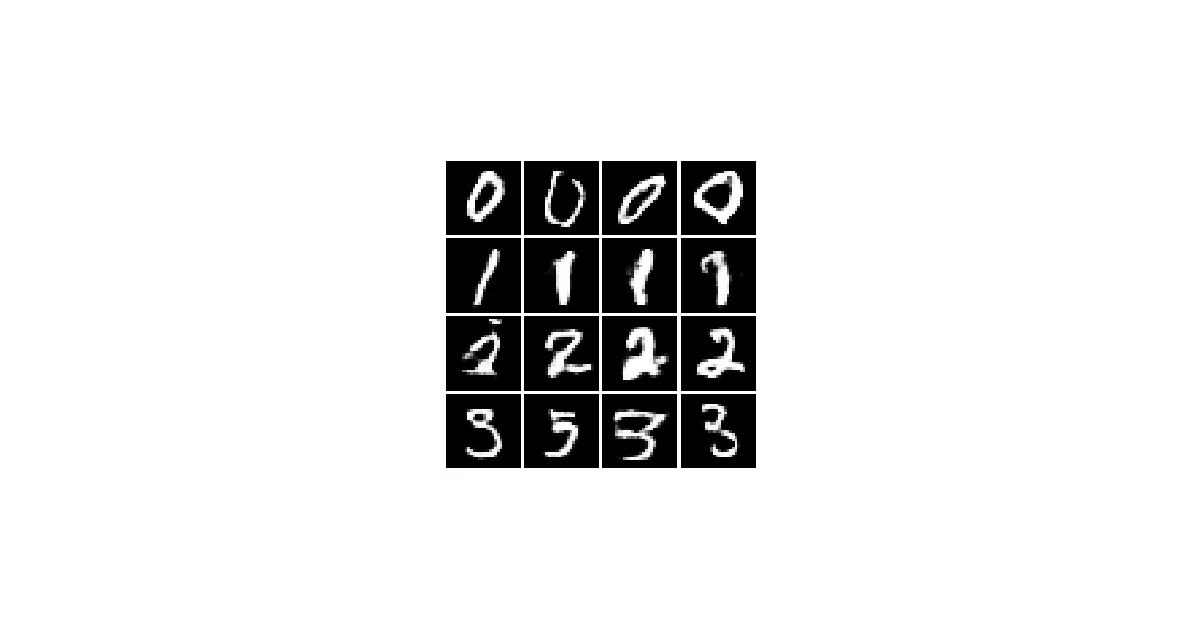
- Results preserved as image grids showing early, middle, and final epochs
Caveats
- Locked to Python 2.7 and TensorFlow 1.0+; modern environments will need compatibility workarounds
- Several combinations are explicitly flagged as incomplete or underperforming by the author, and InfoGAN + WGAN remains marked “to be done”
- Scope is strictly MNIST; no large-scale or real-world dataset experiments
Verdict Reach for this if you want to see how GAN update ratios and loss functions looked before high-level frameworks abstracted them away. Skip it if you need modern PyTorch implementations or production-ready training pipelines.
Frequently asked
- What is yfeng95/GAN?
- Educational implementations of five classic GAN papers built to show how the math maps to code.
- Is GAN open source?
- Yes — yfeng95/GAN is an open-source project tracked on heatdrop.
- What language is GAN written in?
- yfeng95/GAN is primarily written in Python.
- How popular is GAN?
- yfeng95/GAN has 3.1k stars on GitHub.
- Where can I find GAN?
- yfeng95/GAN is on GitHub at https://github.com/yfeng95/GAN.