yejiming/MuseAI
A local engine for persistent AI worlds that outlive the chat window
This desktop app gives AI characters long-term memory, relationship arcs, and their own world to live in.
Not currently ranked — collecting fresh signals.
star history
What it does
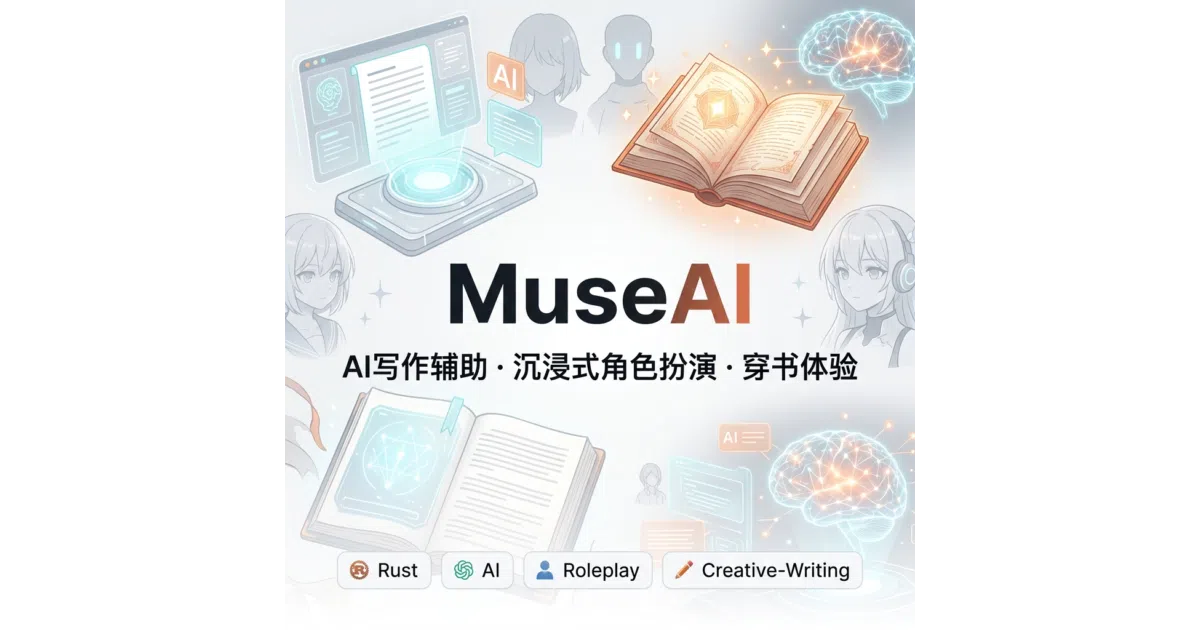
MuseAI is a local-first desktop application that wraps your own API keys into a persistent interactive fiction engine. You create world books and character cards, then chat with characters, run text adventures with multiple actors, or step into a novel world and alter its plot. All session data, relationship histories, and world states live in a local folder.
The interesting bit
The app treats continuity as a first-class feature: after each conversation or adventure, you can archive relationship shifts and key events back into a character’s permanent “bond” profile, so the next session picks up where you left off. It also extracts structured settings from raw novel text automatically, letting you turn existing fiction into playable sandboxes without manual data entry.
Key highlights
- Runs fully offline for data storage; only API calls leave your machine, and you bring your own keys.
- Three interaction modes: one-on-one companion chat, multi-character AI-GM text adventures, and a “book-travel” mode where you enter a novel at a chosen point and branch the plot.
- Persistent bond system tracks relationship trajectories, timelines, and shared history per character across sessions.
- Auto-generates world books and character cards from uploaded novels or outlines.
- Includes auxiliary writing tools: Markdown editor with version history, outline evaluation, reverse-outlining, and a de-AI-flavor detector and rewriter.
- Serves a LAN-accessible web interface so you can continue sessions from a phone on the same WiFi.
Caveats
- The README warns Windows users to disable antivirus during installation and macOS users to strip quarantine flags, suggesting the packaging isn’t fully signed or polished.
- It is essentially a local client for remote LLM APIs; the AI inference itself isn’t local, only your data and orchestration are.
- The writing aids are explicitly described as secondary to the roleplay features.
Verdict
Worth a look if you want AI roleplay with actual persistence and world-building rather than ephemeral chat threads. Skip it if you need a fully offline LLM or a conventional writing app without the character drama.
Frequently asked
- What is yejiming/MuseAI?
- This desktop app gives AI characters long-term memory, relationship arcs, and their own world to live in.
- Is MuseAI open source?
- Yes — yejiming/MuseAI is an open-source project tracked on heatdrop.
- What language is MuseAI written in?
- yejiming/MuseAI is primarily written in TypeScript.
- How popular is MuseAI?
- yejiming/MuseAI has 671 stars on GitHub.
- Where can I find MuseAI?
- yejiming/MuseAI is on GitHub at https://github.com/yejiming/MuseAI.