yc-software/qm
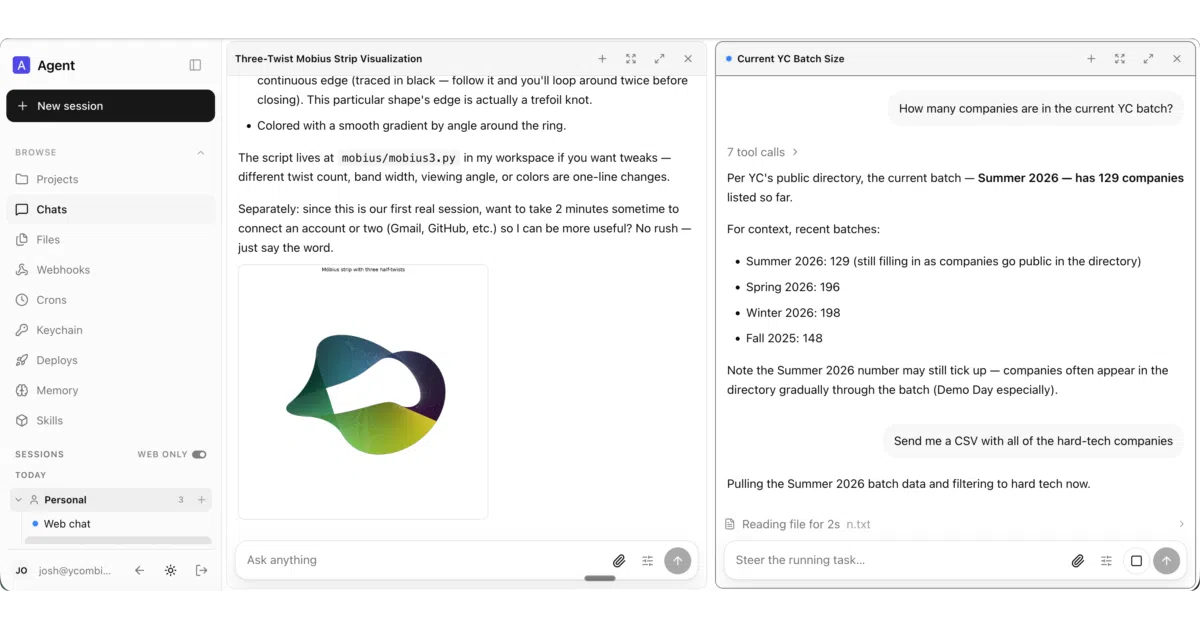
Multiplayer agent harness for teams outgrowing solo assistants
QM is an open-source harness that gives every employee an isolated agent workspace while letting teams collaborate in shared channels, without locking the org to a single model.
Velocity · 7d
+66
★ / day
Trend
↘cooling
star history
What it does
QM is a headless TypeScript core that runs AI agents for entire organizations. Every employee gets an isolated workspace—scoped memory, files, credentials, crons, and a durable sandbox—while shared channels and projects let them collaborate with the same agent identity in Slack or on the web. It is built to be vendor-agnostic, so Pi, OpenCode, Codex, and Claude Code can all drive the same deployment.
The interesting bit
The architecture treats the core like a generic multiplayer server and pushes all company-specific logic—custom tools, skills, sandbox images, infrastructure—into a swappable deployment directory. Because every substrate sits behind an interface, you can swap in your own harness, memory store, or sandbox implementation while keeping the core identical to upstream.
Key highlights
- Each person and room gets isolated memory, files, a keychain view, permissions, and a durable sandbox.
- Admins set org-level configuration and a tiered security posture (Strict, Auto, or Dangerous), with predeclared command policies enforced even in Dangerous mode.
- Supports multiple harnesses and models against the same core, avoiding single-vendor lock-in.
- Optional plugins for Slack, a Vite/Lit web UI, admin panel, and public portal over a Fastify HTTP API.
- Background work via crons and watches; skills are scope-owned, shareable by grant, and promotable to the whole org.
Caveats
- The repository ships no production deployment workflow; operators must supply their own cloud account and CI.
- Contributions are accepted as human-written prose only, not code patches, which may frustrate developers who prefer the usual pull-request flow.
- Organizations that want a private downstream copy must use a plain clone rather than GitHub’s Fork button, because the latter inherits public visibility and shared object networks.
Verdict
Startups that need a self-hosted, multi-tenant agent platform with per-user isolation and model flexibility should look here. If you just wanted a quick personal coding assistant, this is overbuilt.
Frequently asked
- What is yc-software/qm?
- QM is an open-source harness that gives every employee an isolated agent workspace while letting teams collaborate in shared channels, without locking the org to a single model.
- Is qm open source?
- Yes — yc-software/qm is open source, released under the MIT license.
- What language is qm written in?
- yc-software/qm is primarily written in TypeScript.
- How popular is qm?
- yc-software/qm has 15k stars on GitHub and is currently cooling off.
- Where can I find qm?
- yc-software/qm is on GitHub at https://github.com/yc-software/qm.