xmanrui/dsh-im
Your AI agent now has nine IM clients
A DeepSeek Harness plugin that bridges WeChat, Slack, Telegram, and six other messaging platforms so your local AI agent can talk to users without public infrastructure.
Velocity · 7d
+23
★ / day
star history
What it does
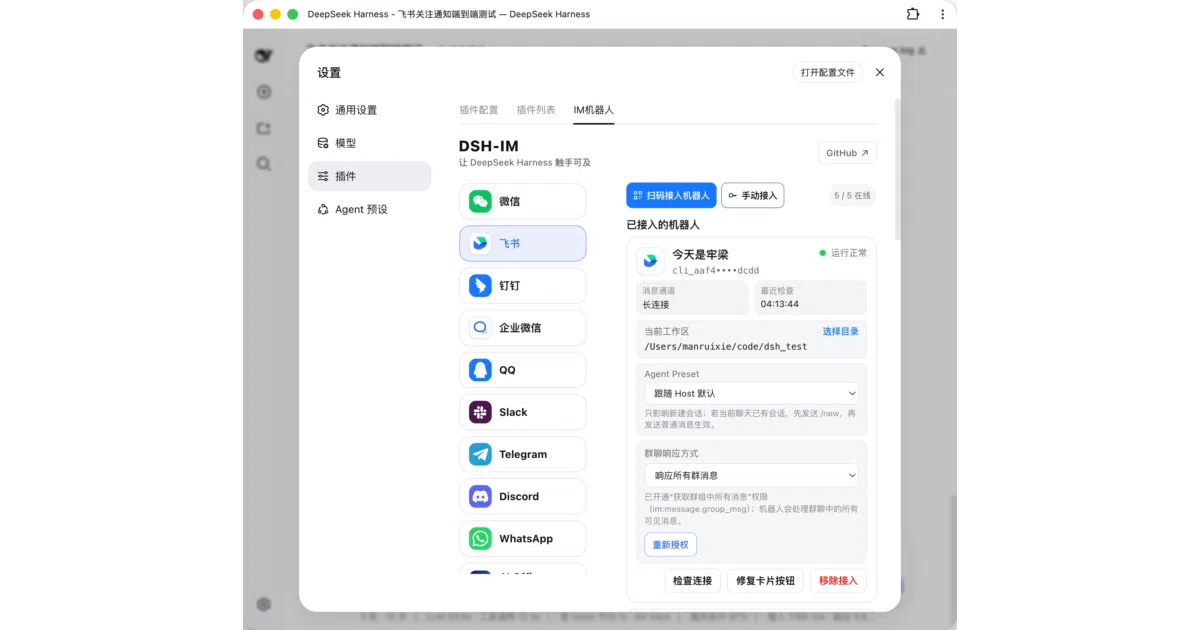
dsh-im is a plugin for DeepSeek Harness that wires nine messaging apps—WeChat, Feishu, DingTalk, WeCom, QQ, Slack, Telegram, Discord, and WhatsApp—into your local AI agent. You authenticate by scanning a QR code or dropping in a bot token, and the plugin manages long-polling, WebSockets, or SSE to shuttle messages back and forth. It also offers an AI Office Connector that lets a local Harness pull jobs from a public Office instance over an outbound SSE stream, eliminating the need for public IPs or port forwarding.
The interesting bit
Instead of forcing you to expose your local Harness to the internet, the Office Connector turns your machine into an outbound worker: it heartbeats upstream, grabs 90-second task leases, and streams results back through the same firewall-friendly SSE pipe. Meanwhile, every bot keeps its own workspace, preset, and connection state, so a single plugin can juggle multiple identities across the same channel without cross-talk.
Key highlights
- Supports multiple bots per channel, each with independent workspaces and agent presets.
- Accepts images (JPEG, PNG, WebP, GIF up to 5 MB apiece, 20 MB total per message) alongside text prompts.
- Office Connector runs fully outbound—no public IP, reverse proxy, or inbound WebSocket required.
- Native streaming UI where supported: Feishu, DingTalk, and WeCom show “thinking” cards; Telegram and Discord edit messages in place to simulate typing.
- Telegram bots can be locked to a numeric user-ID whitelist and ignore all group chats.
Caveats
- Changing an agent preset does not retroactively apply to an active chat; you must send
/newand then a new message to spawn a fresh Harness session. - Feishu WebSocket long connections only respect
HTTPS_PROXY/HTTP_PROXY;ALL_PROXYandNO_PROXYare currently ignored. - Installing directly from GitHub source on pnpm 10+ may require manually allowing build scripts in your workspace configuration.
Verdict
Handy if you are already running DeepSeek Harness and want to drop AI capabilities into existing chat workflows without standing up new infrastructure. If you are not using DSH, this is well-built glue code that will not do much on its own.
Frequently asked
- What is xmanrui/dsh-im?
- A DeepSeek Harness plugin that bridges WeChat, Slack, Telegram, and six other messaging platforms so your local AI agent can talk to users without public infrastructure.
- Is dsh-im open source?
- Yes — xmanrui/dsh-im is open source, released under the MIT license.
- What language is dsh-im written in?
- xmanrui/dsh-im is primarily written in JavaScript.
- How popular is dsh-im?
- xmanrui/dsh-im has 1.7k stars on GitHub.
- Where can I find dsh-im?
- xmanrui/dsh-im is on GitHub at https://github.com/xmanrui/dsh-im.