xiaomi-research/recogdrive
Teaching cars to think in language but steer with diffusion
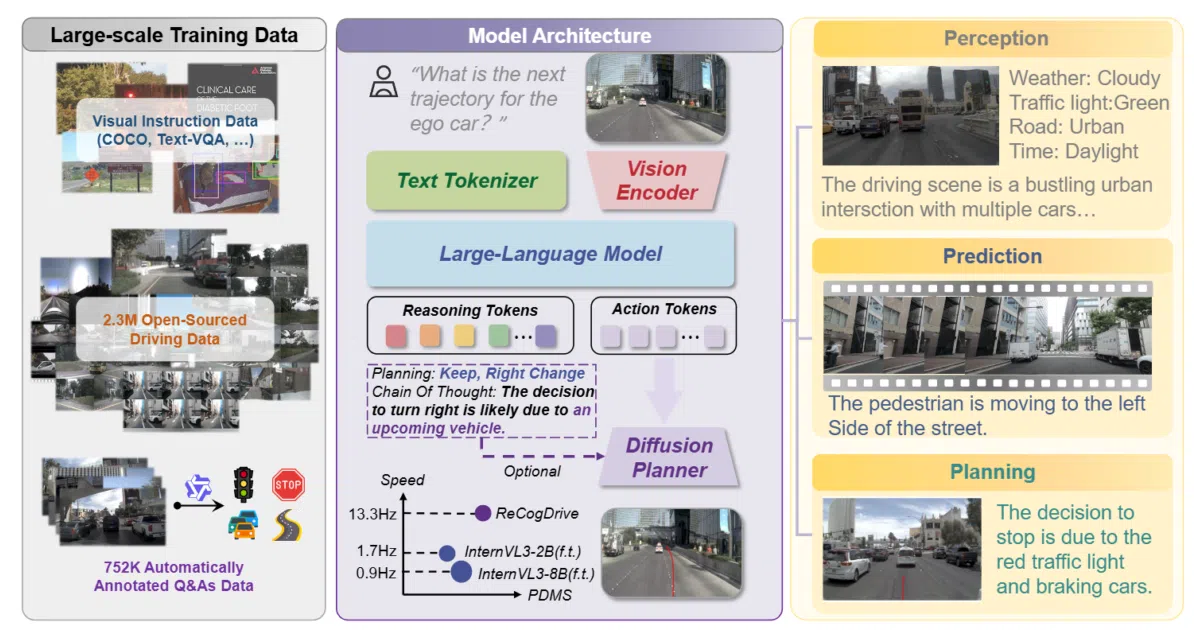
ReCogDrive exists because asking a vision-language model to spit out waypoints as text causes format violations and sluggish inference; it keeps the VLM for scene cognition and hands continuous trajectory generation to a diffusion planner.
Not currently ranked — collecting fresh signals.
star history
What it does
ReCogDrive is a research framework for end-to-end autonomous driving that uses a vision-language model to interpret driving scenarios before delegating actual trajectory planning to a diffusion model. The authors first instill human driving cognition into the VLM through a hierarchical data pipeline built on twelve re-annotated public datasets and 752k synthetic Navsim QA pairs. Once the VLM understands the scene, its learned priors are injected into a diffusion planner that outputs continuous trajectories, with a final reinforcement stage—DiffGRPO—nudging the planner toward safer, more comfortable paths.
The interesting bit The central bet here is that trajectory planning should not be a language modeling task; instead of forcing a VLM to emit waypoints as text strings, ReCogDrive uses the VLM as a cognitive backbone and lets a diffusion policy handle the physics. This separation of concerns is what the authors credit for their reported state-of-the-art numbers on NAVSIM and Bench2Drive while avoiding the slow, format-prone inference of pure language agents.
Key highlights
- Achieves a 90.8 PDMS score on NAVSIM with the 2B-parameter base model after full reinforcement training, and 90.4 with the 8B variant.
- Releases pretraining datasets covering twelve public driving corpora—re-annotated with
Qwen2.5VL-72Band filtered—plus 752k proprietary Navsim QA pairs. - Publishes model weights, training code, and evaluation scripts for NAVSIM, with Bench2Drive and DriveLM evaluation frameworks still on the roadmap.
- Introduces
DiffGRPO, a reinforcement-learning stage tailored for the diffusion planner to optimize for safety and comfort metrics rather than just imitation.
Caveats
- The README notes that evaluation frameworks for Bench2Drive, DriveLM, NAVSIM2.0, and DriveBench are not yet released, so reproducing those specific leaderboard numbers requires extra legwork.
- A NumPy bug previously corrupted the training metric cache; the authors fixed it in a late-2025 update, but early adopters may need to verify their local results if they pulled code before then.
Verdict Researchers building end-to-end driving stacks should look here for a concrete, open-weight alternative to text-only VLM planners; if you need a fully turnkey evaluation suite for every benchmark mentioned, the repo is still a work in progress.
Frequently asked
- What is xiaomi-research/recogdrive?
- ReCogDrive exists because asking a vision-language model to spit out waypoints as text causes format violations and sluggish inference; it keeps the VLM for scene cognition and hands continuous trajectory generation to a diffusion planner.
- Is recogdrive open source?
- Yes — xiaomi-research/recogdrive is open source, released under the Apache-2.0 license.
- What language is recogdrive written in?
- xiaomi-research/recogdrive is primarily written in Python.
- How popular is recogdrive?
- xiaomi-research/recogdrive has 625 stars on GitHub.
- Where can I find recogdrive?
- xiaomi-research/recogdrive is on GitHub at https://github.com/xiaomi-research/recogdrive.