xhluca/bm25s
Pure-Python search that outruns Elasticsearch
It pre-computes BM25 token scores as sparse matrices so pure Python can beat Elasticsearch on query throughput.
Not currently ranked — collecting fresh signals.
star history
What it does
bm25s is a BM25 text-retrieval library written in pure Python. It tokenizes a corpus, builds an index using sparse matrices, and returns ranked document IDs and scores for queries. It runs on NumPy alone—no Java, no PyTorch—and can optionally use Numba for a further speed boost on large datasets.
The interesting bit
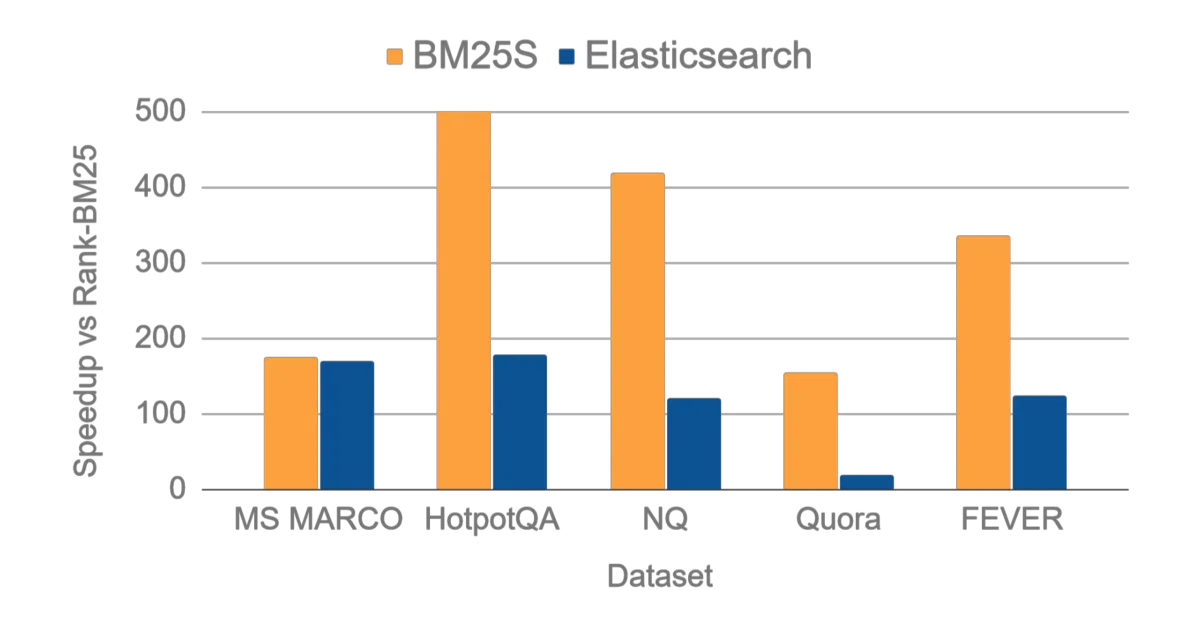
The speed comes from eager sparse scoring: instead of calculating BM25 weights at query time, it front-loads the work at index time and stores every document-token score in a sparse matrix. At query time it just slices and aggregates, which is why the README shows it outpacing both Elasticsearch and the popular rank-bm25 library by orders of magnitude in single-threaded BEIR benchmarks.
Key highlights
- Keeps the dependency stack minimal: core functionality needs only NumPy.
- Supports custom tokenization pipelines, stopword lists, and stemmer functions.
- Corpus entries can be plain strings or arbitrary dictionaries; retrieval returns the original objects by position.
- Indices and corpora can be saved to disk and reloaded later.
- Ships with a high-level API and a terminal CLI for indexing CSV, JSON, JSONL, or plain text without writing Python scripts.
Caveats
- The authors now recommend the separate
BM25PyPI package for beginners, suggestingbm25sis deliberately lean and requires choosing the right extras (e.g.,bm25s[core]) for stemming and JIT compilation. - Retrieved documents are mapped strictly by index position, so the corpus you pass for retrieval must stay in the same order and length as the indexed set.
- Saved corpora must be JSON-serializable strings, dicts, lists, or tuples.
Verdict
Worth a look if you need fast lexical search inside a Python stack without pulling in a search server or ML framework. Skip it if you need semantic/vector search or a fully managed, distributed index.
Frequently asked
- What is xhluca/bm25s?
- It pre-computes BM25 token scores as sparse matrices so pure Python can beat Elasticsearch on query throughput.
- Is bm25s open source?
- Yes — xhluca/bm25s is open source, released under the MIT license.
- What language is bm25s written in?
- xhluca/bm25s is primarily written in Python.
- How popular is bm25s?
- xhluca/bm25s has 1.8k stars on GitHub.
- Where can I find bm25s?
- xhluca/bm25s is on GitHub at https://github.com/xhluca/bm25s.