we0091234/Chinese_license_plate_detection_recognition
A dozen Chinese plate formats, one YOLOv5 detector to read them all
A detection-and-recognition pipeline built to handle the twelve distinct license plate styles used in China, including stacked two-line truck plates.
Not currently ranked — collecting fresh signals.
star history
What it does
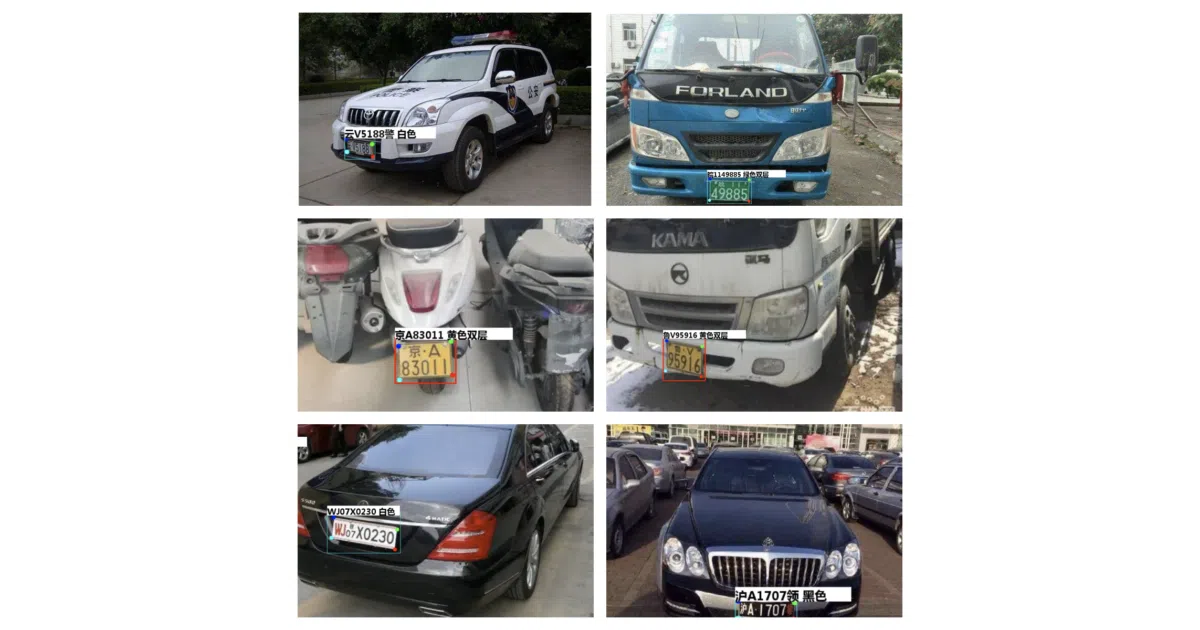
It finds and reads Chinese vehicle license plates in photos and video using a two-stage pipeline that pairs YOLOv5 with a CRNN-based recognizer. The project ships with pre-trained weights covering twelve official plate categories, from common blue and new-energy green plates to rarer embassy, armed-police, and double-decker yellow and white formats. It also exports to ONNX, TensorRT, and OpenVINO, and an external Android NCNN port is available.
The interesting bit
The code is essentially targeted glue between existing YOLO and CRNN work. The real effort is administrative: mapping twelve bureaucratic plate layouts—including the two-line stacked variants used on trucks and coaches—into a single inference flow. That breadth is the selling point, not architectural novelty.
Key highlights
- Supports 12 plate types: blue, yellow, new energy, police, coach, armed police, embassy, Hong Kong/Macau/Guangdong Z, civil aviation, and double-deck yellow, white, and green variants.
- Processes both still images and video streams end-to-end.
- Deployment options include ONNX, TensorRT, and OpenVINO; an Android NCNN implementation lives in a separate repo.
- Pre-trained models are included, though the README notes they were trained on public datasets and may need tuning for production use.
- The author maintains parallel YOLOv7, YOLOv8, and YOLO26 plate repos, plus a vehicle-and-plate joint detection variant.
Caveats
- The README openly states that bundled models are trained on public data and directs users to the author’s WeChat for higher-accuracy commercial weights, so out-of-the-box precision is unclear.
- The repo advertises custom student-project services, which may signal maintenance geared toward coursework rather than long-term production support.
- No benchmarks, dataset details, or accuracy numbers appear in the README.
Verdict
Useful if you need to bootstrap Chinese ALPR quickly and can tolerate some fine-tuning, but production teams should plan to retrain or validate against their own data. If you want a newer backbone, the author’s YOLOv8 sibling is also available.
Frequently asked
- What is we0091234/Chinese_license_plate_detection_recognition?
- A detection-and-recognition pipeline built to handle the twelve distinct license plate styles used in China, including stacked two-line truck plates.
- Is Chinese_license_plate_detection_recognition open source?
- Yes — we0091234/Chinese_license_plate_detection_recognition is open source, released under the GPL-3.0 license.
- What language is Chinese_license_plate_detection_recognition written in?
- we0091234/Chinese_license_plate_detection_recognition is primarily written in Python.
- How popular is Chinese_license_plate_detection_recognition?
- we0091234/Chinese_license_plate_detection_recognition has 1.9k stars on GitHub.
- Where can I find Chinese_license_plate_detection_recognition?
- we0091234/Chinese_license_plate_detection_recognition is on GitHub at https://github.com/we0091234/Chinese_license_plate_detection_recognition.