wanxingai/LightAgent
Another agent framework, but this one actually fits in your head
LightAgent bets that most AI frameworks are overbuilt, so it strips out LangChain and LlamaIndex to ship a minimal Python core with memory, MCP, and multi-agent swarms.
Not currently ranked — collecting fresh signals.
star history
What it does
LightAgent is a Python framework for building LLM agents with persistent memory, tool calling, and multi-agent delegation. It speaks OpenAI-compatible APIs on both ends: any model in, streaming OpenAI-format out. The pitch is deliberately small-core — no LangChain, no LlamaIndex — with pluggable extras for MCP (stdio and SSE), mem0 memory, and Langfuse tracing.
The interesting bit
The “adaptive tool mechanism” is the rare genuinely clever idea here: instead of dumping every tool into the context window, the framework pre-filters candidates before the LLM sees them. The README claims this cuts token use by 80%, which is the kind of number that matters when you’re wiring up “hundreds of personalized custom tools.” There’s also a built-in “Tool Generator” that turns API docs into tool definitions — glue code, but automated glue code.
Key highlights
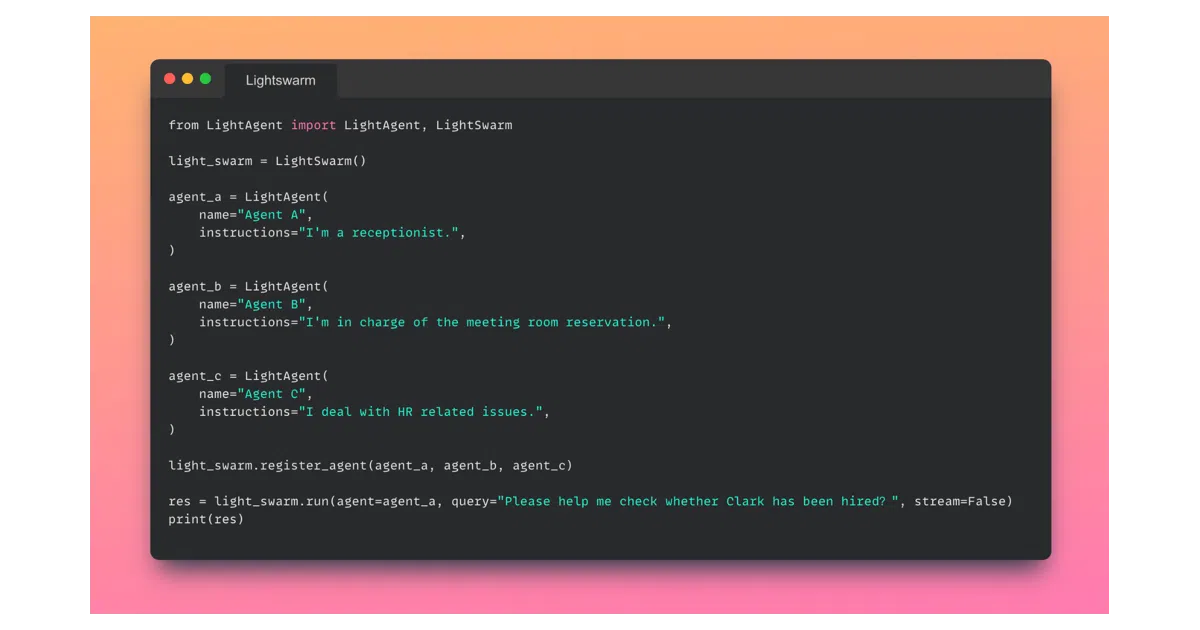
- LightSwarm: Built-in multi-agent collaboration with intent recognition and task delegation; the README claims it’s “simpler to implement than Swarm” (OpenAI’s, presumably).
- LightFlow (v0.8.0): Deterministic DAG workflows with step output passing, retries, and trace events — a separate mode from the agentic swarm.
- Trace observability (v0.7.0): Opt-in structured tracing of run lifecycle, model requests, tool calls, and errors without breaking the default string return.
- Skills architecture (v0.6.0): Refactored core with reusable, composable capabilities bundling memory, tools, and tree-of-thought reasoning.
- Broad model support: OpenAI, DeepSeek, Qwen, OpenRouter, vLLM, llama.cpp, and anything else OpenAI-compatible.
- Academic backing: arXiv preprint (2509.09292) exists, suggesting this isn’t just a weekend repo.
Caveats
- The “self-learning” and “autonomous learning” claims are vague — the README describes scene memory and learning “from user conversations” but offers no detail on mechanism or evaluation.
- Several headline features are marked “Coming Soon”: agent-to-agent message passing and a built-in assessment tool don’t exist yet.
- The v0.8.0 “LightFlow” and v0.7.0 tracing are labeled “Development” releases, not stable.
- The README’s performance claims (80% token reduction, 52% speed improvement) lack methodology or reproducible benchmarks.
Verdict
Worth a look if you’re building agent systems and find LangChain’s abstraction stack exhausting. Skip it if you need mature, battle-tested orchestration — the fast release cadence and “Development” tags suggest the API surface is still shifting underfoot.
Frequently asked
- What is wanxingai/LightAgent?
- LightAgent bets that most AI frameworks are overbuilt, so it strips out LangChain and LlamaIndex to ship a minimal Python core with memory, MCP, and multi-agent swarms.
- Is LightAgent open source?
- Yes — wanxingai/LightAgent is open source, released under the Apache-2.0 license.
- What language is LightAgent written in?
- wanxingai/LightAgent is primarily written in Python.
- How popular is LightAgent?
- wanxingai/LightAgent has 1.2k stars on GitHub.
- Where can I find LightAgent?
- wanxingai/LightAgent is on GitHub at https://github.com/wanxingai/LightAgent.