voicepaw/so-vits-svc-fork
A realtime voice conversion fork the maintainers have already retired
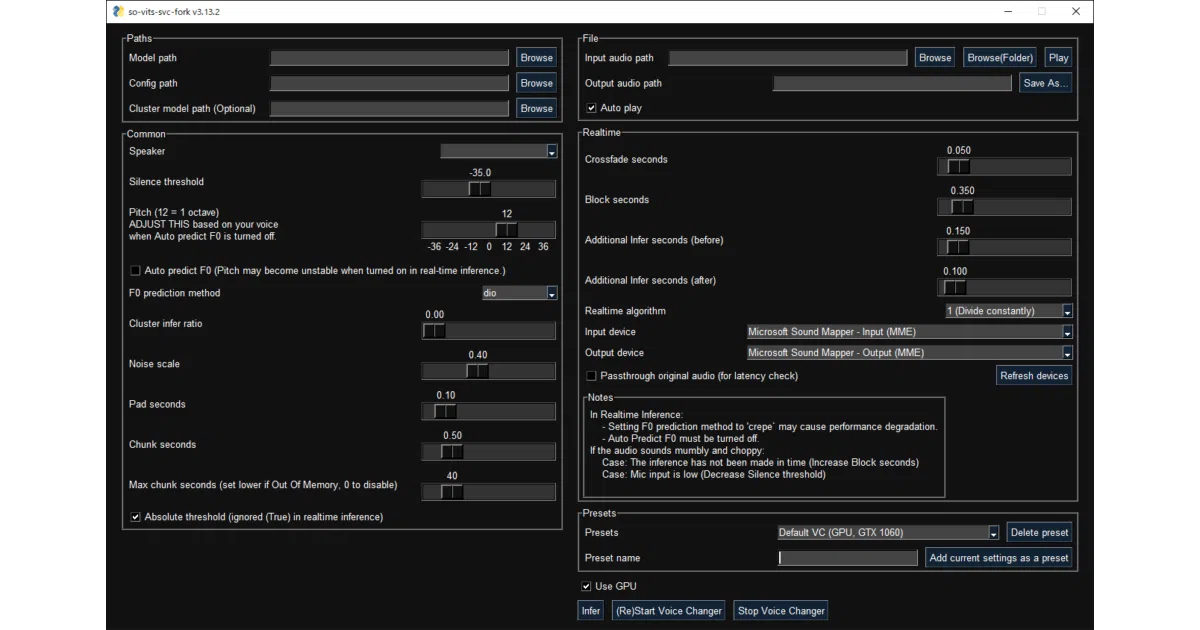
It packages the so-vits-svc singing voice converter with a GUI, unified CLI, and realtime support so you don't have to wrestle with the original setup.
Not currently ranked — collecting fresh signals.
star history
What it does
so-vits-svc-fork is a downstream wrapper of the so-vits-svc singing voice conversion model. It adds a GUI, a unified CLI, and realtime inference capabilities that the original repository lacked. The project also integrates QuickVC partially, swaps in CREPE for pitch estimation, and fixes a ContentVec misuse from upstream. It is distributed via PyPI and automatically fetches pretrained models, removing the need to manually install fairseq.
The interesting bit
The most striking thing about the repository is how candid its authors are: they explicitly state it is no longer maintained because the 2023 voice-changer boom has subsided and superior alternatives like RVC and DDSP-SVC have since taken over. That honesty is refreshing in a field littered with abandoned projects that pretend otherwise. The README even warns against influencers who are “quite overly surprised” by new projects.
Key highlights
- Realtime voice conversion from microphone input, with a GUI and unified CLI.
- ~2x faster training compared to the original repository.
- Fixes upstream misuse of ContentVec and uses CREPE for more accurate pitch estimation.
- Ships as a PyPI package with automatic pretrained model downloads; no manual fairseq installation needed.
- Partial QuickVC integration and support for MS-iSTFT Decoder configuration.
Caveats
- The project is no longer maintained; updates have been limited to maintenance since Spring 2023, and the authors recommend actively maintained alternatives such as Applio or DDSP-SVC.
- It only supports 4.0 (v1) models; 4.1 models and other model formats are explicitly not supported.
- Realtime inference requires at least 4 GB of VRAM for GPU mode, and the HuBERT model can react to input noise, which may affect output quality.
Verdict
Worth a look if you specifically need a pip-installable, offline-capable so-vits-svc 4.0v1 environment and can tolerate an unmaintained codebase. Everyone else should probably follow the authors’ own advice and jump to a newer alternative like the RVC family.
Frequently asked
- What is voicepaw/so-vits-svc-fork?
- It packages the so-vits-svc singing voice converter with a GUI, unified CLI, and realtime support so you don't have to wrestle with the original setup.
- Is so-vits-svc-fork open source?
- Yes — voicepaw/so-vits-svc-fork is an open-source project tracked on heatdrop.
- What language is so-vits-svc-fork written in?
- voicepaw/so-vits-svc-fork is primarily written in Python.
- How popular is so-vits-svc-fork?
- voicepaw/so-vits-svc-fork has 9.3k stars on GitHub.
- Where can I find so-vits-svc-fork?
- voicepaw/so-vits-svc-fork is on GitHub at https://github.com/voicepaw/so-vits-svc-fork.