vllm-project/production-stack
The vLLM project's answer to 'just run it in Kubernetes'
Because running one vLLM instance is easy; running a resilient, observable fleet on Kubernetes is not.
Not currently ranked — collecting fresh signals.
star history
What it does
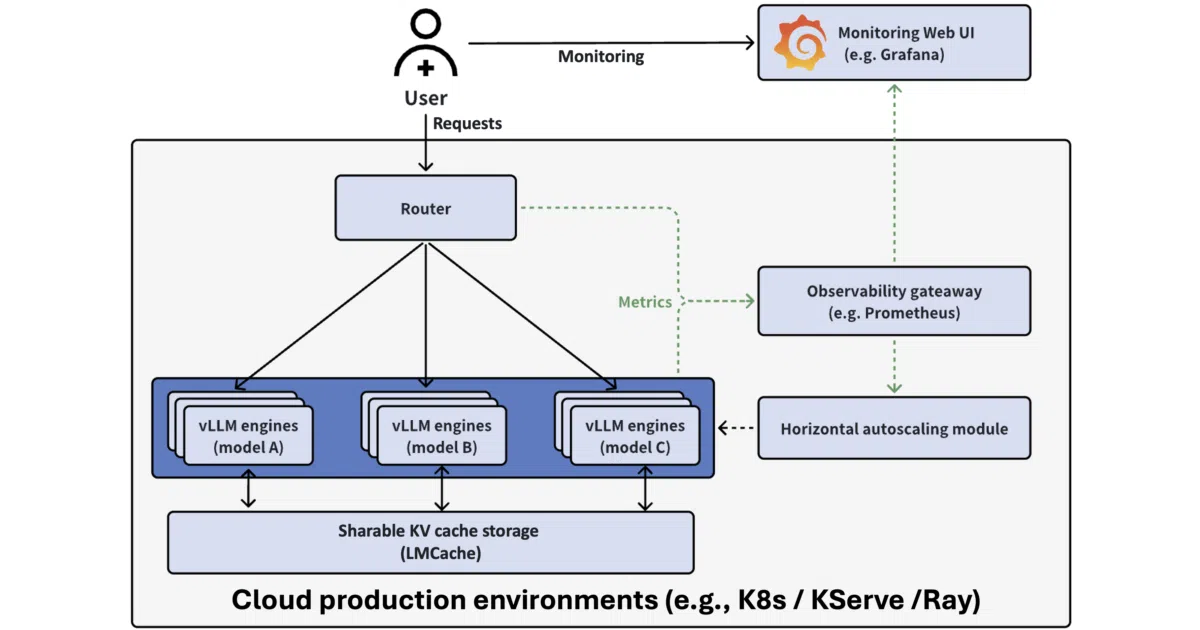
This is a Helm-based reference architecture that wraps vLLM engines in a Kubernetes-native serving layer. It adds a request router, Prometheus/Grafana observability, and hooks for KV-cache offloading so you can scale from a single pod to a distributed deployment without touching client code. The stack exposes the standard OpenAI API interface, making it a drop-in replacement for a standalone vLLM server.
The interesting bit
The router is the quiet star: it routes by session ID or prefix to maximize KV-cache reuse across backends, and the project is explicitly building toward KV-cache-aware algorithms and disaggregated prefill. That suggests the team is treating the inference fleet less like a stateless microservice and more like a coordinated cache hierarchy.
Key highlights
- Drop-in OpenAI API compatibility; clients need no changes to hit a distributed backend.
- Router supports round-robin, session-ID, and prefix-aware (WIP) routing with automatic Kubernetes service discovery.
- Bundled Grafana dashboard tracks TTFT, GPU KV-cache hit rates, pending/running requests, and instance health.
- Integrates with LMCache for KV-cache offloading.
- Roadmap includes autoscaling based on vLLM-specific metrics and a non-Python router rewrite for performance.
Caveats
- Prefix-aware routing is marked WIP, and several router improvements remain on the 2026 roadmap rather than in the current release.
- The project is tightly coupled to Kubernetes and Helm; there is no supported bare-metal or Docker Compose path visible in the sources.
Verdict
Worth a look if you are already running vLLM and need an official, opinionated way to move it to a multi-node Kubernetes fleet. Skip it if you are not on K8s or if you need a fully managed, autoscaling solution today—the autoscaler is still coming.
Frequently asked
- What is vllm-project/production-stack?
- Because running one vLLM instance is easy; running a resilient, observable fleet on Kubernetes is not.
- Is production-stack open source?
- Yes — vllm-project/production-stack is open source, released under the Apache-2.0 license.
- What language is production-stack written in?
- vllm-project/production-stack is primarily written in Python.
- How popular is production-stack?
- vllm-project/production-stack has 2.7k stars on GitHub.
- Where can I find production-stack?
- vllm-project/production-stack is on GitHub at https://github.com/vllm-project/production-stack.