uu201/character-arc
When your novel needs a project manager, not a chatbot
Most AI writing tools are just chatbots; CharacterArc is a local-first desktop workshop that structures long fiction like a software project, complete with world bibles, relationship graphs, and task-specific AI agents.
Not currently ranked — collecting fresh signals.
star history
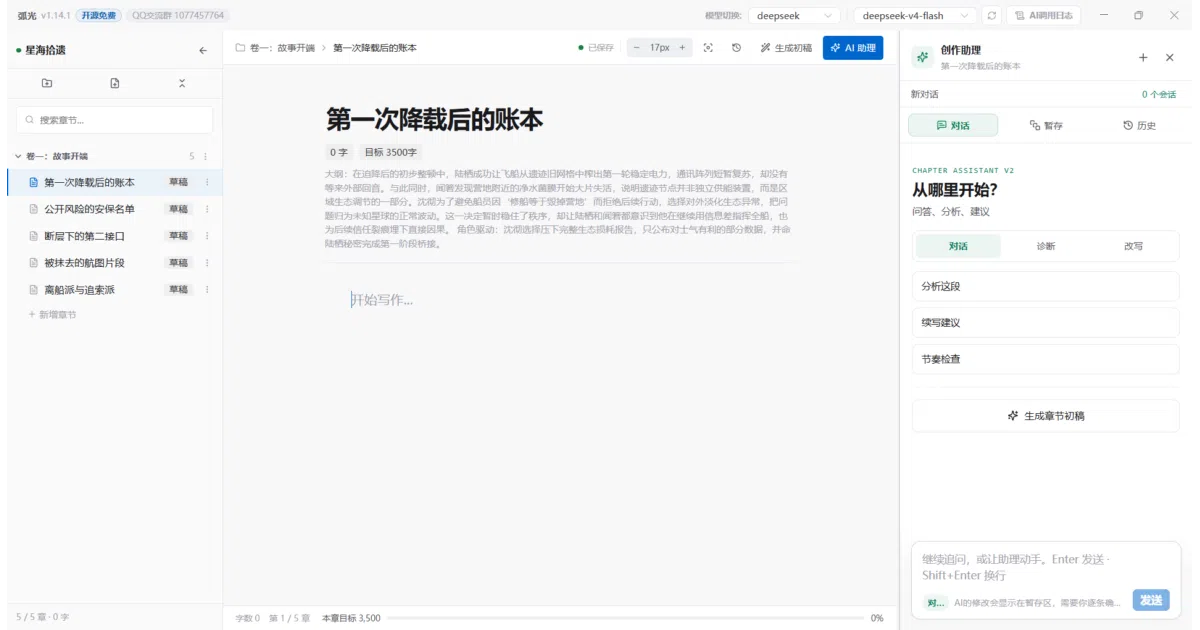
What it does CharacterArc is an Electron-based desktop application for writing long-form fiction. It keeps world-building bibles, character relationship maps, plot outlines, and chapter drafts in local SQLite storage, and routes AI tasks through an internal pipeline supporting OpenAI-compatible and Anthropic models. The interface centers on a three-column chapter editor and a drag-and-drop plot timeline, anchoring the writing process to project structure rather than open-ended chat.
The interesting bit
Instead of treating AI like a generic text generator, the app uses a Skill system and an Agent Loop that lets models consult project-specific tool registries and context routers before acting—essentially handing the model a handbook instead of a blank page. It also scrubs reasoning tokens from models like DeepSeek and Kimi so they do not leak into exported prose.
Key highlights
- Local-first architecture: all project data lives in a local SQLite database with full JSON snapshot export.
- Structured fiction pipeline: world views, character org charts, relationship graphs (
Cytoscape), and a dual-column plot timeline feed directly into chapter drafting. - Skill-driven AI: built-in and project-level
Skillpackages guide task-specific generation, from first-draft flows with audit/repair steps to reference-work disassembly. - Multi-model support: plugs into OpenAI-compatible APIs, Anthropic protocols, and local
Ollamainstances, with quick-switch profiles in the title bar. - Cover workbench: generates platform-specific cover prompts and preview images for Chinese web-novel sites including 番茄, 起点, and 晋江.
Caveats
- macOS builds are currently ad-hoc signed and not notarized, so distributing outside internal testing requires extra Apple developer certificate setup.
- Reasoning content visibility depends on whether the model or proxy actually passes through
reasoningfields, which means AI debug behavior can vary by provider configuration.
Verdict A solid fit for novelists who approach world-building like systems engineering and want AI collaboration without cloud dependency. If you are looking for a lightweight distraction-free editor or a simple chat interface, this will feel like overkill.
Frequently asked
- What is uu201/character-arc?
- Most AI writing tools are just chatbots; CharacterArc is a local-first desktop workshop that structures long fiction like a software project, complete with world bibles, relationship graphs, and task-specific AI agents.
- Is character-arc open source?
- Yes — uu201/character-arc is open source, released under the MIT license.
- What language is character-arc written in?
- uu201/character-arc is primarily written in TypeScript.
- How popular is character-arc?
- uu201/character-arc has 577 stars on GitHub.
- Where can I find character-arc?
- uu201/character-arc is on GitHub at https://github.com/uu201/character-arc.