usehelix/helix
Your AI agent broke a payment call. Again. Helix remembers the fix.
A self-healing runtime that wraps agent functions, diagnoses failures, applies repairs, and stores them in a reinforcement-learned knowledge base so the same error never costs you twice.
Not currently ranked — collecting fresh signals.
star history
What it does
Helix is a TypeScript/Python wrapper around async functions — mostly payment calls for AI agents right now. When a wrapped function throws, a six-stage pipeline diagnoses the error, generates a fix, scores it, executes it, verifies it worked, and stores the repair in a SQLite “Gene Map” scored by reinforcement learning. Next identical error hits in under 1ms with zero LLM cost. The project also ships a generic core (@vial/core) and a second vertical for API failures (rate limits, auth expiry, 5xx).
The interesting bit
The “Gene Map” is the unusual part: a local procedural memory that turns one agent’s painful debugging into every agent’s instant reflex. The README claims 1,083 on-chain transactions at 99.9% success vs. 81.9% for blind retry, and a warm repair dropping from 2,140ms/$0.49 to 1.1ms/$0.00. Whether those numbers hold in the wild is unclear — the eval harness lives in experiments/ but isn’t summarized — but the architecture is at least explicit about what it’s measuring.
Key highlights
- Three safety modes:
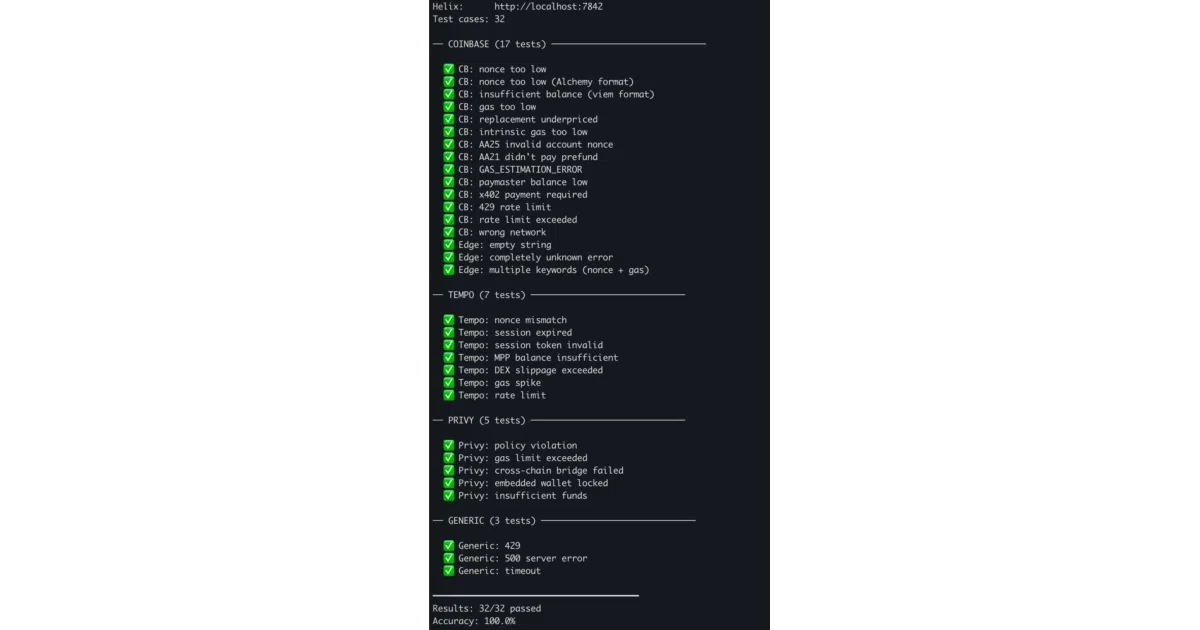
observe(diagnose only),auto(fix params and retry),full(includes fund movement) - 61 pre-catalogued error patterns across Coinbase, Tempo, Privy, and generic HTTP
- 7 pre-execution safety constraints: never modifies recipient address or calldata
- Federated learning module for privacy-preserving cross-agent knowledge sharing
- CLI includes
self-playfor autonomous error discovery anddreamfor memory consolidation - n8n community node and “agentfolded” one-command deployment for Claude Code/Cursor/Codex
Caveats
- The 90.3% auto-recovery figure in the repo description doesn’t appear in the README; the cited benchmarks are 99.9% (on-chain) and 91% (Web2 microservices), so the headline number’s provenance is unclear
- “VialOS Runtime” is referenced heavily but lives in a separate repo; Helix is essentially a vertical product on top of it, not a standalone invention
- Several roadmap items (Gene Registry Cloud, Budget Predictor, CI/CD vertical) are marked not started
- The README warns that
npx helixinstalls a wrong third-party package — naming collision already exists
Verdict
Worth a look if you’re running autonomous agents against flaky payment APIs and tired of writing the same retry logic. Skip it if you need mature, battle-tested infrastructure today — the federated learning and cloud registry are still on the roadmap, and the core engine’s real-world stress testing isn’t publicly documented yet.
Frequently asked
- What is usehelix/helix?
- A self-healing runtime that wraps agent functions, diagnoses failures, applies repairs, and stores them in a reinforcement-learned knowledge base so the same error never costs you twice.
- Is helix open source?
- Yes — usehelix/helix is open source, released under the MIT license.
- What language is helix written in?
- usehelix/helix is primarily written in TypeScript.
- How popular is helix?
- usehelix/helix has 816 stars on GitHub.
- Where can I find helix?
- usehelix/helix is on GitHub at https://github.com/usehelix/helix.