unsky/FPN
A 2017 FPN reimplementation that still teaches anchor math
Unofficial Caffe port of Feature Pyramid Networks with VOC results and hard-won lessons about anchor scales.
Not currently ranked — collecting fresh signals.
star history
What it does
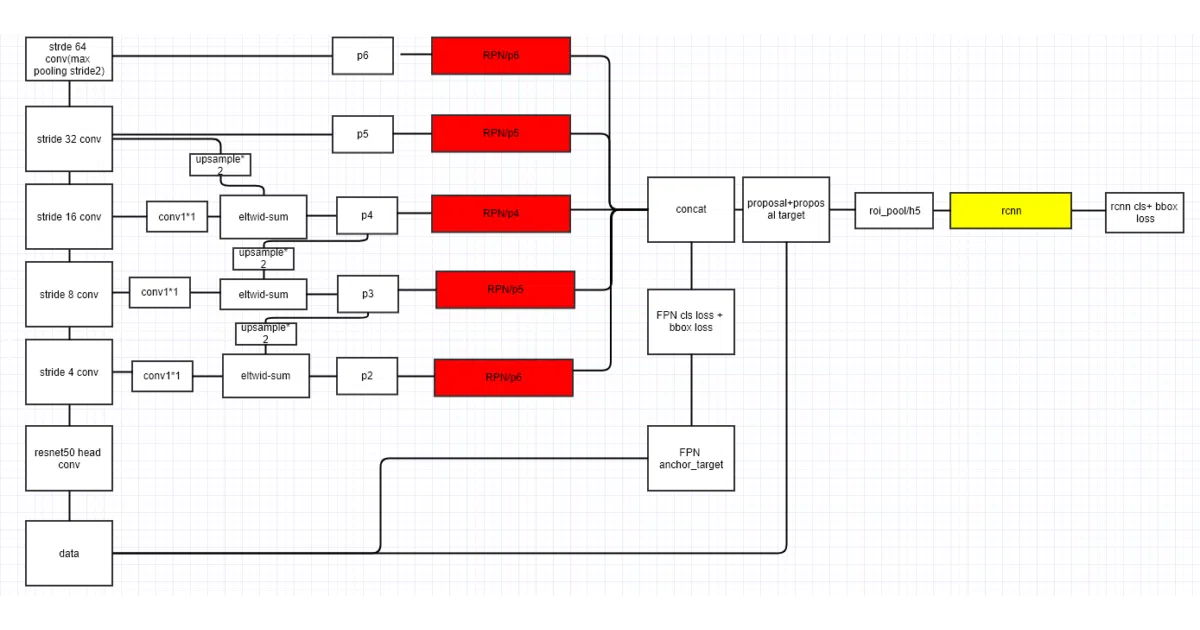
This is an unofficial Caffe implementation of Facebook AI’s 2016 Feature Pyramid Network paper for object detection. It trains on Pascal VOC 2007+2012 and reports mAP@0.5 scores around 0.78–0.79 for both “merged” and “shared” R-CNN variants. The repo includes network definitions, training scripts, and a specific anchor configuration tuned for VOC’s object size distribution.
The interesting bit
The README’s most useful section isn’t the results table—it’s the honest note about anchor scales. The authors discovered that the paper’s default COCO anchors (spanning 32–1024 px) fail on VOC because VOC objects cluster around 128–512 px. Their fix—adding a 16 scale to get [8, 16]—is the kind of dataset-specific tweak that papers skip but practitioners need. The network architecture diagrams are also browseable via Netscope links, which is a nice touch for 2017.
Key highlights
- Two R-CNN variants: “merged” (0.788 mAP) and “shared” (0.783 mAP) with full per-class breakdowns
- Requires ~10 GB GPU for training, ~6 GB for inference—roughly mid-range by 2017 standards
- Ships with Caffe build instructions and shell scripts for end-to-end training
- Anchor design rationale is explicitly documented, not buried in code
- Network graphs available as interactive Netscope visualizations
Caveats
- Caffe-based, which means you’ll need to compile a custom fork (
caffe-fpn) and deal with 2017-era dependencies - The README warns you’ll need to hunt down a ResNet50.v2 caffemodel from OneDrive
- No mention of COCO results, multi-GPU training, or modern framework ports (PyTorch, etc.)
- “Unoffical” [sic] is right there in the first line—expect rough edges
Verdict
Worth a look if you’re studying FPN internals, debugging anchor design for small datasets, or maintaining legacy Caffe pipelines. Skip it if you want a batteries-included, modern implementation—Detectron2 and mmdetection have superseded this years ago.
Frequently asked
- What is unsky/FPN?
- Unofficial Caffe port of Feature Pyramid Networks with VOC results and hard-won lessons about anchor scales.
- Is FPN open source?
- Yes — unsky/FPN is an open-source project tracked on heatdrop.
- What language is FPN written in?
- unsky/FPN is primarily written in Jupyter Notebook.
- How popular is FPN?
- unsky/FPN has 526 stars on GitHub.
- Where can I find FPN?
- unsky/FPN is on GitHub at https://github.com/unsky/FPN.