trycompai/crm
A CRM built backwards: the agent is the product
Most CRMs make humans research and type; this one built a durable agent to do both, using the database as its notebook.
Feature · 03 Aug 2026
Inside the CRM That Treats the Database as a Side Effect
The open-source project inverts CRM architecture so a durable research agent, not a human, decides what is true about your customers.
Read the in-depth article →
Velocity · 7d
+137
★ / day
Trend
↗accelerating
star history
What it does
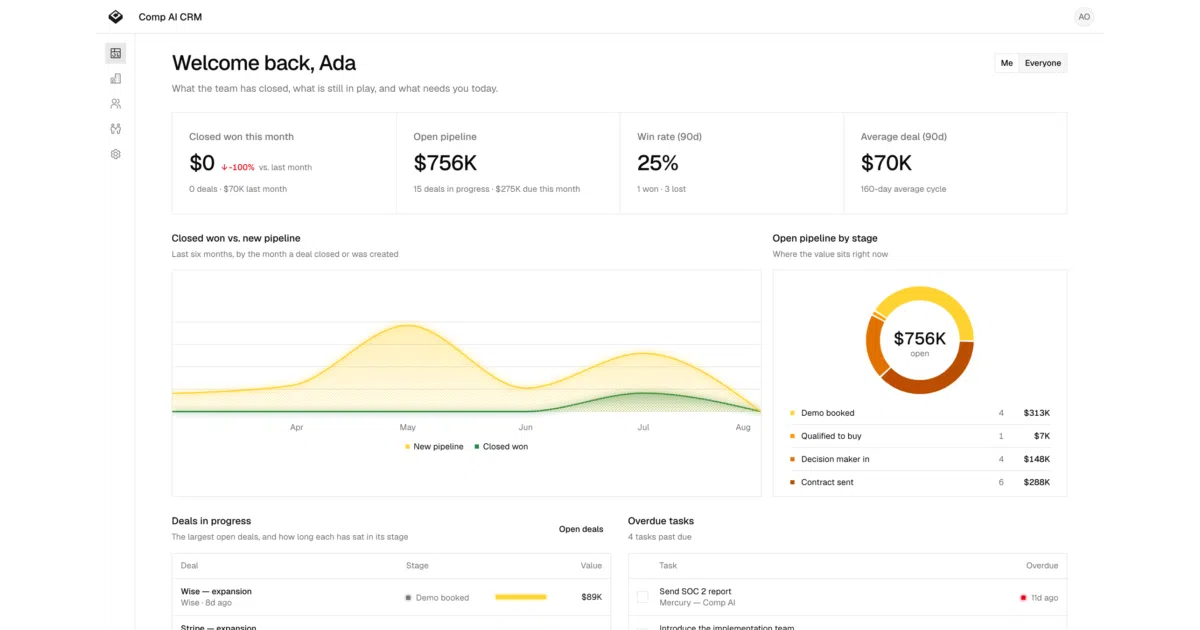
trycompai/crm treats the database as a side effect. A durable research agent runs on its own schedule, leasing tasks from a work queue and deciding what to research next, while the NestJS API deliberately reports that something happened and leaves the meaning to the agent. The result is a CRM where contacts, companies, and deals are largely written by something that keeps working after you close the browser.
The interesting bit
The system enforces an unusual epistemic humility: no tool accepts a confidence score, because a model asked to grade its own certainty will lie in the direction that makes it look useful. Instead, tools report only what they observed—crm.signature-block, github.account-identity—and a ledger prices the evidence before it ever reaches the record.
Key highlights
- Built on Vercel’s
eveframework with 18 tools, 4 markdown skills, and a sandbox withdeny-allegress and no database access. - Runs without any external API keys, falling back to your own mailbox threads and signature blocks as the best available evidence.
- Front end is Next.js with
nuqsfor URL state; API is NestJS with tRPC; list views are copy-pasteable links. - Single-tenant by design: Google-only auth, one allow-list environment variable, and no organizations or role-based permissions.
Caveats
- Strictly internal and single-tenant: everyone who signs in sees everything, and the README warns you to read
SECURITY.mdbefore pointing it at real customer data. - The interactive Agent tab requires a shared bridge secret between processes; without it, the tab simply reports the feature is not configured.
Verdict
Try it if you want a CRM that actually performs research instead of just storing it, but look elsewhere if you need multi-tenant SaaS auth or a chatbot bolted onto a database form.
Frequently asked
- What is trycompai/crm?
- Most CRMs make humans research and type; this one built a durable agent to do both, using the database as its notebook.
- Is crm open source?
- Yes — trycompai/crm is open source, released under the MIT license.
- What language is crm written in?
- trycompai/crm is primarily written in TypeScript.
- How popular is crm?
- trycompai/crm has 10.3k stars on GitHub and is currently accelerating.
- Where can I find crm?
- trycompai/crm is on GitHub at https://github.com/trycompai/crm.