truefoundry/trueforge
Your LLM needs a harness, not another framework
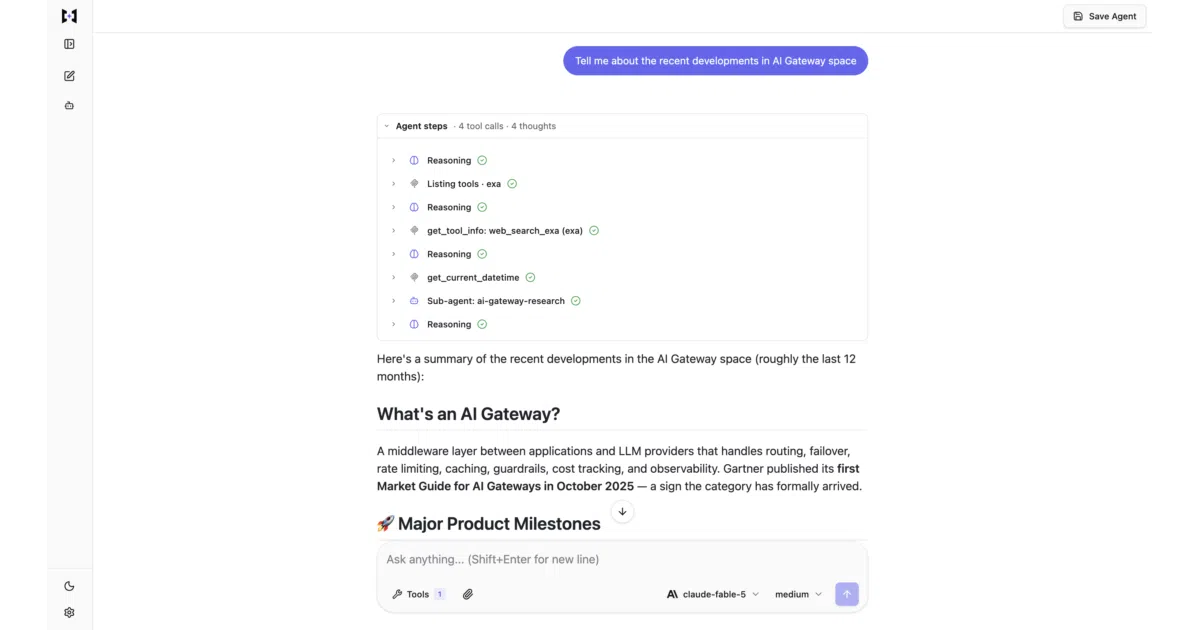
TrueForge runs the full agent execution loop—model calls, tools, sandboxing, approvals, and state—behind a single API and chat UI.
Velocity · 7d
+6.6
★ / day
Trend
↘cooling
star history
What it does
TrueForge is a self-hostable runtime layer that turns an LLM into a working agent. It manages the full execution loop—streaming model calls, MCP tool servers, sandboxed code execution, human-in-the-loop approvals, and session persistence—and exposes it through a bundled chat UI, an HTTP API, and a TypeScript SDK. You configure models, tools, and sandboxes once via YAML catalogs; agents pick from what you connected.
The interesting bit
Instead of treating sandboxed execution as infrastructure, TrueForge provisions a Daytona container on demand and exposes it as just another tool, keeping secrets inside the harness. It also loads git-backed SKILL.md instruction packs into that sandbox when needed, so an agent can carry specialized context without bloating every prompt.
Key highlights
- Catalog-driven setup: Configure models, MCP servers, skills, and sandboxes in one place; agents consume what you connected.
- Sandbox-as-a-tool: Isolated code and file execution via Daytona, spun up only when needed, with secrets kept out of the agent context.
- Human checkpoints: Built-in tool approval, user questions, and Generative UI inside the chat interface.
- Two deployment modes: Local mode with SQLite for experimentation, or hosted mode with Postgres and Redis for teams.
- Benchmarked: The project publishes reproducible benchmarks comparing cost and accuracy against Claude Managed Agents and deepagents.
Caveats
- Local mode is not production-safe: It runs without authentication and stores data in a local SQLite file; the README explicitly warns against exposing it to the internet.
- Sandbox provider lock-in: Code execution currently relies on Daytona; additional providers are planned but not yet available.
Verdict
TrueForge is worth a look if you are tired of gluing together model APIs, tool servers, and sandboxing just to get a reliable agent loop. If you only need a thin wrapper around a single LLM call, it will feel like overkill.
Frequently asked
- What is truefoundry/trueforge?
- TrueForge runs the full agent execution loop—model calls, tools, sandboxing, approvals, and state—behind a single API and chat UI.
- Is trueforge open source?
- Yes — truefoundry/trueforge is open source, released under the MIT license.
- What language is trueforge written in?
- truefoundry/trueforge is primarily written in TypeScript.
- How popular is trueforge?
- truefoundry/trueforge has 6.1k stars on GitHub and is currently cooling off.
- Where can I find trueforge?
- truefoundry/trueforge is on GitHub at https://github.com/truefoundry/trueforge.