tommy0103/obelisk
Your agent's session history, finally queryable — by the agent
Obelisk indexes transcripts from Claude Code, Codex, Kimi, OMP, and Pi into one SQLite file so agents can query their own past work and you can browse it.
Velocity · 7d
+23
★ / day
Trend
↗accelerating
star history
What it does
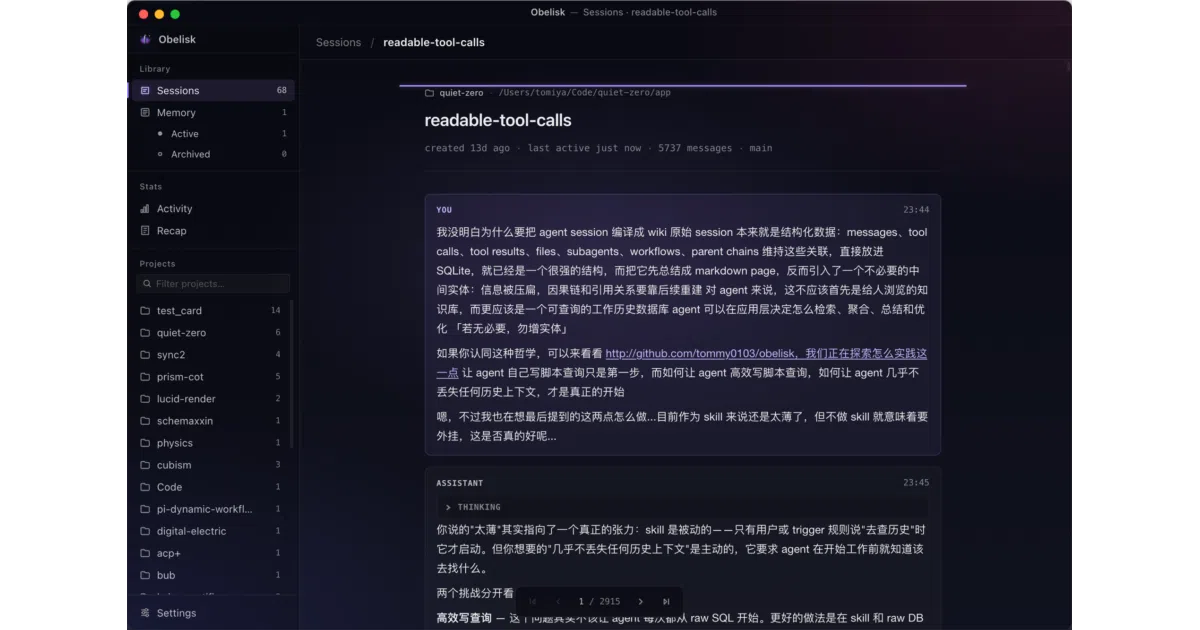
Obelisk builds a single SQLite index (~/.obelisk/obelisk.sqlite) out of the session transcripts that coding agents already scatter across your disk — Claude Code, Codex, DeepSeek Harness, Kimi Code, OMP, and Pi. Two consumers share that index: a CLI plus agent skill so your coding agent can write JS queries against its own history and answer questions in plain language, and an Electron desktop app for humans to browse sessions, usage stats, and weekly recap cards. First index build takes roughly five seconds per hundred sessions, then it rebuilds incrementally and watches the source directories for live refresh.
The interesting bit
The retrieval loop is inverted: instead of you digging through logs, the agent writes a query (search(), context(), raw sql(), or structured helpers like failures and fileHistory) and synthesizes the answer. There’s also a memory layer — when a retrieval produces a conclusion worth keeping, the agent proposes a markdown memory file, and after your approval it’s recalled in future sessions. A synthesis cache, as the README honestly puts it, not a replacement for raw evidence.
Key highlights
- One schema for six providers; rows carry a
sourcevalue and provider-prefixed IDs so histories can’t collide - FTS5 full-text search across sessions, messages, tool calls, subagents, and workflows
- Handles messy provider semantics: Pi compaction/branch visibility, Kimi undo/clear replay, Codex child threads as subagents
- Human surface includes a GitHub-style activity heatmap, token charts, and shareable recap cards
- Runs fully local — everything reads from your own transcript directories
Caveats
- Prebuilt desktop releases are macOS-only for now; other platforms require running the Electron app from source
- Claude Code doesn’t attest rewind state, so superseded-history support varies by provider
- Some custom session directories (CLI-only roots, relative settings) can’t be auto-detected and must be set manually in Settings
Verdict
If you juggle multiple coding agents and ever asked “wait, which session fixed that auth bug?”, this is worth a look — especially since the agent does the digging. If you live in one tool and never revisit old sessions, it’s extra infrastructure you don’t need.
Frequently asked
- What is tommy0103/obelisk?
- Obelisk indexes transcripts from Claude Code, Codex, Kimi, OMP, and Pi into one SQLite file so agents can query their own past work and you can browse it.
- Is obelisk open source?
- Yes — tommy0103/obelisk is open source, released under the AGPL-3.0 license.
- What language is obelisk written in?
- tommy0103/obelisk is primarily written in JavaScript.
- How popular is obelisk?
- tommy0103/obelisk has 851 stars on GitHub and is currently accelerating.
- Where can I find obelisk?
- tommy0103/obelisk is on GitHub at https://github.com/tommy0103/obelisk.