tobegit3hub/advisor
Google Vizier, but you can actually run it locally
An open-source hyperparameter tuner that wraps a dozen search algorithms behind a clean CLI and web UI.
Not currently ranked — collecting fresh signals.
star history
What it does
Advisor is a black-box hyperparameter optimization system that clones the API of Google Vizier — the internal Google service for tuning ML models — but runs on your laptop, a Docker container, or Kubernetes. You define a “Study” (search space and goal), it spawns “Trials” with suggested parameters, and you report back metrics so it can learn.
The interesting bit
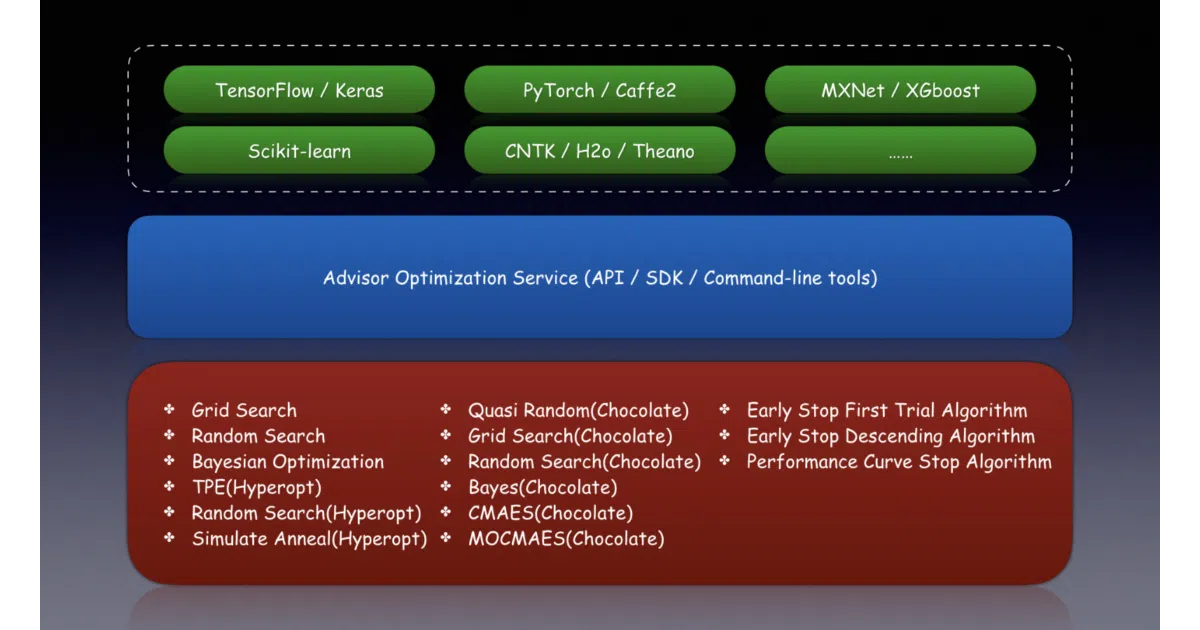
The project doesn’t implement algorithms from scratch; it glues together battle-tested libraries — Hyperopt, Chocolate, scikit-optimize — behind a unified Study/Trial abstraction. The value is the packaging: one pip install, one advisor_admin server start, and you have a web dashboard plus CLI that looks and feels like a first-class service rather than a scatter of Python scripts.
Key highlights
- Supports 13+ algorithms including Bayesian Optimization, TPE, CMA-ES, and quasi-random search
- Identical programming interface to Google Vizier (makes migration or paper-to-code translation easier)
- JSON or YAML configuration for search spaces with INTEGER, DOUBLE, DISCRETE, and CATEGORICAL parameters
- Ships with Docker, docker-compose, and Kubernetes manifests
- Web UI for browsing studies and trial metrics; Python SDK and CLI for automation
- Early-stop algorithms to kill unpromising trials before they waste GPU hours
Caveats
- SMAC and Performance Curve Stop algorithms are listed but not yet implemented
- The README still references Python 2.7 in the development setup, which may indicate stale docs
- No benchmark numbers or comparison tables against Optuna, Ray Tune, or NNI are provided
Verdict
Worth a look if you want Vizier’s conceptual model without Google’s infrastructure, or need a quick on-prem tuning server with a web UI. Skip it if you need cutting-edge multi-objective optimization or deep integration with distributed training frameworks — Ray Tune or Optuna have larger ecosystems there.
Frequently asked
- What is tobegit3hub/advisor?
- An open-source hyperparameter tuner that wraps a dozen search algorithms behind a clean CLI and web UI.
- Is advisor open source?
- Yes — tobegit3hub/advisor is open source, released under the Apache-2.0 license.
- What language is advisor written in?
- tobegit3hub/advisor is primarily written in Jupyter Notebook.
- How popular is advisor?
- tobegit3hub/advisor has 1.6k stars on GitHub.
- Where can I find advisor?
- tobegit3hub/advisor is on GitHub at https://github.com/tobegit3hub/advisor.