thu-ml/Causal-Forcing
Fixing autoregressive video distillation by enforcing causality
It provides the theoretically correct causal initialization that autoregressive video distillation was missing, enabling one-step to four-step generation without extra training overhead.
Not currently ranked — collecting fresh signals.
star history
What it does
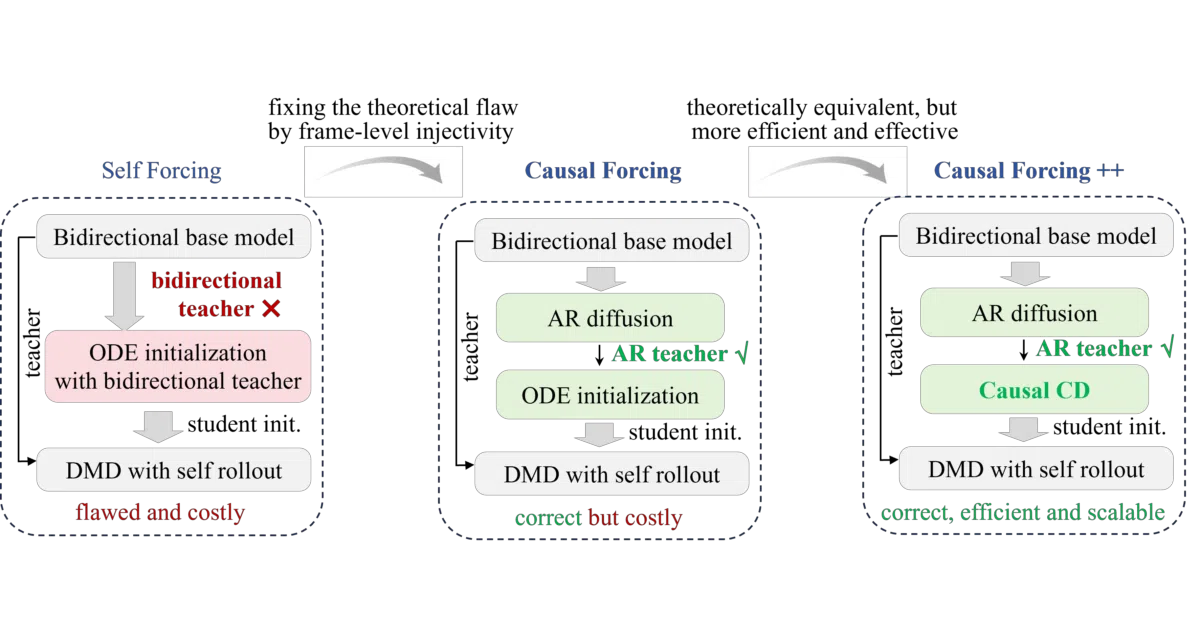
This project is a training recipe for autoregressive video diffusion built on Wan2.1. It inserts a causal initialization stage—either a Causal ODE or Causal Consistency Distillation—before standard asymmetric DMD distillation. The result is a family of few-step generators, including what the authors bill as the first frame-wise one-step and two-step autoregressive video models, that handle both text-to-video and image-to-video in the same frame-wise architecture.
The interesting bit
Most distillation methods treat the whole sequence symmetrically, which ignores the obvious: in video, the past causes the future, not the other way around. By baking that directional constraint into the ODE or consistency trajectory, the method reportedly outperforms Self Forcing on visual quality and motion dynamics while keeping the same training budget and inference speed.
Key highlights
- Frame-wise models natively unify T2V and I2V by conditioning on the first latent frame.
- Causal Forcing++ swaps the ODE stage for causal Consistency Distillation, removing the need to curate ODE paired data.
- Checkpoints cover chunk-wise 4-step, frame-wise 4-step, frame-wise 2-step, and frame-wise 1-step, plus a long-video variant.
- Training is three stages: autoregressive diffusion, causal initialization, and asymmetric DMD.
- The inference environment matches
Self Forcing, implying drop-in compatibility with existingWan2.1setups.
Caveats
- Native generation is hard-capped at 81 frames; the authors explicitly warn that benchmarking the 5-second model on long video is “extremely unfair.”
- The documentation is rich in training scripts but sparse on quantitative metrics or perceptual-study details beyond top-line claims.
Verdict
Worth a look if you are distilling Wan2.1 or building real-time interactive video pipelines and need a theoretically grounded initialization. Skip it if you want a turnkey long-video generator without external scaffolding.
Frequently asked
- What is thu-ml/Causal-Forcing?
- It provides the theoretically correct causal initialization that autoregressive video distillation was missing, enabling one-step to four-step generation without extra training overhead.
- Is Causal-Forcing open source?
- Yes — thu-ml/Causal-Forcing is open source, released under the Apache-2.0 license.
- What language is Causal-Forcing written in?
- thu-ml/Causal-Forcing is primarily written in Python.
- How popular is Causal-Forcing?
- thu-ml/Causal-Forcing has 1k stars on GitHub.
- Where can I find Causal-Forcing?
- thu-ml/Causal-Forcing is on GitHub at https://github.com/thu-ml/Causal-Forcing.