the-momentum/open-wearables
An open-source switchboard for wearable health data
Open Wearables wants to unify fitness tracker data behind one self-hosted API so developers can stop writing bespoke OAuth flows for every wearable brand.
Not currently ranked — collecting fresh signals.
star history
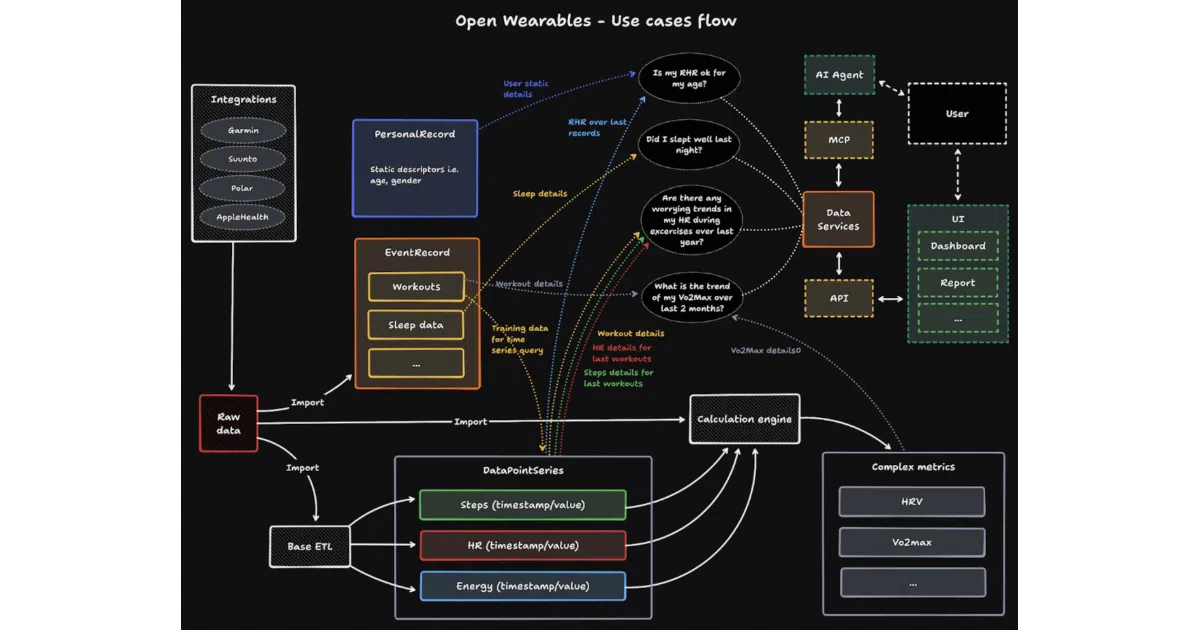
What it does Open Wearables is a self-hosted platform that aims to consolidate health data from wearable devices behind a single REST API. It currently supports OAuth-based workout data sync for Garmin, Polar, and Suunto, alongside mobile SDKs that push on-device data from Apple HealthKit, Samsung Health, and Google Health Connect. A web-based developer portal handles user management, API keys, and data source tracking, while the backend runs on FastAPI with PostgreSQL, Redis, and Celery.
The interesting bit The project treats wearable integration as infrastructure plumbing rather than a product feature: each deployment serves exactly one organization with no multi-tenancy overhead and no external authentication services. It also plans to let users define health automations in plain English and query metrics through an AI assistant, though both capabilities remain on the roadmap.
Key highlights
- Self-hosted by design, with self-contained authentication and no third-party auth services required.
- Native mobile SDKs for iOS, Android, Flutter, and React Native to bridge on-device health stores.
- Developer portal for user management, credential generation, and visualizing connected data sources.
- Background data syncing and processing handled by a Celery task queue.
- RESTful API with OpenAPI/Swagger documentation.
Caveats
- Only Garmin, Polar, and Suunto OAuth flows and workout data sync are currently available; broader cloud provider support is listed but not yet implemented.
- Core health data endpoints, AI-powered insights, natural-language automations, and embeddable widgets are all marked as “coming soon.”
- The README explicitly warns that the project is pre-1.0 and APIs may change before a stable release.
Verdict Teams building fitness or health apps who want to self-host their data pipeline and primarily need Garmin, Polar, or Suunto support should evaluate this now. If you require a mature, fully managed service or immediate integrations with Oura, Whoop, or Fitbit, it is still too early.
Frequently asked
- What is the-momentum/open-wearables?
- Open Wearables wants to unify fitness tracker data behind one self-hosted API so developers can stop writing bespoke OAuth flows for every wearable brand.
- Is open-wearables open source?
- Yes — the-momentum/open-wearables is open source, released under the MIT license.
- What language is open-wearables written in?
- the-momentum/open-wearables is primarily written in Python.
- How popular is open-wearables?
- the-momentum/open-wearables has 2.7k stars on GitHub.
- Where can I find open-wearables?
- the-momentum/open-wearables is on GitHub at https://github.com/the-momentum/open-wearables.