statmike/vertex-ai-mlops
470 notebooks on how Google actually runs ML
A practitioner's field guide to Vertex AI, BigQuery ML, and the rest of the Google Cloud data stack — with notebooks you can steal.
Not currently ranked — collecting fresh signals.
star history
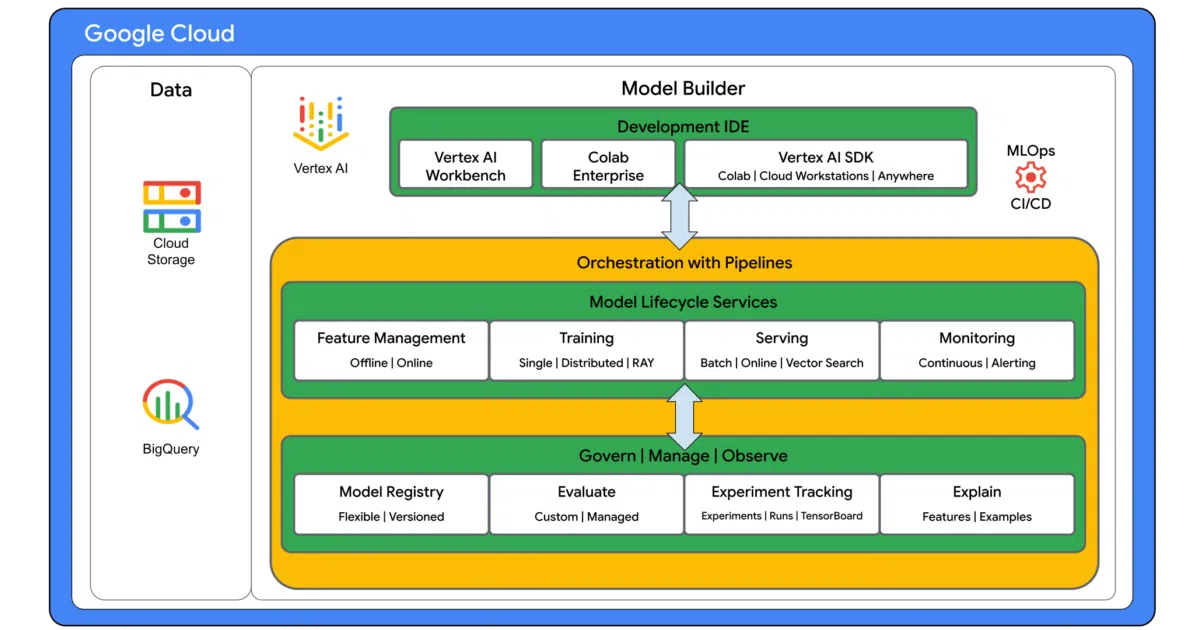
What it does This repo is a massive, curated notebook collection — 470+ of them — walking through end-to-end ML workflows on Google Cloud. It covers training, serving, feature stores, pipelines, model monitoring, and increasingly, agentic AI. Each section is a self-contained tutorial you can run, adapt, or copy into production.
The interesting bit The breadth is the point. Rather than siloing “MLOps” or “GenAI,” it shows how the pieces connect: BigQuery ML for SQL-native inference, Dataflow and Dataproc for batch/streaming, multiple databases as vector search backends, and now ADK-based agents on Agent Engine. It’s essentially a map of how Google Cloud’s data and AI services are supposed to fit together.
Key highlights
- 74 MLOps notebooks: serving (32), feature stores including a 15-notebook Bigtable deep dive (21), KFP pipelines (13), plus evaluation and monitoring
- 40 data+ai notebooks: 32 on BigQuery’s built-in AI functions (AI.GENERATE, AI.EMBED, etc.), plus Dataflow, Dataproc, AlloyDB, and Spanner inference patterns
- 53 Applied GenAI notebooks: retrieval across 11 databases with cost/latency comparisons, chunking, ranking, RAG Engine, and grounding verification
- 20 forecasting notebooks: ARIMA+ to TimesFM foundation models, all on NYC Citibike data
- 34 framework workflows: PyTorch (20 notebooks), Keras, CatBoost, AutoML, Flax, and even R on KFP
- 26 Applied ML notebooks including 8 AI agent projects with A2A protocol and Vertex AI Agent Engine deployment
Caveats
- The repo tracks Google’s branding chaos: “Vertex AI” is becoming “Gemini Enterprise Agent Platform,” so some paths may shift
- 470 notebooks means uneven depth — some sections are deep dives, others are quick starts
- Heavy Google Cloud lock-in; multi-cloud or open-source alternatives are not the focus
Verdict Essential if you’re building on Google Cloud and want to see how the services compose in practice. Skip it if you’re not on GCP or if you need framework-agnostic, portable patterns.
Frequently asked
- What is statmike/vertex-ai-mlops?
- A practitioner's field guide to Vertex AI, BigQuery ML, and the rest of the Google Cloud data stack — with notebooks you can steal.
- Is vertex-ai-mlops open source?
- Yes — statmike/vertex-ai-mlops is open source, released under the Apache-2.0 license.
- What language is vertex-ai-mlops written in?
- statmike/vertex-ai-mlops is primarily written in Jupyter Notebook.
- How popular is vertex-ai-mlops?
- statmike/vertex-ai-mlops has 704 stars on GitHub.
- Where can I find vertex-ai-mlops?
- statmike/vertex-ai-mlops is on GitHub at https://github.com/statmike/vertex-ai-mlops.