stanfordnlp/mac-network
A neural network that thinks in steps, not leaps
Stanford's MAC cell breaks visual reasoning into explicit, inspectable computation steps—rare honesty in a field that usually hides its work.
Not currently ranked — collecting fresh signals.
star history
What it does
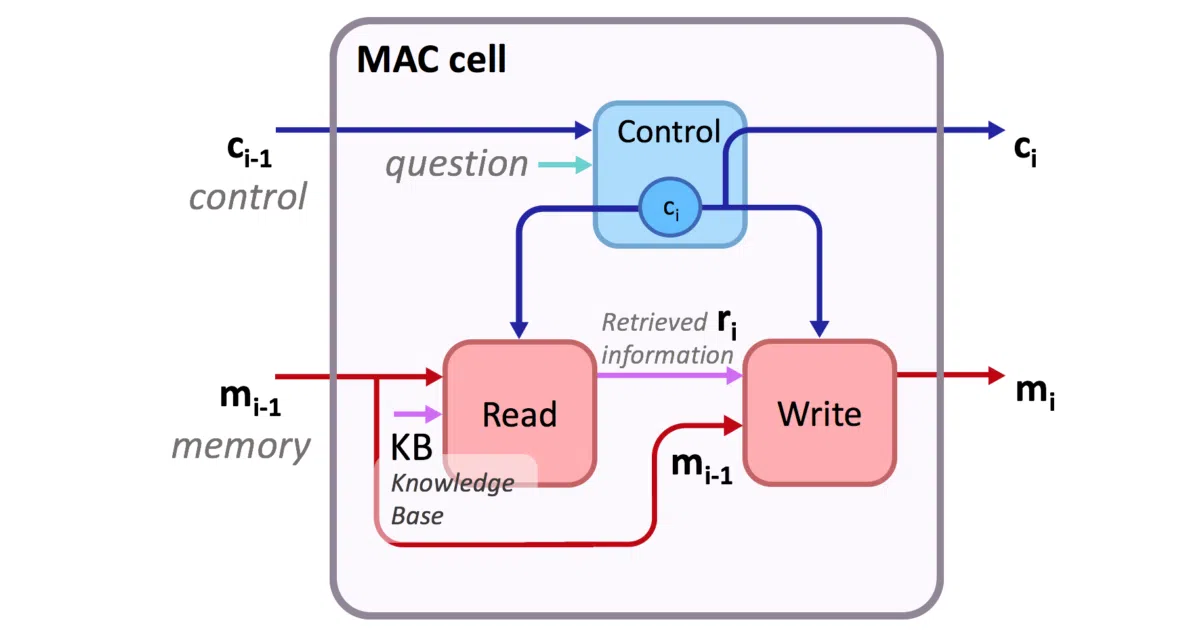
MAC (Compositional Attention Networks) answers complex visual questions by chaining together small reasoning steps. Each “MAC cell” reads the question, looks at the image, and updates a working memory—repeat 4–16 times, then answer. The implementation covers both the synthetic CLEVR benchmark and the newer, messier GQA dataset of real-world scenes.
The interesting bit
The attention maps are genuinely inspectable. The authors explicitly note that shorter networks (4–8 cells) produce more interpretable reasoning traces, while deeper ones trade transparency for accuracy. That’s an unusually frank admission that interpretability and performance pull in opposite directions.
Key highlights
- Fully differentiable multi-step reasoning with explicit memory and attention
- Supports both CLEVR (synthetic shapes) and GQA (real-world visual reasoning)
- Multiple model variants included: non-recurrent control, self-attention writes, memory gating
- TensorFlow 1.x codebase; assumes ~12GB GPU memory
- Visualization tools for attention maps, with ImageMagick polish tips included
Caveats
- TensorFlow 1.3-era code; “should work for later versions” is doing some lifting
- Several config options noted as “still in an experimental stage”
- GQA adaptations live on a separate branch, not mainline
Verdict
Worth studying if you’re building or evaluating neuro-symbolic architectures, or if you need a concrete baseline for compositional reasoning. Skip if you want production-ready modern PyTorch—this is research code from 2018, preserved more than maintained.
Frequently asked
- What is stanfordnlp/mac-network?
- Stanford's MAC cell breaks visual reasoning into explicit, inspectable computation steps—rare honesty in a field that usually hides its work.
- Is mac-network open source?
- Yes — stanfordnlp/mac-network is open source, released under the Apache-2.0 license.
- What language is mac-network written in?
- stanfordnlp/mac-network is primarily written in Python.
- How popular is mac-network?
- stanfordnlp/mac-network has 509 stars on GitHub.
- Where can I find mac-network?
- stanfordnlp/mac-network is on GitHub at https://github.com/stanfordnlp/mac-network.