stanford-iris-lab/meta-harness
Automated search for the code that wraps your LLM
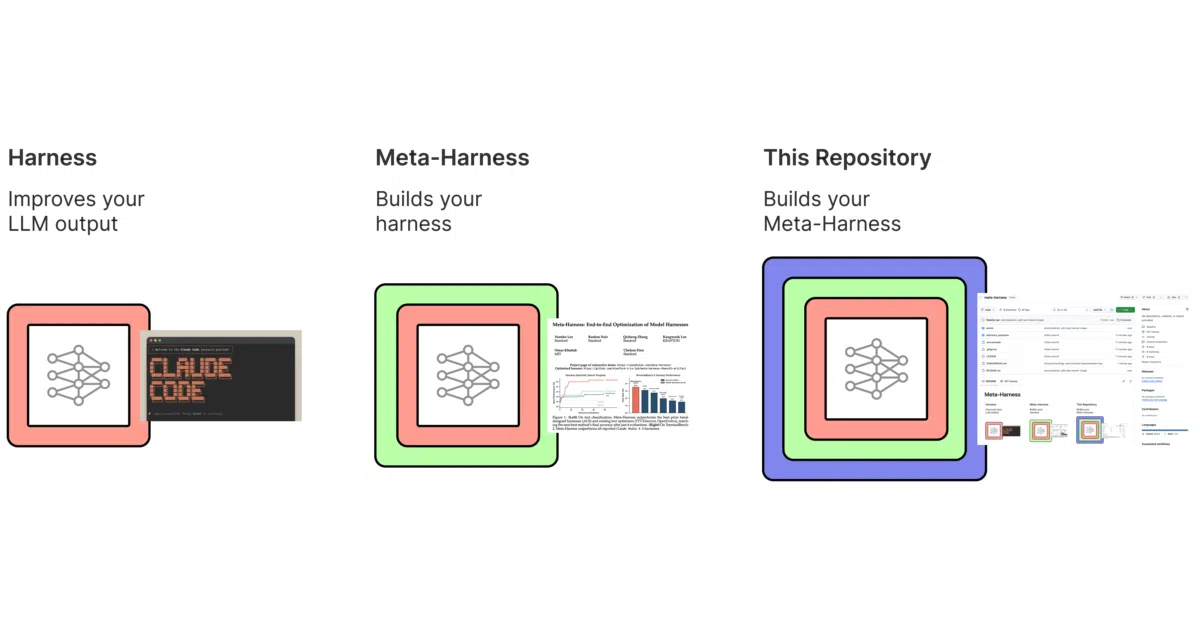
Automates the search for task-specific harnesses around a fixed base model, treating memory systems and scaffolding code as optimizable artifacts instead of hand-tuned glue.
Not currently ranked — collecting fresh signals.
star history
What it does
Meta-Harness is a framework that automatically searches for task-specific model harnesses — the code surrounding a fixed base model that decides what to store, retrieve, and show while the model works. It provides a reusable search loop and two reference experiments from the paper: one that searches memory systems for text classification, and another that evolves scaffolds for Terminal-Bench 2.0. The optimized Terminal-Bench 2 harness from the paper is maintained in a separate artifact repository.
The interesting bit
Instead of optimizing prompts or fine-tuning weights, Meta-Harness treats the entire surrounding infrastructure as the variable to evolve. The onboarding workflow even instructs you to hand ONBOARDING.md to your coding assistant and let it draft a domain_spec.md — a refreshingly candid automation of the setup process.
Key highlights
- Searches over harness code for a frozen base model, not weights or prompts
- Reference experiments cover memory-system search and terminal-task scaffold evolution
- Includes an
ONBOARDING.mddesigned to be fed to a coding assistant for domain adaptation - Proposer agent interactions are wrapped and logged; examples currently assume Claude Code
- Optimized paper artifacts are split into a separate repo to keep the core framework focused
Caveats
- The authors state this is a cleaned-up paper release that has only been verified to run, not thoroughly tested
- Reference examples assume Claude Code as the proposer agent; other agents require a new wrapper
- The optimized Terminal-Bench 2 harness is not in this repo; it lives in a separate artifact repository
Verdict
Useful if you are building agent infrastructure and want to automate the search for better scaffolding around a fixed model. Less relevant if you need battle-tested production tooling or are only looking to tweak prompts.
Frequently asked
- What is stanford-iris-lab/meta-harness?
- Automates the search for task-specific harnesses around a fixed base model, treating memory systems and scaffolding code as optimizable artifacts instead of hand-tuned glue.
- Is meta-harness open source?
- Yes — stanford-iris-lab/meta-harness is open source, released under the MIT license.
- What language is meta-harness written in?
- stanford-iris-lab/meta-harness is primarily written in Python.
- How popular is meta-harness?
- stanford-iris-lab/meta-harness has 1.6k stars on GitHub.
- Where can I find meta-harness?
- stanford-iris-lab/meta-harness is on GitHub at https://github.com/stanford-iris-lab/meta-harness.