srush/Tensor-Puzzles
Learn PyTorch by forbidding PyTorch
A collection of 21 one-line puzzles that break your reflex to reach for `torch.sum` by forcing you to rebuild it from broadcasting primitives.
Velocity · 7d
+2.0
★ / day
Trend
↘cooling
star history
What it does
Tensor Puzzles is a notebook of 21 exercises—styled like chess puzzles—where each asks you to reimplement a single NumPy standard-library function (such as cumsum, outer, or sequence_mask) in one line of PyTorch. The catch is a strict whitelist: you may use only broadcasting, arithmetic, comparison, indexing, and a handful of primitives like arange and where. Standard helpers such as view, sum, squeeze, or even the tensor constructor are off-limits.
The interesting bit
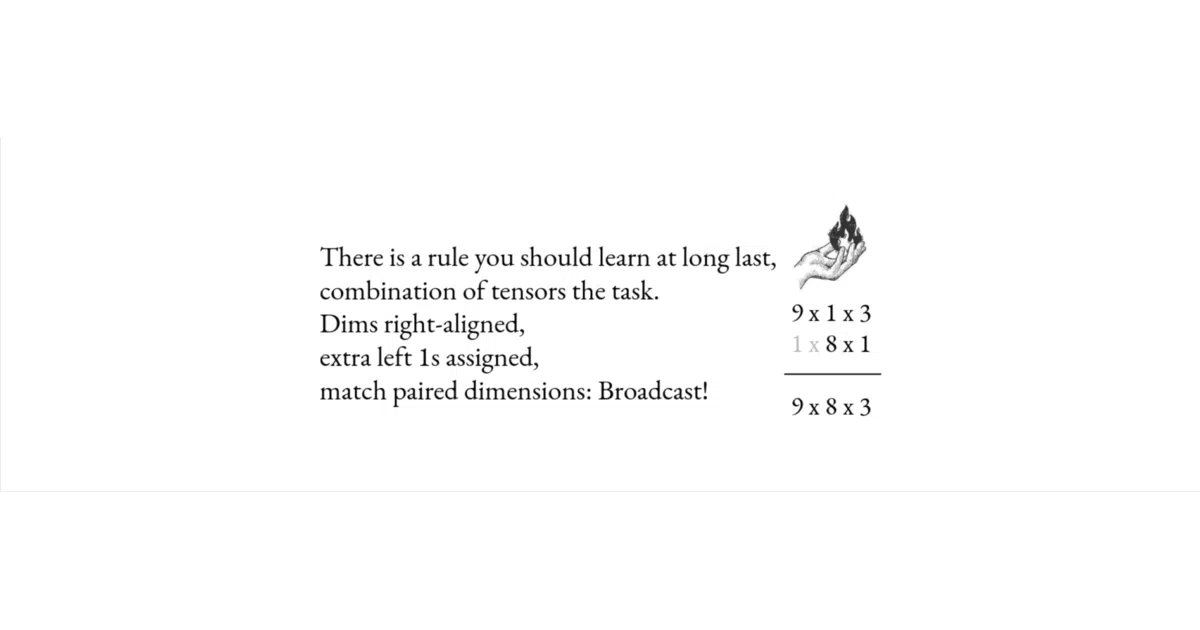
The project treats tensor programming as a language to be spoken fluently rather than a library to be memorized. By stripping away the “magic” convenience functions, you are forced to manipulate shape and broadcasting directly, which is exactly the skill that separates copy-paste StackOverflow solutions from actual comprehension.
Key highlights
- 21 puzzles ranging from
onesanddiagtoscatter_addandsequence_mask - Each solution must fit in a single line under 80 columns
- Visual SVG diagrams illustrate the input-output relationship for every puzzle
- Includes a YouTube walkthrough if you get stuck
- Designed to run in Google Colab with minimal dependencies
Caveats
- The README cuts off mid-list during the
scatter_adddescription, so the full roster of later puzzles is incomplete in the source - Some puzzle descriptions are extremely terse (e.g., “Compute pad_to”), so you may need to infer exact behavior from the reference spec
Verdict
Grab this if you are teaching PyTorch, interviewing for ML engineering roles, or simply tired of cargo-culting tensor code you do not fully understand. Skip it if you are looking for a reference manual or production-ready utilities; this is strictly a pedagogical constraint engine.
Frequently asked
- What is srush/Tensor-Puzzles?
- A collection of 21 one-line puzzles that break your reflex to reach for `torch.sum` by forcing you to rebuild it from broadcasting primitives.
- Is Tensor-Puzzles open source?
- Yes — srush/Tensor-Puzzles is open source, released under the MIT license.
- What language is Tensor-Puzzles written in?
- srush/Tensor-Puzzles is primarily written in Jupyter Notebook.
- How popular is Tensor-Puzzles?
- srush/Tensor-Puzzles has 4.4k stars on GitHub and is currently cooling off.
- Where can I find Tensor-Puzzles?
- srush/Tensor-Puzzles is on GitHub at https://github.com/srush/Tensor-Puzzles.