snflkd/fluent-korean
Claude’s Korean drops particles. A lit major wrote the fix
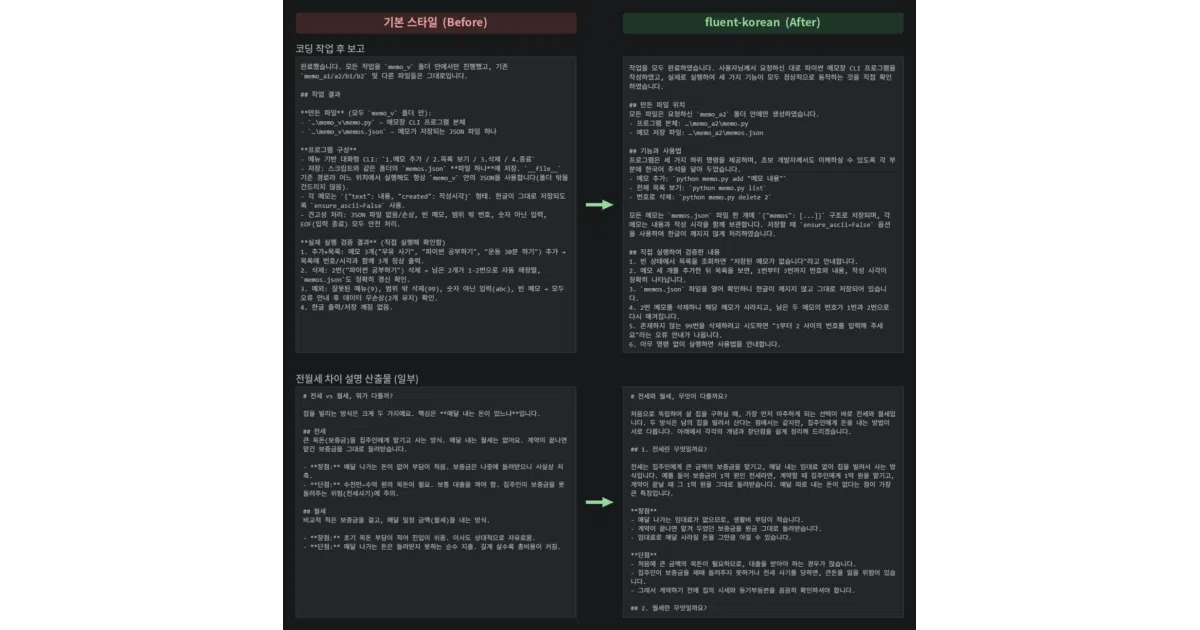
A Claude Code plugin that stops LLMs from writing broken machine-Korean—dropped particles, noun strings, and all.
Velocity · 7d
+3.3
★ / day
Trend
↘cooling
star history
What it does
fluent-korean is a Claude Code output-style plugin that preemptively instructs the model to write clear, unambiguous Korean. It targets the specific dysfluencies coding agents exhibit when squeezed for tokens: omitted particles and verb endings, telegraphic noun chains, and bizarre metaphor-swapped vocabulary. The goal is plain, reasonably natural Korean rather than elegant prose.
The interesting bit
The maintainer is a Korean-literature major, and the rules are tuned like a style guide rather than a translation layer. It ships as two variants—one that preserves Claude Code’s coding directives, and one that strips them out for non-coding tasks. You can also paste the underlying markdown instructions into other LLM contexts (web Claude, desktop app, or competing models) if you want the same behavioral guardrails.
Key highlights
- Fixes “machine-Korean” artifacts: dropped particles, telegraphic endings, and unnatural word choices.
- Two output-style variants:
fluent-korean(with coding instructions) andfluent-korean-not-coding(without). - Optional add-on blocks let you tune tone (polite vs. casual), target audience (beginner devs), genre sensitivity, and mandatory pre-output self-correction.
- Works outside Claude Code CLI by dropping the markdown rules into
CLAUDE.md, project instructions, or system prompts. - Human-written by a Korean-literature major; the Korean README is not AI-generated.
Caveats
- Effectiveness decays as tasks grow longer, instructions multiply, or priming text accumulates; the author recommends pairing it with harnesses and adversarial verification for critical outputs.
- Token usage rises slightly because the style forces the model to restore omitted sentence components and morphological endings.
Verdict
Grab this if you write Korean prompts or review Korean LLM output and are tired of decoding particle-less noun salad. Skip it if you only interact with Claude in English, or if you already have a custom Korean prompt-engineering pipeline that handles style and morphology.
Frequently asked
- What is snflkd/fluent-korean?
- A Claude Code plugin that stops LLMs from writing broken machine-Korean—dropped particles, noun strings, and all.
- Is fluent-korean open source?
- Yes — snflkd/fluent-korean is open source, released under the MIT license.
- How popular is fluent-korean?
- snflkd/fluent-korean has 1.4k stars on GitHub and is currently cooling off.
- Where can I find fluent-korean?
- snflkd/fluent-korean is on GitHub at https://github.com/snflkd/fluent-korean.