shrimbly/node-banana
A node editor that wires up AI APIs without the vendor lock-in
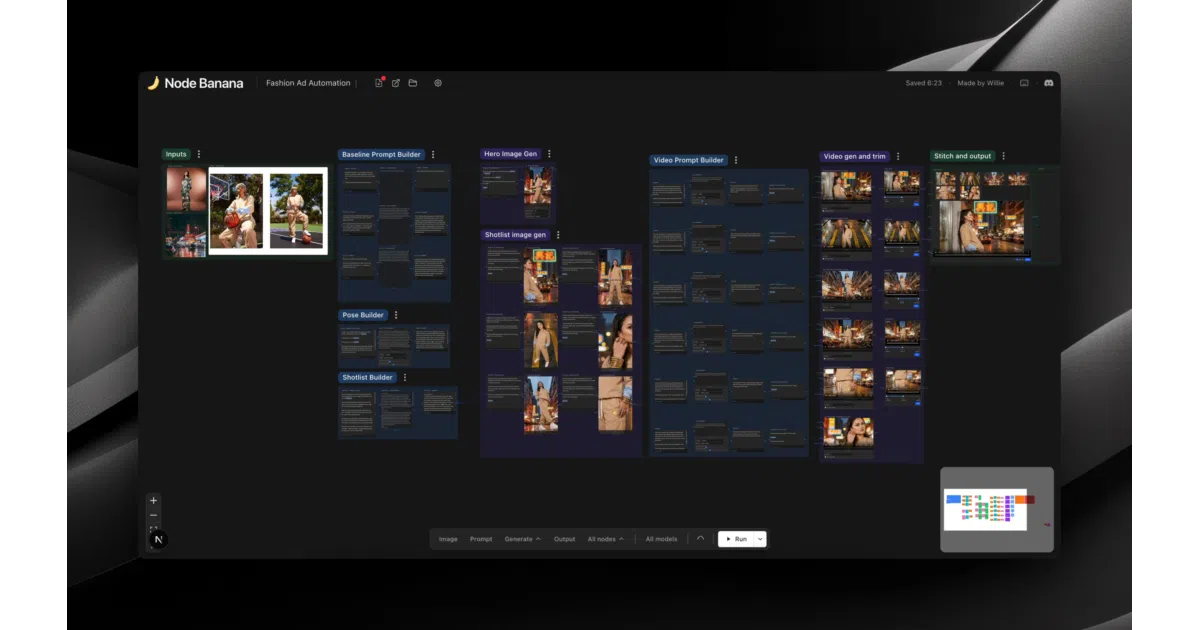
Node Banana lets you chain image, video, audio, and 3D generation across multiple providers on an infinite canvas.
Not currently ranked — collecting fresh signals.
star history
What it does
Node Banana is a local, MIT-licensed visual workflow editor built on Next.js and React Flow. You drag nodes onto a canvas, connect them with typed handles, and run pipelines that call AI APIs in dependency order. It handles image, video, 3D, audio, and text generation across six providers, plus annotation, video editing, and dynamic prompt construction.
The interesting bit
The “Prompt Constructor” node uses LLMs to build prompts from variables and reusable chains, and you can generate entire workflows from natural language descriptions. The author also notes this is “primarily built for my own workflows” — a refreshingly honest scope guard that doubles as fair warning for contributors.
Key highlights
- Multi-provider support: Google Gemini (fully supported), Replicate, fal.ai, Kie.ai, WaveSpeed, and OpenAI (LLM only)
- 20+ node types including video stitch/trim/frame grab, 3D GLB viewer, image annotation with drawing tools, and conditional routing
- Dynamic prompting with variables and LLM-powered text construction
- Workflows export as portable JSON; drag-and-drop to import
- API keys configurable via
.env.localor in-app Project Settings - Built on React Flow, Konva.js for drawing, Zustand for state
Caveats
- Prompt-to-workflow generation requires a Gemini API key; no fallback provider for that feature
- Contributing note: “if a PR conflicts with my plans I’ll politely decline” — coordinate on Discord first for larger changes
Verdict
Worth a spin if you’re juggling multiple AI APIs and want a visual, self-hosted alternative to closed pipeline tools. Skip it if you need a polished SaaS with guaranteed roadmap stability or deep enterprise integrations.
Frequently asked
- What is shrimbly/node-banana?
- Node Banana lets you chain image, video, audio, and 3D generation across multiple providers on an infinite canvas.
- Is node-banana open source?
- Yes — shrimbly/node-banana is open source, released under the MIT license.
- What language is node-banana written in?
- shrimbly/node-banana is primarily written in TypeScript.
- How popular is node-banana?
- shrimbly/node-banana has 1.6k stars on GitHub.
- Where can I find node-banana?
- shrimbly/node-banana is on GitHub at https://github.com/shrimbly/node-banana.