scutcyr/SoulChat
An LLM That Knows When to Nod and When to Give Advice
It exists because purely long-winded advice annoys users, and purely chatty empathy leaves them without guidance—so SoulChat fine-tunes ChatGLM-6B on both.
Not currently ranked — collecting fresh signals.
star history
What it does
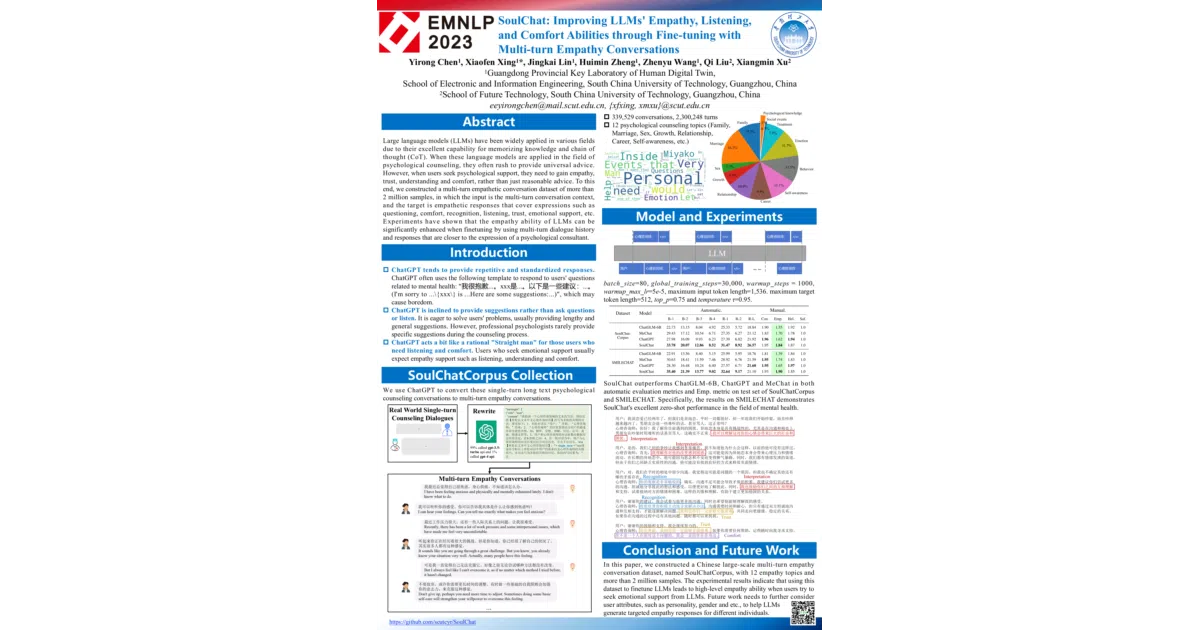
SoulChat is a Chinese-language mental health chatbot built by fine-tuning ChatGLM-6B on a massive blended dataset of psychological counseling text. It aims to do two things at once: provide substantive advice when needed, and maintain a patient, empathetic back-and-forth when the user just needs to vent. The project ships with its own training corpus, SoulChatCorpus, and an academic paper to back up the methodology.
The interesting bit
The researchers identified an awkward tension in AI counseling: models trained only on long, single-turn replies produce walls of text that feel overbearing, while models trained only on multi-turn chit-chat forget how to give concrete guidance. Their fix was to mix both—over 150,000 single-turn Q&A pairs with roughly a million rounds of multi-turn empathetic conversation generated via ChatGPT and GPT-4—and fine-tune on the combined soup. It is a pragmatic admission that good counseling requires both silence and sentences.
Key highlights
- Built on
ChatGLM-6Bwith full-parameter fine-tuning, not just lightweight adapters. - The open-source
SoulChatCorpusrelease contains 258,354 multi-turn dialogues totaling over 1.5 million rounds, after filtering out roughly 90,000 samples for privacy, safety, and quality risks. - Published in Findings of EMNLP 2023, giving it more academic grounding than the average fine-tuned chatbot repo.
- Explicitly targets “proactive health” use cases—chronic stress, breakups, exam anxiety, dorm friction—rather than general chitchat.
- Licensed for non-commercial research only, inherited from the
ChatGLM-6Bbase model.
Caveats
- Output is explicitly described as random and not a substitute for professional psychological diagnosis or treatment; the README repeatedly warns users not to trust or obsess over the model.
- The dataset maintainers are still manually reviewing the ~90,000 filtered samples, so the current open corpus is a scrubbed subset.
- Non-commercial restriction means you cannot legally deploy this in a product or service.
Verdict
Worth a look if you are doing NLP research on empathetic dialogue or building non-commercial Chinese-language mental health prototypes. Skip it if you need a production-ready, commercially licensable therapy bot—this is a research artifact with a safety disclaimer, not a digital psychiatrist.
Frequently asked
- What is scutcyr/SoulChat?
- It exists because purely long-winded advice annoys users, and purely chatty empathy leaves them without guidance—so SoulChat fine-tunes ChatGLM-6B on both.
- Is SoulChat open source?
- Yes — scutcyr/SoulChat is open source, released under the Apache-2.0 license.
- What language is SoulChat written in?
- scutcyr/SoulChat is primarily written in Python.
- How popular is SoulChat?
- scutcyr/SoulChat has 769 stars on GitHub.
- Where can I find SoulChat?
- scutcyr/SoulChat is on GitHub at https://github.com/scutcyr/SoulChat.