ryouchinsa/Rectlabel-support
A Mac-native image annotator that ships SAM 3 on your laptop
RectLabel is a commercial macOS app whose support repo reveals an unusually deep stack of offline ML models for labeling images and video.
Not currently ranked — collecting fresh signals.
star history
What it does RectLabel is an offline image annotation tool for object detection and segmentation, distributed as a paid Mac app with a free tier. This repository is its public support channel—issues, feature requests, and documentation—rather than open-source code. The README functions as a feature list and marketing page for the App Store downloads.
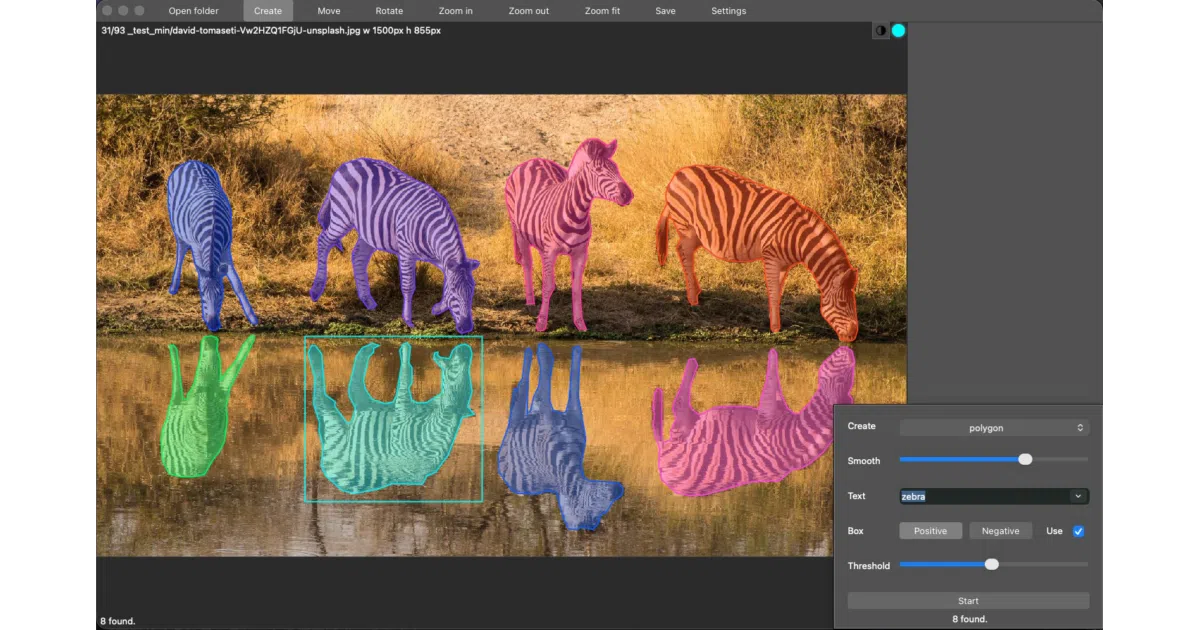
The interesting bit The app integrates a surprising breadth of models locally: Segment Anything 2 and 3 for polygon and pixel labeling, Cellpose for biological segmentation, Core ML models including RF-DETR and YOLO26 for auto-labeling, plus tracking and OCR. That’s a lot of neural network inference running offline on Apple hardware, not a web service with usage caps.
Key highlights
- Supports bounding boxes, polygons, pixels, oriented bounding boxes, cubic Bézier curves, keypoints with skeletons, and point annotations
- Auto-labeling via SAM 3 text/box prompts, SAM 2, Cellpose, Core ML detection models, and a tracking model
- Exports to YOLO, COCO, CreateML, and DOTA formats; also exports indexed color and grayscale masks
- Includes video frame extraction, image augmentation, gallery search across objects/attributes/filenames/memos, and configurable hotkeys
- Two App Store tiers: RectLabel and RectLabel Pro (pricing not listed in repo)
Caveats
- The app is macOS-only and distributed through the App Store, not open source; this repo contains no code to inspect or build from
- “Jupyter Notebook” as the listed repository language is misleading—there appear to be no notebooks in the README
- Several listed features (YOLO26, RF-DETR) are mentioned without version specificity or performance claims
Verdict Mac-owning ML engineers who need offline, format-flexible annotation and want SAM-powered auto-labeling without cloud dependencies should evaluate the free tier. Windows and Linux users, open-source purists, and anyone wanting to self-host or modify the tool are out of luck.
Frequently asked
- What is ryouchinsa/Rectlabel-support?
- RectLabel is a commercial macOS app whose support repo reveals an unusually deep stack of offline ML models for labeling images and video.
- Is Rectlabel-support open source?
- Yes — ryouchinsa/Rectlabel-support is an open-source project tracked on heatdrop.
- What language is Rectlabel-support written in?
- ryouchinsa/Rectlabel-support is primarily written in Jupyter Notebook.
- How popular is Rectlabel-support?
- ryouchinsa/Rectlabel-support has 552 stars on GitHub.
- Where can I find Rectlabel-support?
- ryouchinsa/Rectlabel-support is on GitHub at https://github.com/ryouchinsa/Rectlabel-support.