rupeshs/fastsdcpu
Stable Diffusion for machines that don't have a GPU
It squeezes Stable Diffusion onto CPUs, Intel NPUs, and Raspberry Pis using OpenVINO and distilled one-step models so you don't need a cloud GPU to generate images locally.
Not currently ranked — collecting fresh signals.
star history
What it does
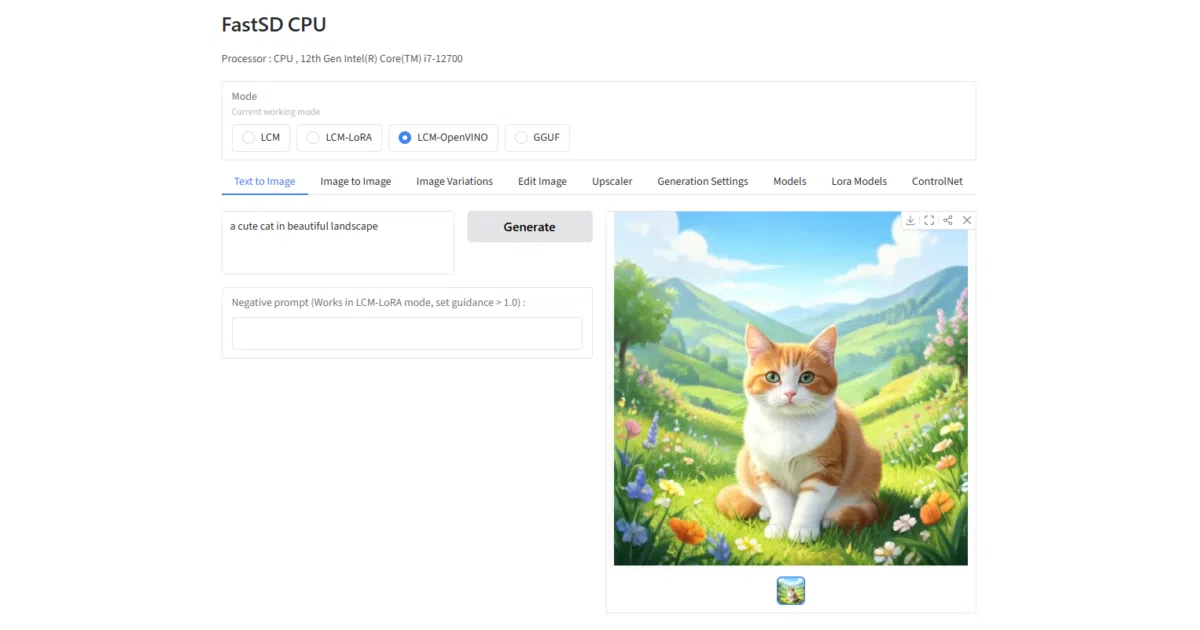
FastSD CPU is a multi-interface Stable Diffusion toolkit built for processors, not graphics cards. It bundles a Qt desktop app, a Gradio web UI, and a CLI into one package, then accelerates inference with OpenVINO and distilled one-step models like SD Turbo and SDXS. The result is local image generation on everything from a Core i7 desktop to a Raspberry Pi 4 or Android phone running Termux.
The interesting bit
The project isn’t just a wrapper around diffusers; it maintains its own converted OpenVINO checkpoints (often INT8-compressed via NNCF) and supports real-time “generate-as-you-type” inference. It also plugs into external ecosystems via a REST API, an MCP server for Claude Desktop, a ComfyUI node, and even an official GIMP plugin.
Key highlights
- Benchmarked at 0.82 seconds for a 512×512 image on a Core i7-12700 using OpenVINO with SDXS-512-0.9 and a tiny autoencoder.
- Supports a wide model zoo: SD 1.5, SDXL, SD Turbo, SDXL-Lightning, Hyper-SD, FLUX.1-schnell, and SANA Sprint, plus LoRA, ControlNet v1.1, and upscalers.
- Runs on Windows, Linux, macOS, Android via Termux, and Raspberry Pi 4, with optional offloading to Intel iGPUs and NPUs.
- Uses Tiny AutoEncoders to shave off roughly 2 GB of RAM and deliver a 1.4× speed boost in supported modes.
- Includes experimental real-time text-to-image that generates while you type.
Caveats
- The fastest advertised model, SDXS-512-0.9, is experimental and only supports text-to-image workflows.
- FLUX.1-schnell via OpenVINO requires roughly 30 GB of system RAM and takes over four minutes per 512×512 image on a Core i7-12700.
- Raising the guidance scale above 1.0 noticeably increases RAM usage and slows inference, which limits fine-grained prompt adherence in some modes.
Verdict
Worth a look if you want local image generation on Intel hardware or low-end machines without a discrete GPU. Skip it if you already have a fast CUDA setup and need production-grade fine-tuning or broad model compatibility.
Frequently asked
- What is rupeshs/fastsdcpu?
- It squeezes Stable Diffusion onto CPUs, Intel NPUs, and Raspberry Pis using OpenVINO and distilled one-step models so you don't need a cloud GPU to generate images locally.
- Is fastsdcpu open source?
- Yes — rupeshs/fastsdcpu is open source, released under the MIT license.
- What language is fastsdcpu written in?
- rupeshs/fastsdcpu is primarily written in Python.
- How popular is fastsdcpu?
- rupeshs/fastsdcpu has 2.2k stars on GitHub.
- Where can I find fastsdcpu?
- rupeshs/fastsdcpu is on GitHub at https://github.com/rupeshs/fastsdcpu.