rivet-dev/actors
Actors with photographic memory and no pod bloat
Rivet is an open-source actor framework that gives every AI agent, chat room, and workflow its own long-running, auto-persisted process, claiming 20 ms cold starts and 0.6 KB memory footprints.
Velocity · 7d
+4.9
★ / day
Trend
↘cooling
star history
What it does
Rivet is an open-source actor framework built in Rust that spawns long-running, lightweight processes for stateful workloads. Each actor keeps state in-memory—persisted automatically to co-located SQLite or an external database—and handles its own queues, workflows, scheduling, and WebSocket broadcasts. You can run it as a local TypeScript library during development, self-host the engine via a single Rust binary or Docker container backed by Postgres or FoundationDB, or offload scaling to Rivet Cloud’s managed global edge network.
The interesting bit
The engine is a Rust monolith split into specialized crates—Pegboard for actor orchestration, Gasoline for durable execution, Guard for traffic routing, and Epoxy, a multi-region KV store built on EPaxos. The README’s benchmark methodology is unusually detailed, breaking down AWS EKS node costs and containerd shim overhead to justify claims of ~20 ms cold starts and ~0.6 KB per-actor memory overhead.
Key highlights
- Claims ~20 ms cold starts and ~0.6 KB memory per actor instance, with methodology comparing Node.js/FoundationDB against Kubernetes pods and EC2 instances.
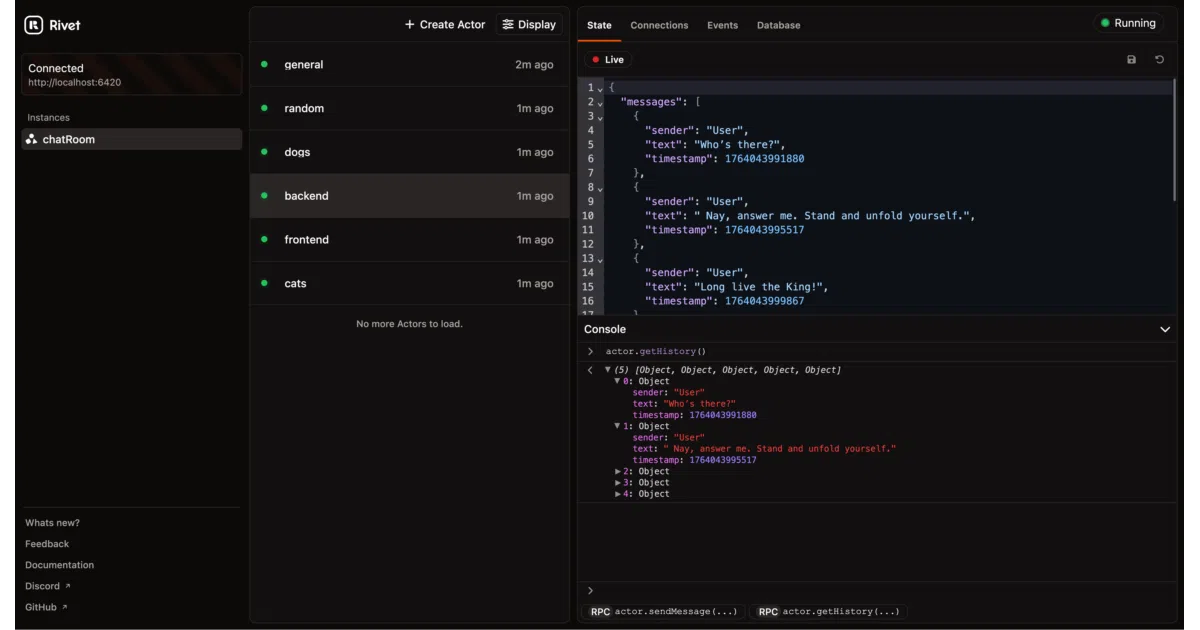
- Built-in observability includes a real-time SQLite viewer, workflow step inspector, event monitor, and REPL.
- Supports multiple runtimes (Node.js, Bun, Deno) and frameworks (React, Next.js, Hono, Express, tRPC) via the TypeScript-first
RivetKit. - Self-hosting options include a single Rust binary or Docker container with Postgres, filesystem, or FoundationDB backends.
- Experimental Rust and Python client libraries ship in the same monorepo.
Caveats
- Rust and Python clients are explicitly marked experimental; the developer experience is TypeScript-first.
- The “$0 idle cost” and “infinite” horizontal scale figures assume Rivet Cloud’s serverless platform, not the self-hosted engine.
Verdict
Worth a look if you need per-user or per-session stateful services—like AI agents or collaborative editors—with Durable Objects-style semantics and open-source portability. Skip it if you require mature non-TypeScript SDKs today or if your stack is strictly stateless.
Frequently asked
- What is rivet-dev/actors?
- Rivet is an open-source actor framework that gives every AI agent, chat room, and workflow its own long-running, auto-persisted process, claiming 20 ms cold starts and 0.6 KB memory footprints.
- Is actors open source?
- Yes — rivet-dev/actors is open source, released under the Apache-2.0 license.
- What language is actors written in?
- rivet-dev/actors is primarily written in Rust.
- How popular is actors?
- rivet-dev/actors has 6.1k stars on GitHub and is currently cooling off.
- Where can I find actors?
- rivet-dev/actors is on GitHub at https://github.com/rivet-dev/actors.