ringhyacinth/Star-Office-UI
Your AI agents now have a pixel office and a commute
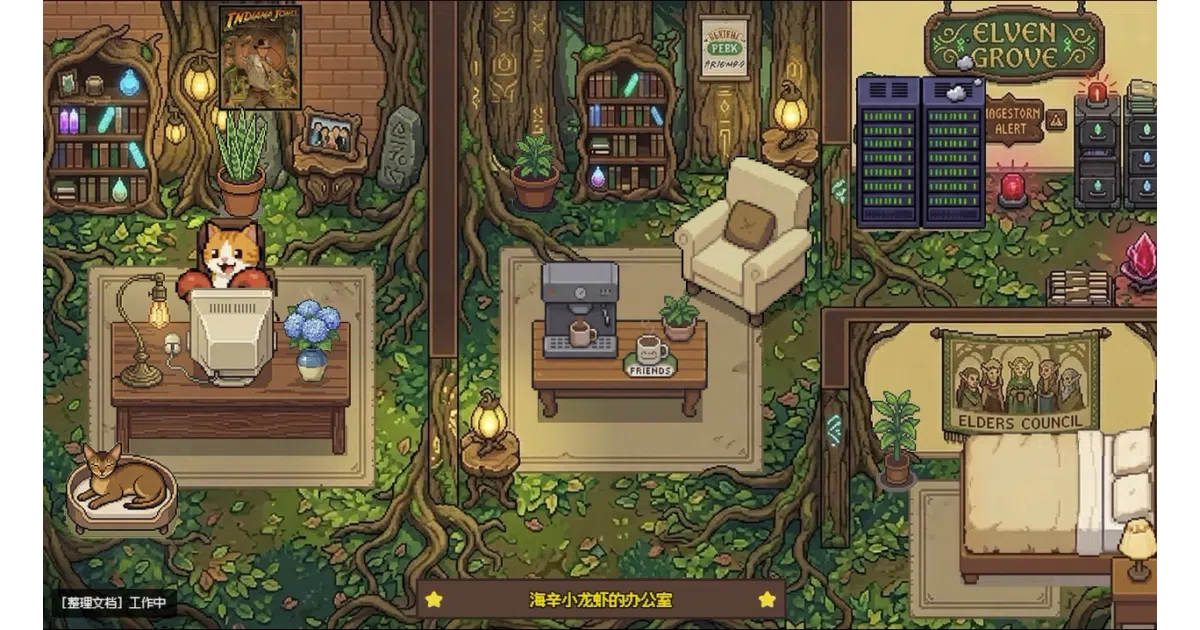
A Flask + Phaser dashboard that turns invisible agent states into a little pixel-art workspace you can actually watch.
Not currently ranked — collecting fresh signals.
star history
What it does
Star Office UI is a browser-based status board: agents report states like writing, researching, or error, and little pixel characters walk to matching zones—desk, couch, or bug corner. It reads yesterday’s work from local markdown files, supports multi-agent rooms via join keys, and speaks Chinese, English, and Japanese. There’s also an optional Electron wrapper if you want the office floating on your desktop like a pet.
The interesting bit The whole thing is essentially a state-to-animation mapper with a Flask backend and a Phaser frontend. The cleverness is in the social layer: agents push HTTP state updates, and the office becomes a shared context. It’s Tamagotchi for infrastructure—cute, but the cuteness is functional, because “who is stuck in the bug zone” is faster to parse than a wall of logs.
Key highlights
- Six states map to three office zones with real-time sprite animation and speech bubbles
- Multi-agent “offices” via join keys (default limit 3 concurrent per key)
- “Yesterday memo” auto-populated from
memory/*.mdfiles, with claimed de-identification - AI-generated background art via Gemini API (optional; core features work without it)
- Mobile layout, Cloudflare Tunnel docs, and skeleton-screen loading included
- Desktop pet mode: Electron wrapper, macOS-tested, auto-launches Python backend
Caveats
- Art assets are explicitly non-commercial; commercial use requires replacing all sprites
- Desktop pet build is labeled “experimental” and macOS-primary
- Requires Python 3.10+ due to union type syntax; 3.9 is out
Verdict Grab this if you run OpenClaw or similar agent frameworks and want a low-friction team presence tool. Skip it if you need hard operational metrics—this is a social signal layer, not a monitoring stack.
Frequently asked
- What is ringhyacinth/Star-Office-UI?
- A Flask + Phaser dashboard that turns invisible agent states into a little pixel-art workspace you can actually watch.
- Is Star-Office-UI open source?
- Yes — ringhyacinth/Star-Office-UI is an open-source project tracked on heatdrop.
- What language is Star-Office-UI written in?
- ringhyacinth/Star-Office-UI is primarily written in HTML.
- How popular is Star-Office-UI?
- ringhyacinth/Star-Office-UI has 7.3k stars on GitHub.
- Where can I find Star-Office-UI?
- ringhyacinth/Star-Office-UI is on GitHub at https://github.com/ringhyacinth/Star-Office-UI.