reiinakano/xcessiv
Stacking models without the Kaggle-grade headache
A web UI that handles the plumbing for stacked ensembles so you can focus on the models, not the meta-features.
Not currently ranked — collecting fresh signals.
star history
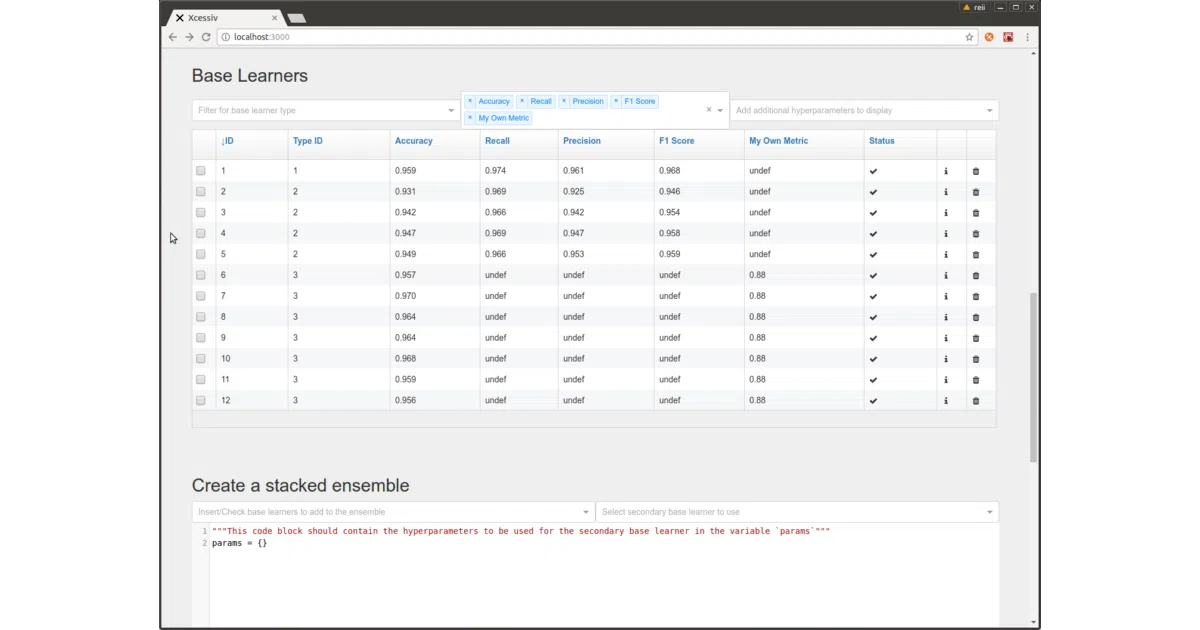
What it does Xcessiv is a web-based Python tool for building stacked ensembles — feeding predictions from multiple base learners into another model — plus hyperparameter search and model comparison. It wraps the scikit-learn API, tracks hundreds of model-hyperparameter combinations, and exports the final stack as a standalone Python file.
The interesting bit The project explicitly targets a pain point the README calls “impractical to apply outside of Kaggle competitions”: proper stacked generalization requires careful cross-validated meta-feature generation, and Xcessiv automates that plumbing while still letting you define data sources, metrics, and learners in raw Python code.
Key highlights
- Any scikit-learn-compatible model works as a base learner
- Task-queue architecture for parallel hyperparameter search across multiple cores
- Bayesian optimization for automated hyperparameter tuning
- Direct TPOT integration for automated pipeline construction
- Greedy forward model selection for automated ensemble construction
- Supports both cross-validated stacked generalization and holdout-set blending
Caveats
- The project is explicitly alpha and unstable; future versions may break backwards compatibility with existing project files
- Development appears early-stage; the README asks for community guidance on direction
Verdict Worth a look if you routinely stack models or want a web UI to manage large hyperparameter search grids. Skip it if you need production stability today or your ensembles are simple enough to hand-roll in a notebook.
Frequently asked
- What is reiinakano/xcessiv?
- A web UI that handles the plumbing for stacked ensembles so you can focus on the models, not the meta-features.
- Is xcessiv open source?
- Yes — reiinakano/xcessiv is open source, released under the Apache-2.0 license.
- What language is xcessiv written in?
- reiinakano/xcessiv is primarily written in Python.
- How popular is xcessiv?
- reiinakano/xcessiv has 1.3k stars on GitHub.
- Where can I find xcessiv?
- reiinakano/xcessiv is on GitHub at https://github.com/reiinakano/xcessiv.