rasbt/pattern_classification
Pattern classification deconstructed, notebook by notebook
A curated syllabus of Jupyter notebooks that teaches machine learning end-to-end, leaving the math intact.
Not currently ranked — collecting fresh signals.
star history
What it does
This repository is a curated index of IPython notebooks, PDFs, and markdown files that covers the full machine-learning workflow. It links out to tutorials on pre-processing (feature encoding, scaling, PCA), classical algorithms (Naive Bayes, logistic regression, single-layer neural networks), and model-evaluation metrics. The collection also includes practical data-scraping walkthroughs—fantasy-soccer stats, Twitter timelines, and MNIST ingestion—plus visualization examples built on Matplotlib.
The interesting bit
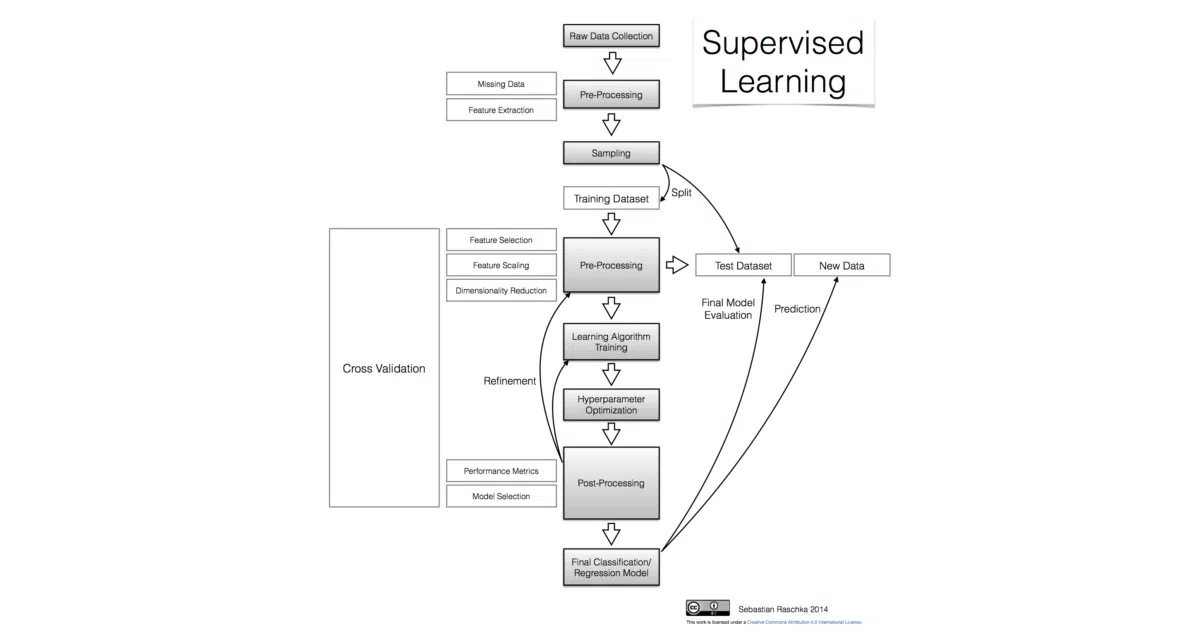
The repo functions less like a library and more like a structured curriculum, pairing statistical theory with scikit-learn code. It explicitly ties to Sebastian Raschka’s Python Machine Learning book and even offers a downloadable supervised-learning flowchart, treating pedagogy as the product.
Key highlights
- Covers the full pipeline: feature extraction, dimensionality reduction (PCA, LDA, kernel PCA), parameter estimation, and cross-validation.
- Balances theory and practice, with notebooks on maximum-likelihood estimation and Parzen-window density estimation alongside
scikit-learnensemble methods. - Includes data-collection tutorials—scraping with Beautiful Soup, Twitter word clouds, and reading MNIST into
NumPy. - Provides a supervised-learning flowchart as a downloadable PDF.
- Authored by Sebastian Raschka and cross-linked to his Python Machine Learning book repository.
Caveats
- The README lists several outline sections—such as density-based clustering, graph-based clustering, and non-linear regression—that are named but contain no linked content.
- Most notebooks are rendered via external nbviewer URLs rather than being runnable directly in the repository.
- The README itself is truncated, so the full scope of the later sections (Talks, Applications, Resources) is unclear from the source.
Verdict
Best for developers or students who want a structured, classical introduction to ML concepts and scikit-learn patterns. Look elsewhere if you need a maintained installable package or copy-paste utilities; this is a reading list, not a framework.
Frequently asked
- What is rasbt/pattern_classification?
- A curated syllabus of Jupyter notebooks that teaches machine learning end-to-end, leaving the math intact.
- Is pattern_classification open source?
- Yes — rasbt/pattern_classification is open source, released under the GPL-3.0 license.
- What language is pattern_classification written in?
- rasbt/pattern_classification is primarily written in Jupyter Notebook.
- How popular is pattern_classification?
- rasbt/pattern_classification has 4.2k stars on GitHub.
- Where can I find pattern_classification?
- rasbt/pattern_classification is on GitHub at https://github.com/rasbt/pattern_classification.