pzqpzq/Principia
A GitHub-Native Knowledge Layer for Scientific Discovery
Principia turns scientific literature and private notes into durable, composable principles so researchers can inspect evidence and build hypotheses without starting from raw papers every time.
Velocity · 7d
+28
★ / day
Trend
↗accelerating
star history
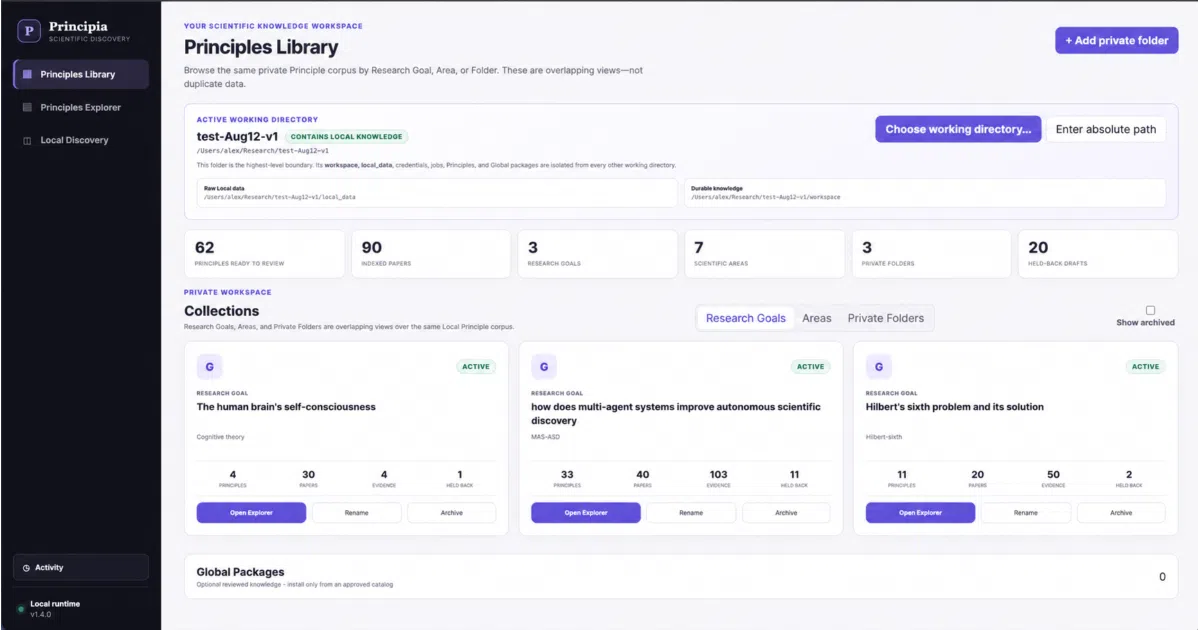
What it does Principia is an open-source Python framework that treats scientific literature as a mine for reusable Principles—compact arguments that carry their own claims, boundaries, evidence, and falsifiability tests. It organizes these into versioned Area packages (Global Cloud), mixes in private user materials (Local Map), and supports temporary counterfactual assumptions (Scenario Layer) to generate and inspect research hypotheses. A built-in Library, Explorer, and Inspector let users search, graph, and compare Principles without ever uploading private data to a hosted backend.
The interesting bit
The architecture deliberately rejects the usual SaaS model: public knowledge reaches users through GitHub-hosted .pcp packages, while private folders and credentials remain strictly offline. This creates a non-destructive overlay where Global, Local, and Scenario layers combine into one searchable, traceable reasoning substrate.
Key highlights
- Principles are structured scientific objects, not paper summaries—each records scope, evidence state, testability, and typed relations like
supports,contradicts, ordepends_on. - Three strictly separated layers (Global, Local, Scenario) let users reason counterfactually without mutating canonical knowledge.
- The current seed catalog is tiny but illustrative: 62 Principles and 36 relations across three Areas (MAS-ASD, Hilbert, Cognitive), distributed as compact
.pcppackages containing SQLite databases. - Local Discovery ingests private documents through deterministic indexing or LLM-assisted extraction, with explicit model policies including a
no_llmoption. - All search, graph exploration, and Scenario analysis happen locally; the project deliberately avoids a paid hosted backend entirely.
Caveats
- The entire public Cloud is currently a seed of just 62 Principles across three packages, and every entry is explicitly labeled an “Unassessed Candidate” awaiting human review.
- The README is truncated mid-sentence during the model policy table, leaving some Local Discovery behavior unclear.
- Because it is a knowledge lifecycle tool rather than an answer engine, Principia does not claim that retrieved Principles automatically solve problems; it merely supplies a structured substrate for manual composition and inspection.
Verdict Researchers drowning in paper summaries but hungry for structured, reusable arguments should experiment with the Local Discovery layer. If you are looking for an automated hypothesis generator that skips human inspection, this is explicitly not it.
Frequently asked
- What is pzqpzq/Principia?
- Principia turns scientific literature and private notes into durable, composable principles so researchers can inspect evidence and build hypotheses without starting from raw papers every time.
- Is Principia open source?
- Yes — pzqpzq/Principia is open source, released under the Apache-2.0 license.
- What language is Principia written in?
- pzqpzq/Principia is primarily written in Rich Text Format.
- How popular is Principia?
- pzqpzq/Principia has 1.1k stars on GitHub and is currently accelerating.
- Where can I find Principia?
- pzqpzq/Principia is on GitHub at https://github.com/pzqpzq/Principia.