prs-eth/OverlapPredator
Teaching point clouds to find common ground when they barely share any
PREDATOR registers 3D point clouds that share only a sliver of overlap, using attention to focus on the matching regions instead of wasting compute on the rest.
Not currently ranked — collecting fresh signals.
star history
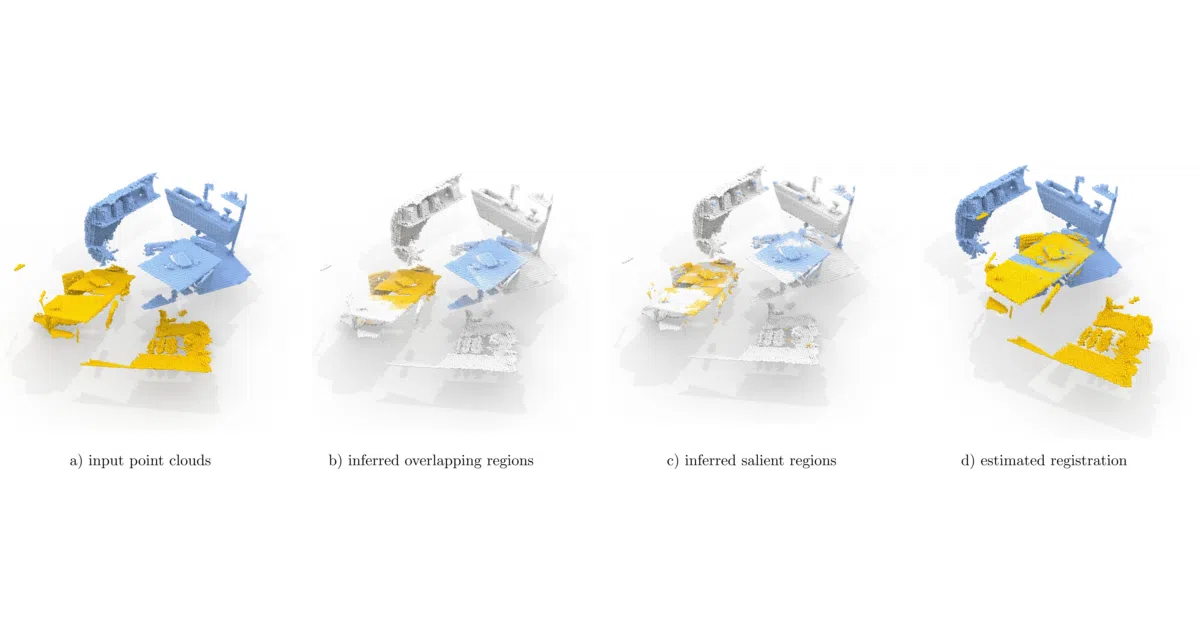
What it does PREDATOR aligns pairs of 3D point clouds into a single coordinate frame, even when the two scans share only a small overlapping region. It predicts which points lie in that shared sliver, extracts features, and estimates a rigid transformation via RANSAC. The repo ships with training and evaluation code for indoor 3DMatch, outdoor KITTI, and synthetic ModelNet scenes, plus pretrained weights for each domain.
The interesting bit Rather than processing every point with equal zeal, the network deploys a transformer-style attention module—acknowledged debt to SuperGlue—to highlight points that actually appear in both scans. This selective focus on the overlap region is what lets the model succeed on benchmarks like 3DLoMatch where conventional registration methods typically struggle.
Key highlights
- Official CVPR 2021 Oral implementation from ETH Zurich.
- Supports indoor, outdoor, and synthetic datasets with downloadable pretrained models.
- Ships with a demo script that visualizes inferred overlap regions and the final aligned point clouds.
- A faster sparse-convolution variant built on MinkowskiEngine lives in a separate repository.
- The authors candidly note that RANSAC randomness can cause rotation and translation errors to drift from the paper’s reported numbers.
Caveats
- The README warns of random data-loader crashes caused by memory pressure; you may need to reduce worker counts or increase CPU RAM.
- A feature-gathering bug in the k-NN graph was fixed in June 2021, so forks based on earlier commits may show degraded performance.
Verdict Grab it if you are stitching together partial 3D scans—say, in SLAM or reconstruction—where overlap is minimal. If your scans already share most of their geometry, classic ICP will save you a lot of PyTorch versioning grief.
Frequently asked
- What is prs-eth/OverlapPredator?
- PREDATOR registers 3D point clouds that share only a sliver of overlap, using attention to focus on the matching regions instead of wasting compute on the rest.
- Is OverlapPredator open source?
- Yes — prs-eth/OverlapPredator is open source, released under the MIT license.
- What language is OverlapPredator written in?
- prs-eth/OverlapPredator is primarily written in Python.
- How popular is OverlapPredator?
- prs-eth/OverlapPredator has 606 stars on GitHub.
- Where can I find OverlapPredator?
- prs-eth/OverlapPredator is on GitHub at https://github.com/prs-eth/OverlapPredator.