principia-ai/WriteHERE
An AI writing engine that actually plans like a human
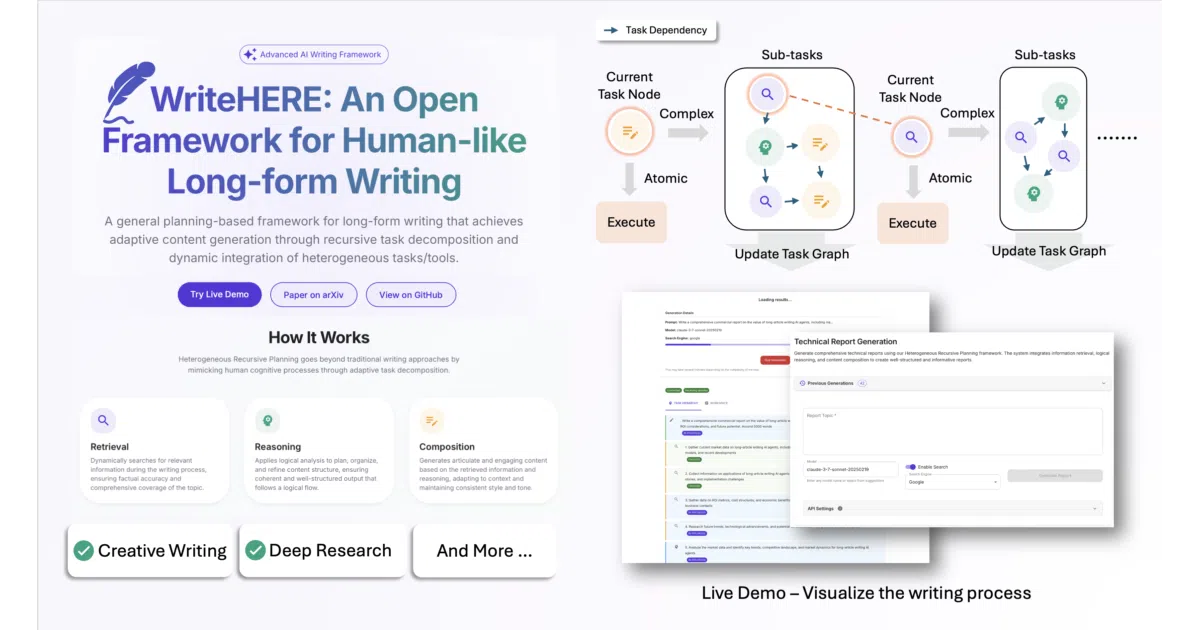
WriteHERE replaces rigid AI writing pipelines with recursive, heterogeneous task decomposition that adapts mid-process.
Not currently ranked — collecting fresh signals.
star history
What it does
WriteHERE is a Python framework for long-form writing—fiction or technical reports—that breaks tasks down recursively and interleaves planning with execution. It runs as a backend engine or with a React frontend that visualizes the agent’s “thinking process” in real time. You feed it a prompt file, pick a model (GPT-4o, Claude 3 Sonnet, etc.), and choose story or report mode.
The interesting bit
Most AI writing tools lock you into a fixed outline-then-draft pipeline. WriteHERE’s engine (recursive/engine.py) decomposes tasks on the fly, mixing retrieval, reasoning, and composition steps as needed. The frontend renders this as a live task graph—handy for watching an agent wander down a wrong branch before correcting itself.
Key highlights
- Supports both creative fiction and technical report generation, with search integration via SerpAPI for the latter
- Real-time web visualization of hierarchical task decomposition and status
- Transparent operation: all agent decisions and prompts are exposed, not black-boxed
- One-script setup (
./start.sh) spins up backend (port 5001) and frontend (port 3000) - EMNLP 2025 oral paper backing the approach; MIT licensed and explicitly non-commercial
Caveats
- Requires API keys for OpenAI, Anthropic, and SerpAPI; no local model support mentioned
- Python 3.6+ and Node.js 14+ prerequisites, plus dependency wrangling that merits a dedicated Anaconda script
- The README claims it “consistently outperforms state-of-the-art methods” but offers no actual metrics or benchmark names
Verdict
Worth a look if you’re researching agentic writing workflows or want a transparent, hackable alternative to closed AI writing tools. Skip it if you need offline-only operation or are allergic to API costs and Node.js frontend setups.
Frequently asked
- What is principia-ai/WriteHERE?
- WriteHERE replaces rigid AI writing pipelines with recursive, heterogeneous task decomposition that adapts mid-process.
- Is WriteHERE open source?
- Yes — principia-ai/WriteHERE is an open-source project tracked on heatdrop.
- What language is WriteHERE written in?
- principia-ai/WriteHERE is primarily written in Python.
- How popular is WriteHERE?
- principia-ai/WriteHERE has 974 stars on GitHub.
- Where can I find WriteHERE?
- principia-ai/WriteHERE is on GitHub at https://github.com/principia-ai/WriteHERE.