pikpikcu/airecon
A Local LLM Agent That Actually Pentests Your Network
Built to automate security assessments and bug bounty recon without shipping target data to cloud LLMs or burning API credits.
Not currently ranked — collecting fresh signals.
star history
What it does
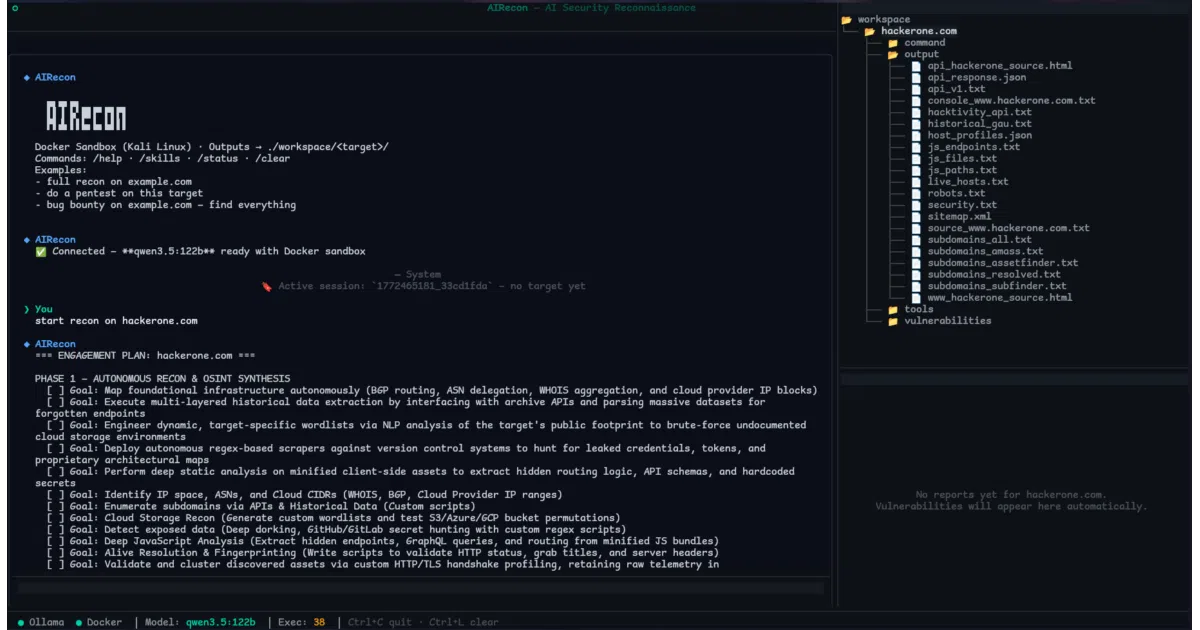
AIRecon is an autonomous penetration-testing agent that chains a local Ollama LLM to a Kali Linux Docker sandbox. It drives a RECON → ANALYSIS → EXPLOIT → REPORT pipeline through a Textual TUI, orchestrating browser automation, fuzzers, SAST scanners, and a Caido proxy entirely on your own hardware. The goal is hands-off reconnaissance and vulnerability discovery without API keys or cloud dependencies.
The interesting bit
Its “learning” is not model fine-tuning but structured local telemetry: a SQLite memory database, per-target intel files, and adaptive tool rankings based on historical success and failure. The agent also queries an optional local FTS5 index of roughly 1.09 million security records—CVEs, nuclei templates, CTF writeups—before attempting unfamiliar techniques, which keeps reasoning grounded in actual indexed data rather than hallucinated confidence.
Key highlights
- Runs fully offline with self-hosted Ollama models; no target data leaves the machine.
- Soft phase enforcement guides the agent through recon, analysis, exploit, and report stages without hard gates.
- Native Caido proxy integration with five built-in tools for traffic replay, fuzzing, and scope management.
- Optional local knowledge base (
airecon-dataset) indexes ~1.09M security records for autonomous lookup. - Includes 57 built-in skill files and 289 keyword-to-skill mappings, extendable via the community
airecon-skillslibrary.
Caveats
- Requires an Ollama model with reliable native tool-calling support; without it, the agent is effectively non-functional. DeepSeek R1 is explicitly noted to produce incomplete function calls.
- The README warns that models below 8B parameters frequently hallucinate tool output, invent CVEs, and ignore scope rules; the recommended minimum is 9B, with 35B suggested for most users.
- Long autonomous sessions may strain limited hardware, and the Colab fallback option carries session-length limits and changing tunnel URLs.
Verdict
Worth a look for bug bounty hunters and red-teamers who want to automate recon against internal or sensitive targets without cloud exposure. Skip it if you expect production-grade reliability from small local models or lack the GPU VRAM to run a 9B+ parameter model comfortably.
Frequently asked
- What is pikpikcu/airecon?
- Built to automate security assessments and bug bounty recon without shipping target data to cloud LLMs or burning API credits.
- Is airecon open source?
- Yes — pikpikcu/airecon is open source, released under the MIT license.
- What language is airecon written in?
- pikpikcu/airecon is primarily written in Python.
- How popular is airecon?
- pikpikcu/airecon has 1.1k stars on GitHub.
- Where can I find airecon?
- pikpikcu/airecon is on GitHub at https://github.com/pikpikcu/airecon.