pgrundev/pgbot
Postgres triage in one binary: read-only, baseline-aware, agent-ready
It exists to deliver a point-in-time Postgres diagnosis from a single static binary, no write privileges or external services required.
Velocity · 7d
+3.4
★ / day
collecting data…
star history
What it does
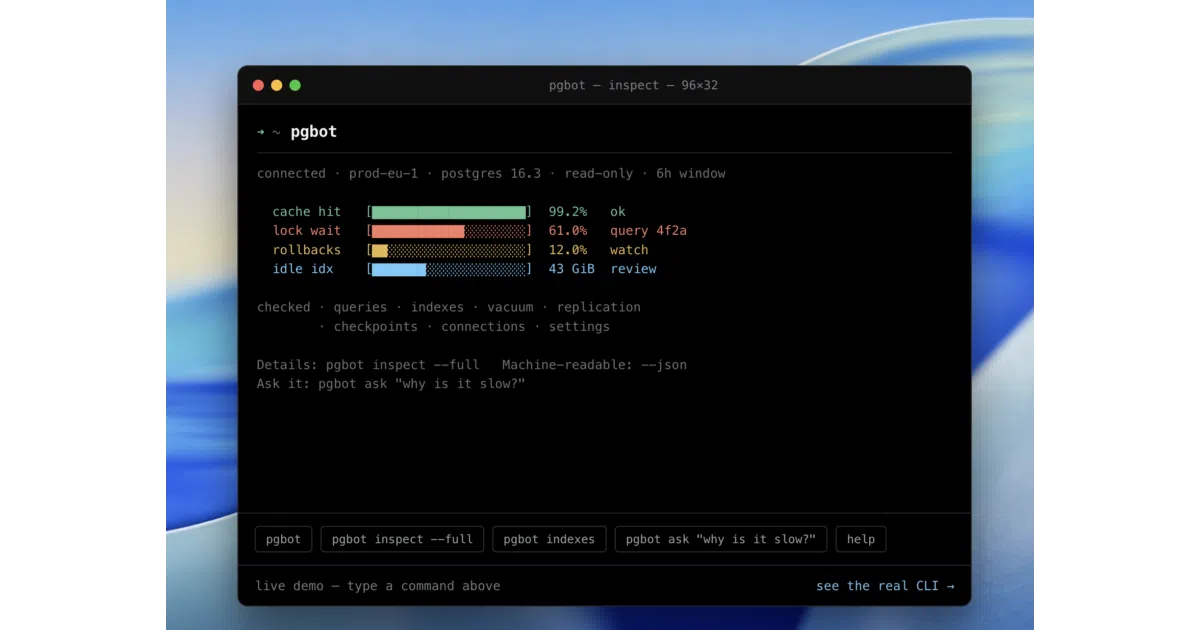
pgbot is a single static binary that connects to PostgreSQL 14–18 through a read-only pg_monitor role and prints a graded health report. It buckets findings into CRITICAL, WARNING, and GOOD lists so you see both what hurts and what was actually verified. After the first run it keeps a local baseline, so subsequent checks highlight what changed—queries that slowed, indexes that went idle, tables that started scanning sequentially.
The interesting bit
The tool treats AI as a translator, not a fortune-teller: every finding is computed deterministically in Go from Postgres’s own statistics views, and the optional ask/explain layer merely puts plain language on top. That discipline makes it safe to hand to agents—a versioned JSON contract and an MCP server expose the same structured, PII-free findings without scraping terminal output.
Key highlights
- Read-only by role, not by wishful thinking—
pg_monitor,BEGIN READ ONLY, and session timeouts are defense in depth. - Baseline memory: local snapshots let it report deltas (regressions, new bloat) rather than one-off snapshots.
- Fully offline core: deterministic inspection needs no API keys; the AI layer is strictly optional.
- Agent-native: versioned JSON schema and MCP interface for scripts and LLMs that need structured, stable data.
- CI-friendly exit codes and machine formats including SARIF and JUnit.
Caveats
- Explicitly beta. The human-readable report is not a stable API—rely on the versioned
--jsoncontract. - PostgreSQL 14–15 support is best-effort; collectors degrade gracefully on older feature sets.
- Index-usage stats are per-node, so an “unused” index on a primary may still be active on a replica.
Verdict
Use it for fast, portable Postgres triage in CI, on a laptop, or inside an agent workflow. If you need long-term dashboards, alerting, or multi-host rollups, stay with a full monitoring platform like pganalyze or PMM.
Frequently asked
- What is pgrundev/pgbot?
- It exists to deliver a point-in-time Postgres diagnosis from a single static binary, no write privileges or external services required.
- Is pgbot open source?
- Yes — pgrundev/pgbot is an open-source project tracked on heatdrop.
- What language is pgbot written in?
- pgrundev/pgbot is primarily written in Go.
- How popular is pgbot?
- pgrundev/pgbot has 1.4k stars on GitHub.
- Where can I find pgbot?
- pgrundev/pgbot is on GitHub at https://github.com/pgrundev/pgbot.